Romsdal Museum
Most museums have a building. The Romsdal Museum has a coastline. Founded in 1912 by Peter Tonder Solemdal and opened to the public in 1928, it has grown into one of Norway's largest folk museums -- not by expanding a single campus, but by absorbing an entire region's worth of historical sites. Its departments stretch from the Molde archipelago to the inner fjords, from a medieval church on the island of Veoya to a German coastal fort at Bud, from a childhood parsonage of a Nobel laureate to a clothing factory frozen in its 1960s prime. To visit the Romsdal Museum fully is to visit Romsdal itself.
Forty Buildings on a Farm
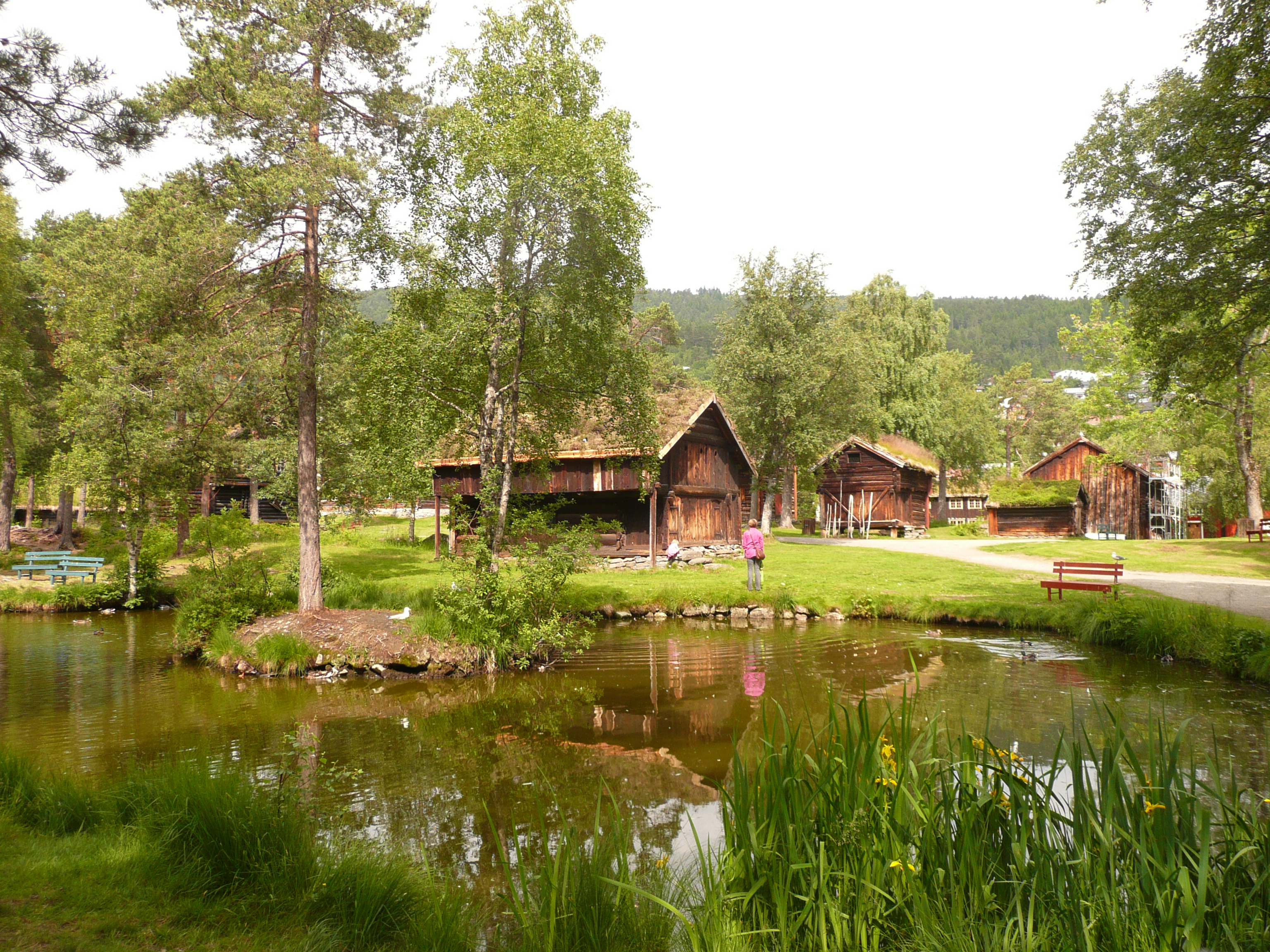
The museum's main campus occupies the former Reknes farm in Molde, where more than forty historic buildings have been reassembled from sites across the Romsdal region. Barns, farmhouses, stables, and workshops dating from the sixteenth to the twentieth century stand along paths that wind past a recreated city street showing what Molde looked like before a devastating fire in 1916. The indoor collection spans from Mesolithic-era findings through artifacts from the German occupation in World War II. In the center of the grounds sits the old Isdammen, once used for ice production, now the heart of a lake that attracts local birdlife. A stage beside it hosts performances during Moldejazz, the Molde International Jazz Festival. The museum's newest building, Krona, houses an art collection, archives of historical photographs, and a permanent exhibition tracing how people in the region have lived through different eras.
Islands and Fortifications
On the island of Hjertoya, reachable by water taxi from Molde, the Fishing Museum recreates coastal life through a collection of fifteen buildings arranged as a maritime community from the 1700s and 1800s. Boats, nets, and drying racks conjure the rhythms of a world oriented entirely toward the sea. Farther along the coast, the Bud Museum at Ergan Coastal Fort preserves a restored German fortification from World War II. The command centre, cannon positions, sickbay, and water reservoir are all carved into the rock, a reminder that this coastline has been contested territory. The fort sits near the village of Bud, where the Atlantic Ocean Road begins its spectacular island-hopping journey south.
A Poet's Parsonage
In the former Nesset Municipality, the museum oversees a parsonage in Eidsvag that was the childhood home of Bjornstjerne Bjornson -- national poet of Norway and recipient of the Nobel Prize in Literature in 1903. Bjornson's early years in this fjord-country parsonage shaped the sensibility of a writer who would go on to pen the Norwegian national anthem. Since 1992 the site has hosted Bjornsonfestivalen, an annual international literature festival held each August. The festival was founded by author Knut Odegard in connection with Molde's 250-year anniversary, and it draws writers and readers from across Scandinavia and beyond to the quiet grounds where one of Norway's most celebrated voices first heard the language he would transform.
Medieval Stone and Wartime Thread
The Old Veoy Church and Vicarage, dating to the late twelfth century, stand on the island of Veoya -- once an important medieval trading center. The church is among the oldest surviving structures in the region, a stone testament to how long this fjord has attracted settlement and commerce. At the opposite end of the temporal spectrum, the Museum of Apparel in Isfjorden preserves Oddfred Tokles konfeksjonsfabrikk, a clothing factory that operated from 1938 to 1982. Its authentic 1960s environment -- sewing machines, cutting tables, finished garments -- captures an era when small-scale manufacturing still defined Norwegian towns. On the island of Gossen in Aukra Municipality, the Lovikremma Farm Museum preserves a traditional coastal farm from the late nineteenth century, complete with dwelling houses, barn, raised food store, and peat shed.
From the Air
The Romsdal Museum's main campus is in Molde at 62.74N, 7.15E, on the north shore of the Romsdalsfjord. The museum's scattered sites span the entire Romsdal coast and fjord region. Molde Airport Aro (ENML) is approximately 5 km east of the main campus. The Hjertoya fishing museum is visible as a small island in the Molde archipelago just offshore. Best viewed at 3,000-5,000 ft for the main campus area.