Ronda
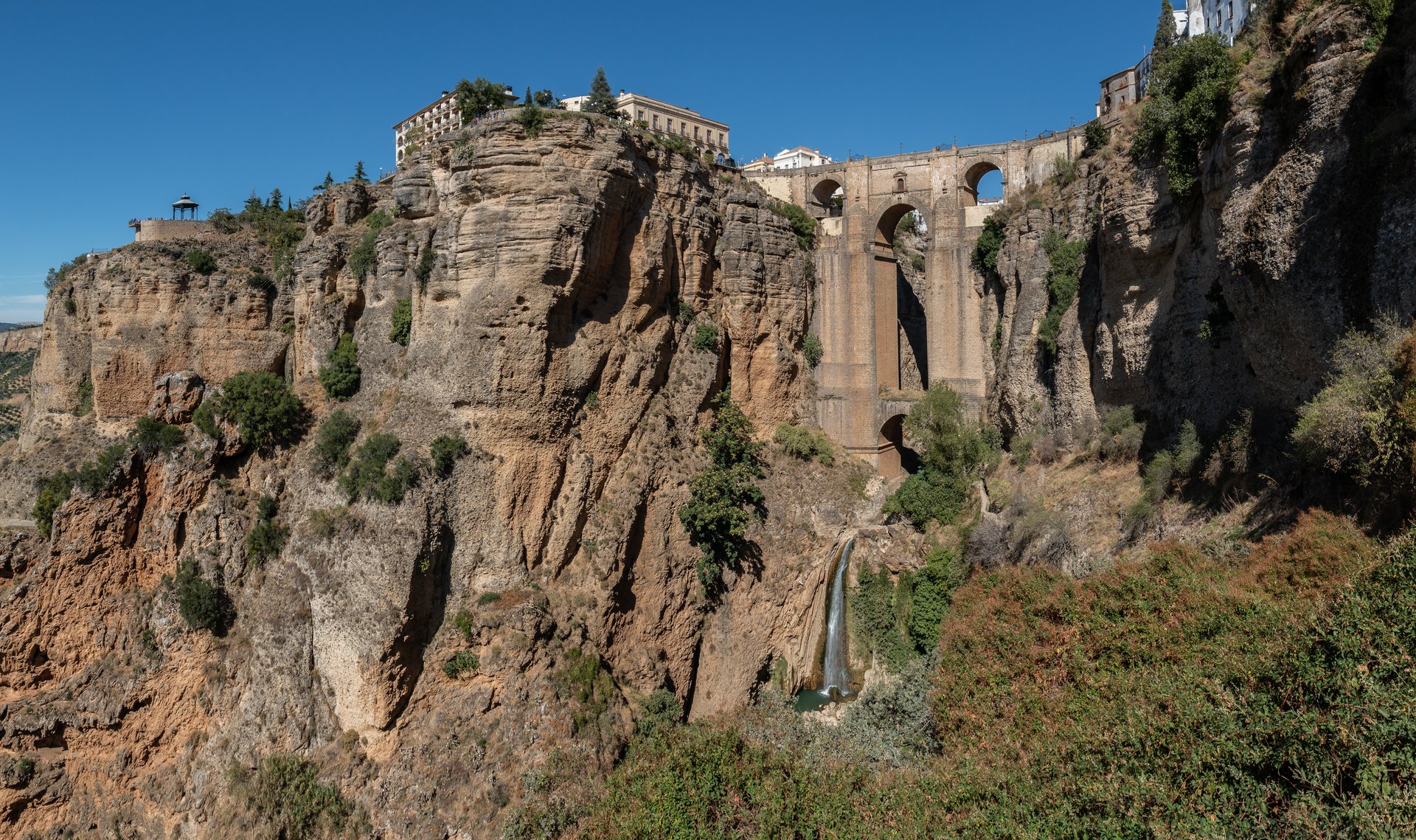
Ernest Hemingway set the execution scene in Chapter 10 of For Whom the Bell Tolls in Ronda, and the choice was not arbitrary. The town sits on the rim of El Tajo, a gorge that drops more than 100 meters to the Guadalevin River below, and during the Spanish Civil War prisoners were thrown from its edge. That violence belongs to another century, but the gorge still defines the town. Puente Nuevo, the "New Bridge" completed in 1793 after 34 years of construction, spans the chasm and separates Ronda's modern Mercadillo quarter from La Ciudad, the old Moorish district where narrow streets twist through seven centuries of layered history.
Layers of Conquest
Ronda's strategic position on its limestone plateau attracted settlers early. Celts came first, followed by Phoenicians, Greeks, and Romans. But the Moors left the deepest imprint, ruling for nearly eight centuries until the Christian Reconquista under Ferdinand and Isabella finally took the city in 1485. La Ciudad, the old Moorish quarter, survives largely intact -- its narrow alleys, Arab baths, and whitewashed walls a living museum of Islamic Iberia. The transition from Moorish to Christian rule was less a replacement than a palimpsest: churches were built on mosque foundations, and the architecture of both traditions shares walls throughout the old quarter.
The Bridge and the Abyss
Puente Nuevo is Ronda's icon, an arched stone bridge rising 98 meters above the gorge floor. Its architect, Martin de Aldehuela, did not live to see it finished -- he died in 1802, nine years after its completion. A small chamber inside the bridge above the central arch once served as a prison. The bridge connects the Mercadillo, where the bus and train stations cluster alongside shops and restaurants, to La Ciudad across the gorge. Walking from one side to the other takes only minutes, but the cultural distance spans centuries. On the modern side, pedestrian shopping streets and hotels; on the old, the Barrio de San Francisco and winding lanes where non-resident cars are simply not allowed.
A Writers' Town
Ronda has drawn writers like few other Spanish towns its size. Hemingway spent time here and made the town a presence in his fiction. Orson Welles loved it so much that his ashes were scattered on the estate of his friend Antonio Ordonez, the bullfighter. James Joyce visited, and the German poet Rainer Maria Rilke stayed at a hotel overlooking El Tajo, writing some of his Spanish Letters. A stone memorial to Rilke, topped with a stylized pen nib, stands at the highest point of the mountain road from Marbella, 1,125 meters above sea level. The road itself, the A-376, is one of Andalusia's great scenic drives, its hairpin curves climbing through the mountains of the Costa del Sol's interior before descending to Ronda's plateau.
Beyond the Gorge
Ronda serves as a hub for exploring the pueblos blancos -- the white villages scattered through the mountains of western Malaga province. Bus services connect to Montejaque, Benaojan, and Zahara la Sierra, villages where daily life still moves at a pace the Costa del Sol forgot decades ago. The surrounding countryside is excellent for hiking, canoeing, and mountain biking. High-quality wines are produced in small wineries nearby, and the local anise liqueur, Anis del Tajo, takes its name from the gorge. Ronda's own distinctive white-enameled ceramics, used for everyday domestic ware, make practical souvenirs. But the town's real souvenir is simpler: the memory of standing on Puente Nuevo and looking down into the gorge, where the Guadalevin runs green and quiet at the bottom of a world carved by water and time.
From the Air
Located at 36.74°N, 5.16°W on a limestone plateau in the mountains of Malaga province, approximately 750 m above sea level. The El Tajo gorge is visible from the air as a dramatic cleft dividing the town. Nearest airports: Malaga-Costa del Sol (LEMG) 100 km east, Gibraltar International (LXGB) 100 km south. The town sits at a natural crossroads between the Costa del Sol and the Andalusian interior.