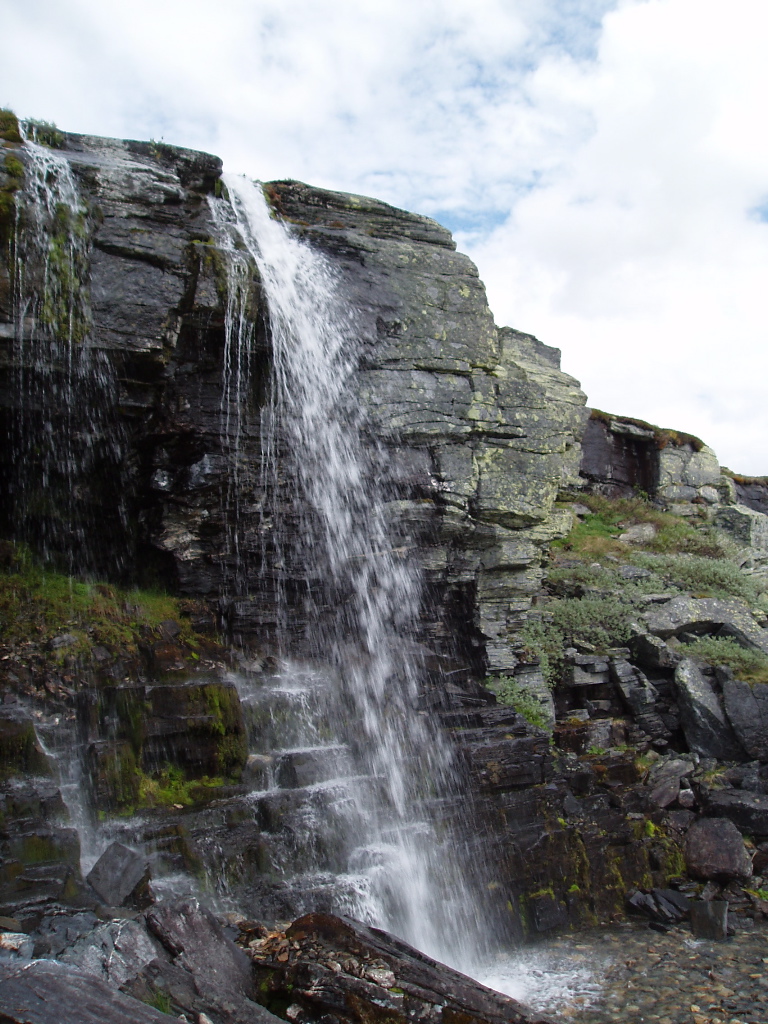
Rondane National Park
"Tower over tower arises! Hei, what a glittering gate!" Henrik Ibsen put those words in Peer Gynt's mouth as the character stumbled, dizzy and bewildered, among shining snowpeaks in Act 2 of the 1867 play. The mountains Ibsen described were real. Rondane, the massif that became Norway's first national park in 1962, had already been inspiring writers for decades before Ibsen made it a symbol of the nation itself. Peter Christen Asbjornsen collected folk tales here. Aasmund Olavsson Vinje set his poem Ved Rundarne in these peaks. The landscape earns its literary reputation -- ten summits above 2,000 meters, wild reindeer moving across plateaus of lichen and stone, and a silence so complete it feels like the land is listening back.
Deep Time in Shallow Seas
The bedrock beneath Rondane tells a story that begins 500 to 600 million years ago, on the floor of a shallow sea. Changes in the Earth's crust compressed that seafloor sediment into metamorphic rock and quartz, then pushed it skyward into mountains. No fossils have been found in Rondane's rock -- the ancient sea apparently held no animal life, or none that left a trace. What remains is a stark, mineral landscape stripped down to essentials: stone, sky, and the thin veneer of lichen that makes everything else possible. The highest point, Rondeslottet, reaches 2,178 meters, and nine other peaks in the park exceed the 2,000-meter mark. Just to the east lies the Gudbrandsdalen valley, and two other mountain ranges -- Dovre and Jotunheimen -- rise nearby, making this one of the most concentrated alpine landscapes in Scandinavia.
The Reindeer's Kingdom
Between 2,000 and 4,000 wild reindeer roam Rondane and the nearby Dovre area, making this one of Europe's most important habitats for the species. These are not domesticated herds but genuinely wild populations, descendants of animals that have grazed these plateaus since the last Ice Age retreated. They survive on a diet of lichen and reindeer moss that grows on the arid, nutrient-poor stone plateaus -- a fragile food source that also fertilizes the thin soil, allowing hardier plants to establish and providing forage for mice and lemmings further down the food chain. To protect the reindeer in their core areas, hiking trails have been rerouted. The park was significantly enlarged in 2003, nearly doubling from 580 to 963 square kilometers, primarily as a conservation measure for the herds. Wolverines, lynxes, and a small population of bears also inhabit the park, while wolves remain rare.
Norway's First Protected Wilderness
After nearly a decade of planning that began with Norway's 1954 nature protection law, Rondane was established as the country's first national park on December 21, 1962. Community meetings in the surrounding municipalities started as early as 1955, and a commission led by Norman Heitkotter pushed the project through to a Royal resolution. The original park covered 580 square kilometers, a boundary that was nearly doubled in the 2003 expansion. That enlargement also created a new national park, Dovre, just to the north -- the gap between Rondane's northern border and Dovre's southern edge is now barely one kilometer, linking large sections of protected mountain territory. The stated purpose at establishment was straightforward: to safeguard the natural environment and secure the landscape as a recreational area for future generations.
Walking Where Peer Gynt Wandered
The Norwegian Mountain Touring Association maintains a network of staffed cabins in the park -- Rondvassbu at the southern end of Lake Rondvatnet, Doralseter to the north, Bjornhollia to the east -- connected by trails marked with the red T symbols that guide hikers across Norwegian mountains. The T-trails run cabin to cabin and up to the peaks near Rondvatnet, though some routes have been adjusted to avoid disturbing the wild reindeer in their core habitat. Unstaffed cabins like Eldabu offer shelter for those carrying a DNT key. In winter, ski trails are marked and sometimes groomed by DNT or nearby hotels. The park operates under minimal regulations: motor traffic is prohibited, but hiking, camping, and -- with a license -- fishing and hunting are permitted throughout. It is wilderness on Norwegian terms, which means accessible, well-marked, and trusted to those who enter it.
From the Air
Located at 61.83N, 9.83E in Innlandet county, east of the Gudbrandsdal valley. The park's ten peaks above 2,000 meters, including Rondeslottet at 2,178 m, are visible as a compact massif from considerable distances. Dovre and Jotunheimen mountain ranges are nearby. Nearest airports include Fagernes Leirin (ENFG) approximately 90 km south, and Roros Airport (ENRO) approximately 110 km east. Best viewed from 5,000-8,000 feet AGL to appreciate the plateau topography and surrounding valleys. In winter, snow cover makes the massif stand out dramatically.