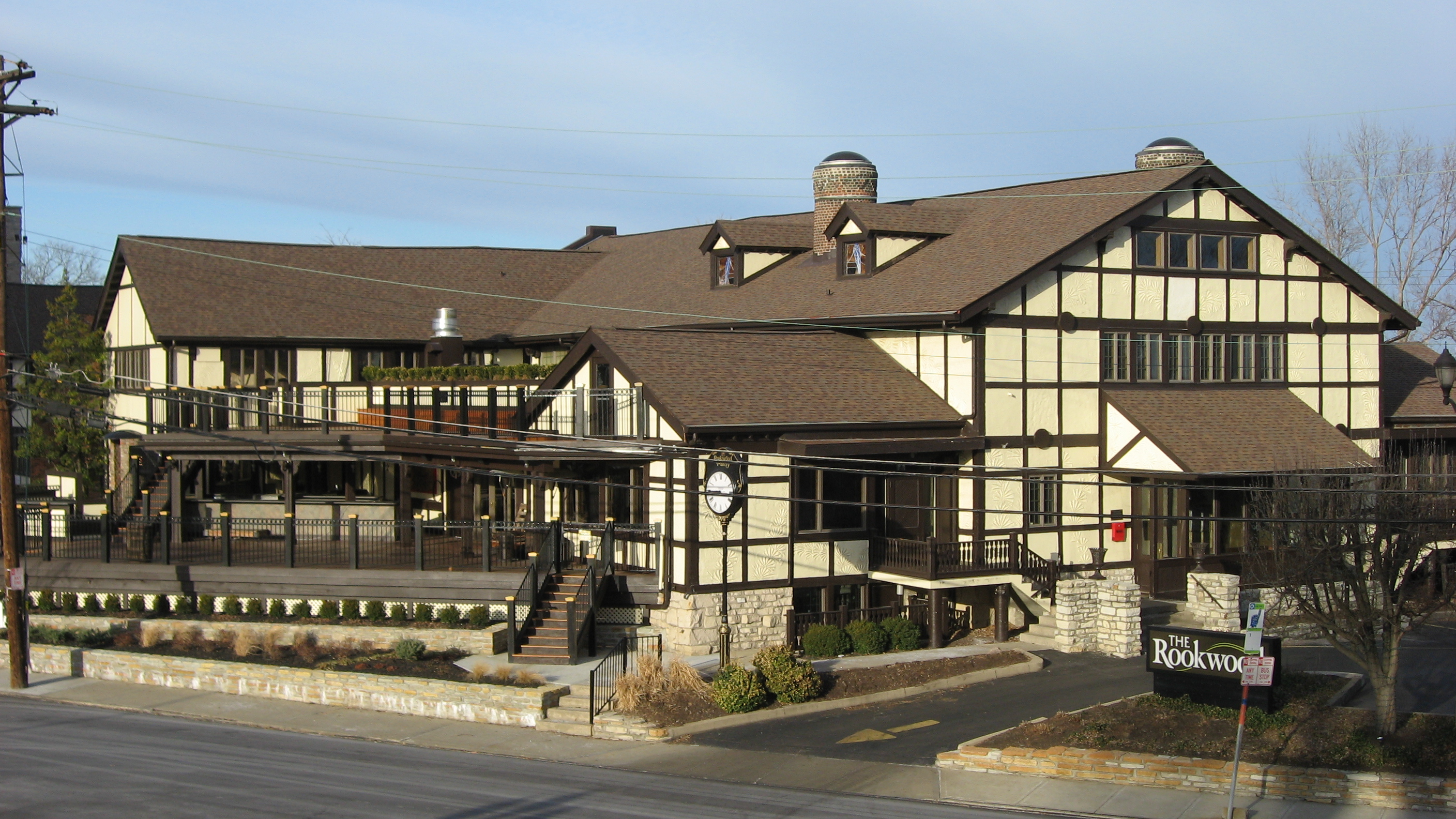
Rookwood Pottery Company
The first ware came from the kiln on Thanksgiving Day, 1880. Maria Longworth Nichols Storer, daughter of one of Cincinnati's wealthiest families, had founded her pottery company in a renovated schoolhouse on Eastern Avenue -- purchased by her father at a sheriff's sale just months earlier. She named it Rookwood, after her family's country estate in Walnut Hills. What began as a wealthy woman's artistic passion, sparked by Japanese and French ceramics she had admired at Philadelphia's 1876 Centennial Exhibition, would grow into the most important art pottery company in American history.
The Alchemy of Glaze
Rookwood's early pieces were relief-worked on colored clay in reds, pinks, greys, and sage greens, some gilt or carved. But Storer was after something more distinctive. She developed the signature Standard Glaze -- a yellow-tinted, high-gloss clear finish often applied over leaf and flower motifs that gave Rookwood its first recognizable identity. A rare variant called Tiger Eye, which produced an unpredictable golden shimmer deep within the glaze, appeared only on red clay and could not be reliably reproduced, making surviving pieces highly collectible. In 1887, Storer invited Japanese artist Kitaro Shirayamadani to Cincinnati to work for the company, and his influence wove Japonism through Rookwood's aesthetic. New glazes followed: the clear colorless Iris in 1894, the green-tinted Sea Green, and the rare Aerial Blue, produced for just a single year. The Vellum glaze, introduced in 1904, gave pieces a frosted matte surface through which painted floral and landscape decorations glowed softly beneath.
From Hilltop to Grand Central
In 1891, Rookwood moved from its schoolhouse origins to a purpose-built facility atop Mount Adams, designed by H. Neill Wilson. The hilltop location became a destination -- by the 1920s, nearly 5,000 visitors toured the pottery each year. In 1902, the company launched an architectural tile division under William Watts Taylor that rapidly gained national acclaim. Rookwood tiles found their way into some of America's most prominent buildings: the Rathskeller room at Louisville's Seelbach Hotel, where Bavarian landscapes unfold in glazed faience; the soaring interior of Cincinnati's Union Terminal and Carew Tower; the Vanderbilt Hotel and Grand Central Terminal in New York City; and even several New York subway stations. One of the most celebrated installations, a panel depicting Durham Cathedral, still graces the Carnegie West Branch of the Cleveland Public Library.
The Crash and the Long Silence
The 1920s were Rookwood's golden age, with roughly 200 workers producing art pottery and architectural commissions. Then the 1929 crash struck. Art pottery became a luxury few could afford, and architects stopped ordering custom tiles and mantels. By 1934, Rookwood posted its first loss. By 1936, the company was operating an average of just one week per month. Key employees departed, with Harold Bopp, William Hentschel, and David Seyler leaving to start Kenton Hills Porcelains across the river in Erlanger, Kentucky. On April 17, 1941, Rookwood filed for bankruptcy. Through changes in ownership, the artists stubbornly remained. In 1959, the Herschede Clock Company purchased the pottery and moved production to Starkville, Mississippi -- far from the Cincinnati hills where the kilns had first fired. Production finally ceased in 1967.
A Dentist's Life Savings
By 1982, Rookwood's remaining assets were in negotiations to be sold to overseas manufacturers. Arthur Townley, a Michigan dentist and passionate art pottery collector, intervened -- spending his life savings to purchase everything that remained: the trademarks, more than 2,000 original molds, and hundreds of glaze recipes. For over two decades, Townley produced small batches to keep the trademarks alive while refusing offers to sell. In 2004, he finally collaborated with Cincinnati investors Christopher and Patrick Rose to bring the company home. By 2006, the Rookwood Pottery Company had formally reacquired all of the original assets.
Back to Over-the-Rhine
Today, Rookwood operates from a production studio in Cincinnati's historic Over-the-Rhine neighborhood, not far from where Maria Longworth Storer first loaded her schoolhouse kiln nearly a century and a half ago. The revived company has invested in new kilns and equipment, hired new staff, and returned to producing both art pottery and architectural commissions. In 2012, they restored thousands of original Rookwood tiles in Chicago's landmark Monroe Building. A dedicated Rookwood gallery occupies the Cincinnati Wing of the Cincinnati Art Museum, and masterpiece pieces are exhibited at the Museum of the American Arts and Crafts Movement in St. Petersburg. The glazes that Maria Storer and her artists developed -- Tiger Eye, Vellum, Standard, Iris -- remain among the most sought-after names in American decorative arts, each piece carrying the warmth of Cincinnati clay and the ambition of a woman who refused to see pottery as anything less than fine art.
From the Air
Rookwood Pottery Company is located at 39.1072N, 84.5008W in the Over-the-Rhine neighborhood of Cincinnati, Ohio. The original Mount Adams pottery building, perched on the hilltop east of downtown, remains a visible landmark. Cincinnati's downtown sits in a basin along the Ohio River, which provides an unmistakable visual reference curving around the city. Cincinnati/Northern Kentucky International Airport (KCVG) lies about 12 miles southwest across the river in Kentucky. Lunken Airport (KLUK), a general aviation field, is just 3 miles east of downtown along the river. Best viewed at 2,000-3,000 feet AGL. The Over-the-Rhine neighborhood is north of downtown, identifiable by its dense 19th-century row-house architecture.