Roomade
At 10:00 a.m. on 27 September 2001, the doors of the central sphere of the Atomium closed behind a hundred people. They had food, furniture, sanitary facilities, and no programme. For the next twenty-four hours, they would not be allowed to leave. No film crew. No camera. The only documentation would be what they remembered afterward and chose to tell. The piece was called The Baudouin/Boudewijn Experiment. The artist was Carsten Hoeller, the German conceptual artist later known for the giant slides at the Tate Modern. The commissioning organisation was Roomade, a small Brussels outfit run by the curator Barbara Vanderlinden, which specialised in art projects that did not look like art projects, did not happen in galleries, and were almost impossible to sell.
Making Room
Roomade started in 1996 as an answer to a complaint. In the mid-1990s, Brussels was unusually short of spaces for contemporary visual art - no major kunsthalle, few alternative spaces, a museum landscape weighted heavily toward heritage rather than the living scene. Vanderlinden, who had been working with international artists and curators, decided to build the missing infrastructure herself. The American artist-curator Fareed Armaly suggested the name: Roomade, a contraction of "room" and "made," meaning both the rooms it would make available and the gesture of making room. The organisation's strategy was to find empty spaces in the city - an office tower here, a hotel ballroom there - and treat them as exhibition venues for projects that would have been awkward in a museum. The Dutch-Flemish art journal De Witte Raaf described the approach as art "for the production of art projects outside the traditional exhibition circuit, embedded in a specific social situation and intended for a new audience."
Mullican Under Hypnosis
Roomade's first major project, in 1996, took the American conceptual artist Matt Mullican and put him under hypnosis in fifteen different locations around Brussels. Mullican had been doing hypnosis performances since the late 1970s, but had stopped showing them publicly long before. Under hypnosis he would attempt to reconstruct his identity from fragments of memory: drawing as a four-year-old, smelling, looking for and entering a picture. The performances were recorded on video. They were strange to watch and stranger to think about - what happens when critical consciousness is suspended, what an artist's body knows when the artist himself is not in the room. The final performance took place on 3 May 1997 in the Zuilenzaal of the Arenberg Institute in Leuven, the first time in two decades Mullican had performed the work for a live audience. Vanderlinden was the kind of curator who could persuade a famous American to do something he had stopped doing, in a city most of his peers had never visited.
The Office Tower Years
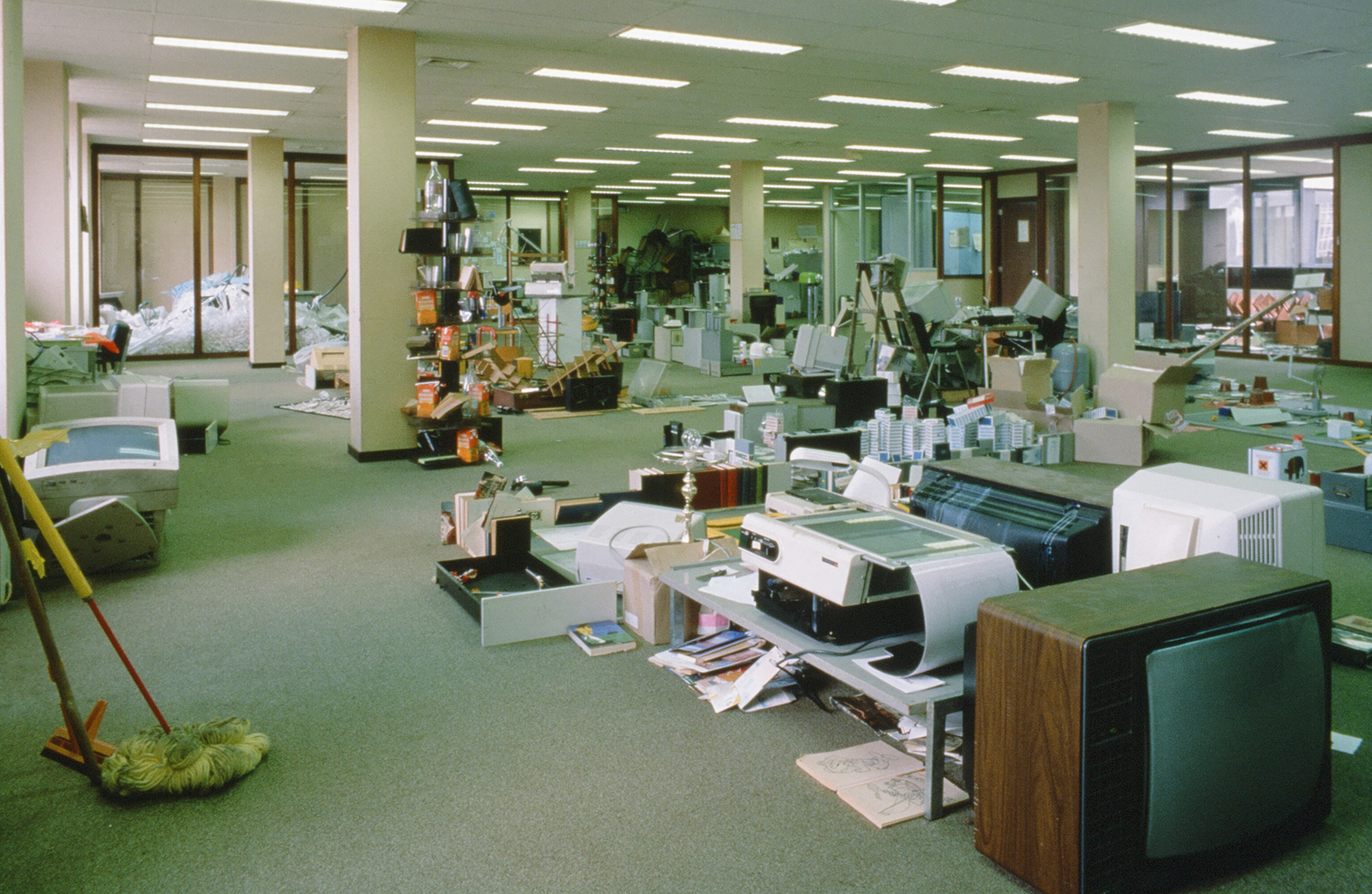
Between 1996 and 1999, Roomade ran a series of exhibitions in the Manhattan Tower, an office complex in Brussels' North District attached to a Sheraton hotel. The owners gave Roomade access to floors they could not rent. On the twelfth floor, ten video projections of Mullican's hypnosis pieces played continuously. On the twenty-sixth floor, the Belgian artist Kobe Matthys built a module out of plasterboard, a TV, sofas, and a sound system - a kind of squatted living room called Agentschap. In the ground-floor storefronts on the Bolwerklaan, Marie-Jose Burki projected enormous video close-ups of caged finches bouncing from perch to perch, the loops lit from seven in the evening until morning. Office workers in surrounding buildings could see the birds at three in the morning, throwing themselves at the glass. The exhibition was called On the Desperate and long neglected need for small events. The title described both the artworks and the strategy.
Laboratorium and Indiscipline
In 1999, Roomade co-organised Laboratorium with Hans Ulrich Obrist, who would later become co-director of the Serpentine Galleries in London. The premise was to identify places where culture and knowledge are actually made - laboratories, workshops, studios - and open them to the public during the exhibition. Scientists and artists were paired and discussions documented. The piece refused to argue that art and science were similar or different; it simply put them in the same room and watched what happened. A year later came Indiscipline, eight presentations spread across Brussels and the Centrum Brussel 2000 venue, in which philosophers, psychoanalysts, theatre directors, and artists were invited to step outside their disciplinary languages. The participant list reads like a syllabus: Chantal Mouffe, Bruno Latour, Boris Groys, Martha Rosler, Richard Foreman, Liam Gillick. The project was co-curated with Jens Hoffmann and live-streamed - in 2000 - to Split and BAK Maastricht.
Twenty-Four Hours in a Sphere
The Baudouin/Boudewijn Experiment was originally announced for autumn 2000 and cancelled. It was restaged at the Atomium - the 1958 World's Fair landmark in northern Brussels shaped like an iron crystal - on 27-28 September 2001. The premise was simple and deeply strange: a hundred people would spend twenty-four hours together in the central sphere, isolated from the outside world, with no instructions about what to do. The frame for the piece came from real Belgian history. On 4 April 1990, King Baudouin had been declared temporarily incapable of governing the country for twenty-four hours, a constitutional manoeuvre that allowed a bill legalising abortion - which the devout Catholic king refused to sign - to become law without his signature. He resumed his royal duties the next day. Hoeller's piece staged its own twenty-four-hour suspension: a small group of ordinary people stepping out of productive life, governed by nothing in particular, returning to the world afterward with only their memories. By 2006 Vanderlinden had stepped back from Roomade. The organisation's archive lives on through MIT Press publications, the writers who passed through, and the small fact that a hundred people in Brussels once spent a day inside an atom.
From the Air
Roomade was a Brussels-based organisation rather than a single visitable building; the location coordinates (50.857°N, 4.350°E) sit in north-central Brussels in the Saint-Josse / North District area, near where the Manhattan Tower exhibition site was located. The Atomium - venue for the Baudouin Experiment - stands at the Heysel Plateau in northern Brussels and is the city's most distinctive aerial landmark: nine polished aluminium spheres connected by tubes, 102 metres tall, visible from miles in any direction. From the air, look for it just southeast of Brussels Airport. Nearest airport: Brussels Airport (EBBR), about 7 km northeast of the Atomium and 8 km northeast of Roomade's location.