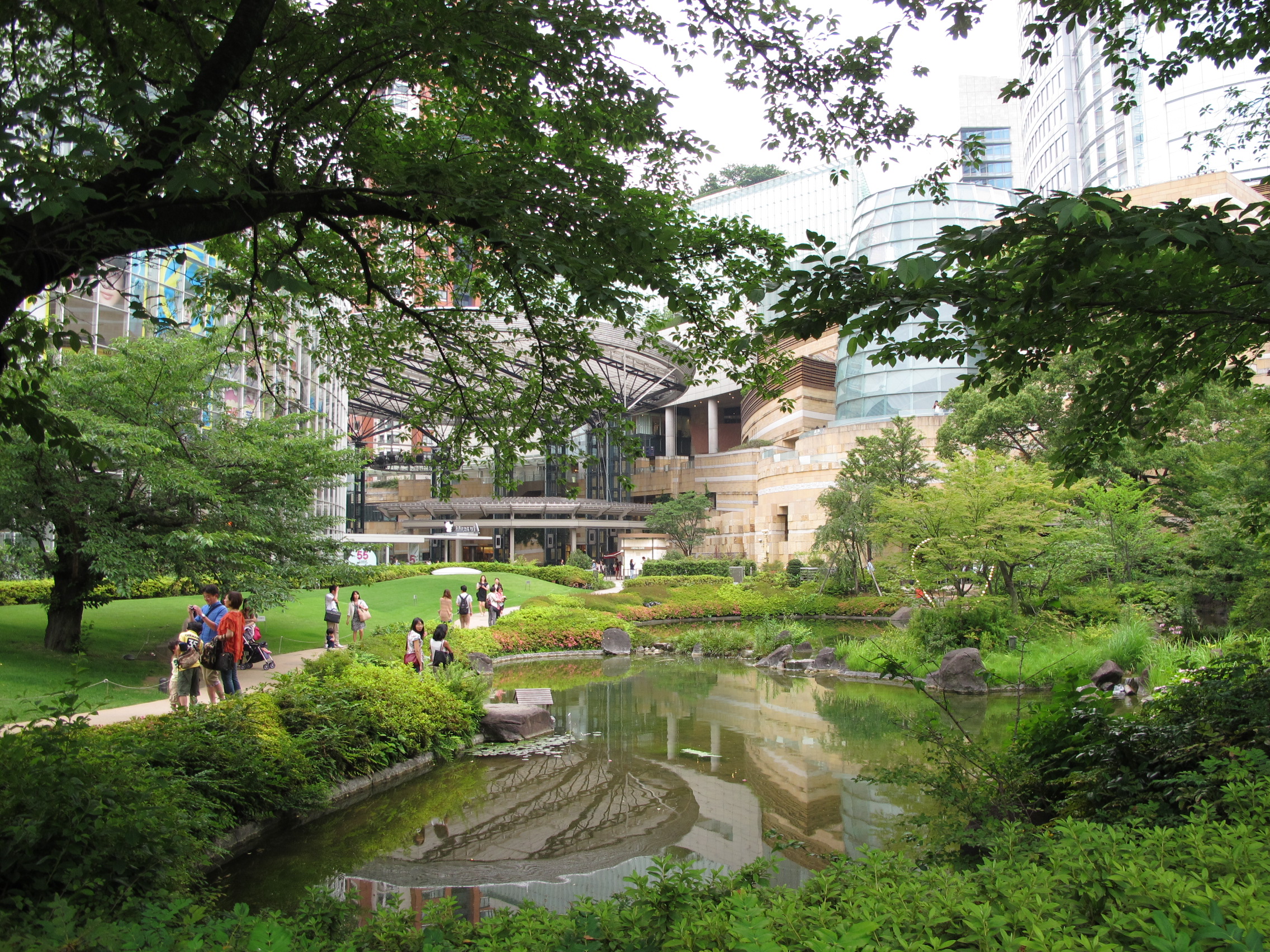
Roppongi Hills
It took Minoru Mori 14 years just to buy the land. One by one, more than 400 small property owners in Tokyo's Roppongi district sold their lots to the building tycoon, who had a vision that most of them thought was impossible: a 27-acre vertical city where people would live, work, shop, and play without ever needing to commute. When Roppongi Hills finally opened on April 25, 2003, seventeen years after its initial conception, the $4 billion complex was either a revolutionary answer to Tokyo's crushing density or a monument to corporate hubris, depending on who you asked. Two decades later, the debate continues, but the crowds keep coming.
A Feudal Garden Beneath Glass and Steel
The most surprising thing about Roppongi Hills is how much of it is empty space. About half the development consists of gardens, pavilions, and open areas, a deliberate contrast to the soaring 54-story Mori Tower that anchors the complex. The centerpiece of this green ambition is the Mori Garden, an elaborate Japanese garden with a pond and mature trees that traces its origins to the feudal Mori clan, whose mansion once occupied this ground. The garden is authentic, not decorative, a living remnant of Edo-period aristocratic life surrounded by the glass-and-steel ambitions of 21st-century capitalism. Nearby, the Keyakizaka Street comes alive each winter with 1.2 million LEDs, a luminous corridor flanked by Louis Vuitton and upscale cafes that draws visitors from mid-November through Christmas Day. A playground near the complex known as Robot Park, with its robot-themed play equipment, sits beside the American School in Japan's Early Learning Center, a reminder that families actually live here.
The Tower That Holds a City
Mori Tower, designed by the American firm Kohn Pedersen Fox, functions as a vertical neighborhood. The first six floors house retail stores and restaurants. Above them, office floors host an improbable roster of global tenants: Goldman Sachs, Google, Konami, The Pokemon Company, Baidu, and Lenovo all share the same address. The top six floors belong to the Mori Art Museum and the Tokyo City View observation deck, offering panoramic views of the sprawling city below. A glass atrium connects directly to Roppongi Station, filling with escalators, television screens, and commuters. The TV Asahi headquarters, designed by Pritzker Prize-winning architect Fumihiko Maki, sits at the base of the complex beside the Mori Garden, its gleaming modernist form in quiet conversation with the ancient trees.
The Price of Vision
Roppongi Hills was financed with $800 million in equity and $1.3 billion in debt from a bank syndicate led by the Development Bank of Japan, pushing Mori Building's total debts to $5.6 billion. Goldman Sachs, as the anchor tenant, negotiated deep rental discounts because of the sheer volume of space it leased. Japan's sluggish economy in the early 2000s, combined with staff cuts by foreign firms and a flood of new office space across Tokyo, put relentless downward pressure on rents. Some former residents of the site received apartments in the new complex as compensation for vacating their homes under Japan's eminent domain laws. Critics argued that the labyrinthine walkways were confusing, that the outdoor arena created noise pollution for older neighbors, and that the complex prioritized spectacle over livability. Defenders countered that Mori had done what no one else dared: proved that Tokyo's future lay in building up, not out.
Living Laboratory
Mori's philosophy was straightforward: eliminate the commute, and you give people back their lives. The four Roppongi Hills residence towers contain 793 apartments, their occupants able to step from home to office to museum to restaurant to garden without crossing a public street. The complex includes cinemas, clinics, cafes, an outdoor amphitheater, and a hotel. It was, in essence, an argument made in concrete and glass that the future of urban life was vertical integration. The architecture itself is documented in the book Six Strata: Roppongi Hills Redefined, which examines how the layered design attempts to create community within density. Whether you see Roppongi Hills as a self-contained utopia or a gilded fortress depends on your relationship to the city around it, but the model it established has shaped urban development across Japan and beyond.
From the Air
Roppongi Hills sits at 35.66N, 139.73E in the Minato ward of central Tokyo. The 54-story Mori Tower is a prominent landmark visible from altitude, particularly from approaches to Tokyo's Haneda Airport (RJTT), approximately 12 km to the south. Look for the distinctive cluster of towers in the Roppongi district, southwest of the Imperial Palace grounds. Tokyo Narita International Airport (RJAA) lies about 60 km to the east. Best viewed at 3,000-5,000 feet for context within the dense Tokyo skyline.