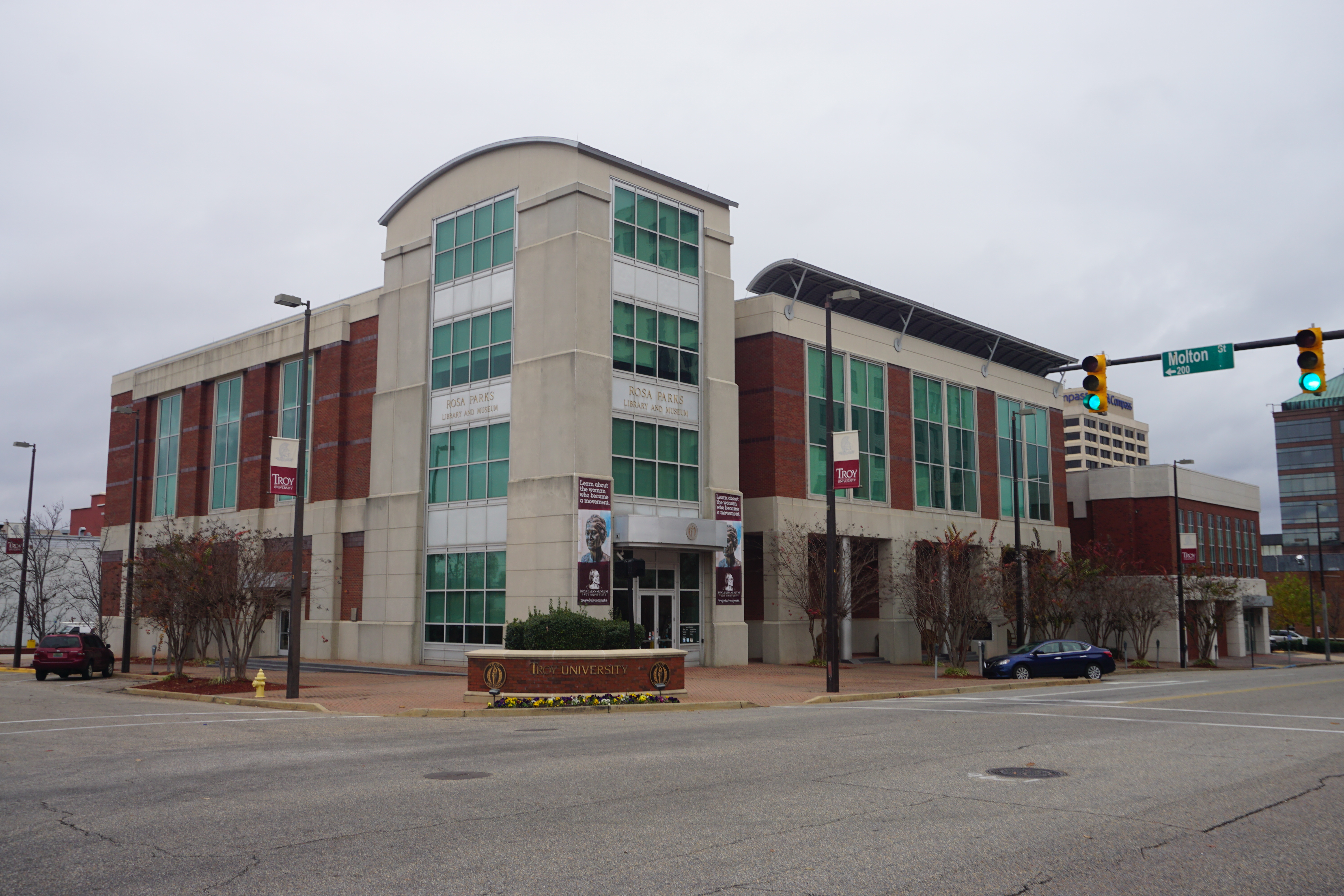
Rosa Parks Museum
The museum stands on the precise corner where everything changed. On December 1, 1955, Rosa Parks boarded the Cleveland Avenue bus after her shift as a seamstress at a downtown Montgomery department store. She sat in the first row of the section designated for Black passengers. When the white section filled and driver J. Fred Blake ordered Parks and three others to vacate their seats, the other riders moved. Parks did not. She was arrested. Within four days, the Montgomery Bus Boycott was underway -- a 381-day campaign of organized resistance that would reach the Supreme Court and launch the modern civil rights movement. Today the Rosa Parks Museum at Troy University's Montgomery campus occupies that same ground, the nation's only museum dedicated entirely to her story.
The Bus Room
The centerpiece of the museum is a 1950s-era Montgomery city bus and a ten-minute multimedia reenactment that places visitors outside the bus on that December evening, watching events unfold through the windows. The museum holds Rosa Parks's original fingerprint arrest record and the police reports from her booking. Court documents from the legal challenge that followed sit in display cases nearby. These are not reproductions. The fingerprint card bears the actual ink impressions from Parks's hands on the night that divided American history into before and after. A restored 1955 station wagon -- known as a "rolling church" because congregations used their vehicles to transport boycott participants -- represents the practical ingenuity that sustained 40,000 Black Montgomerians who found other ways to get to work for over a year.
The Women Who Walked
For the boycott's 65th anniversary, the museum added the traveling exhibition "The Women of the Movement," telling stories that the simplified national narrative often omits. Jo Ann Robinson, an English professor at Alabama State College, led the Women's Political Council in distributing 35,000 flyers calling for the boycott. Aurelia Browder became the lead plaintiff in Browder v. Gayle, the federal case that declared bus segregation unconstitutional. Claudette Colvin, just fifteen years old, had refused to give up her bus seat nine months before Parks -- but organizers judged her case less ideal for a legal challenge. Mary Louise Smith and Lucille Times were fellow plaintiffs who risked their livelihoods to stand in court. The exhibition restores these women to the story, a necessary correction to the myth that one refusal on one bus changed everything by itself.
From Arrest to the Supreme Court
The boycott began on December 5, 1955, the Monday after Parks's arrest, when Montgomery's Black community stayed off the buses. It was supposed to last one day. It lasted 381. A 26-year-old pastor named Martin Luther King Jr., new to Montgomery's Dexter Avenue Baptist Church, emerged as the movement's spokesman. His house was bombed. He was arrested. The bus company lost revenue; downtown merchants watched their customer base evaporate. On November 13, 1956, the Supreme Court affirmed the lower court ruling in Browder v. Gayle: segregation on public buses was unconstitutional. The boycott ended on December 20, 1956, when the ruling took effect. Parks, who had lost her job and received death threats, eventually moved to Detroit. The museum preserves not just her courage but the cost of it.
Standing on Sacred Ground
The Rosa Parks Museum opened in 2000 on the Troy University Montgomery campus, deliberately sited at the location of Parks's arrest. Original works of art including statuary and quilts complement the historical artifacts. "The Legacy of Rosa Parks" exhibition connects the boycott to the broader tradition of nonviolent disobedience and its relevance today. The museum sits within walking distance of Montgomery's other civil rights landmarks: the Dexter Avenue King Memorial Baptist Church, the Southern Poverty Law Center's Civil Rights Memorial, and the National Memorial for Peace and Justice. Together they make Montgomery one of the most significant civil rights destinations in America, a city where the ground itself carries memory and where a bus stop became a turning point in the nation's story.
From the Air
Located at 32.38N, 86.31W on the Troy University Montgomery campus in downtown Montgomery, Alabama. The museum is situated at the corner where Rosa Parks was arrested in 1955, in the heart of Montgomery's civil rights landmark district. Montgomery Regional Airport (KMGM) is approximately 7 miles southwest. From altitude, the Troy University campus is visible in Montgomery's downtown grid near the Alabama River bend, with the State Capitol dome on Goat Hill serving as a primary navigation reference.
Sources
- Rosa Parks Museum - Wikipedia
- Troy University Rosa Parks Museum - Encyclopedia of Alabama
- Troy University Rosa Parks Museum - About
- Montgomery Bus Boycott - Stanford King Institute
- Wikipedia - Browder v. Gayle
- Rosa Parks Museum - Troy University
- James F. Blake - Wikipedia
- Claudette Colvin - National Geographic
- Jo Ann Robinson - National Museum of African American History
- Rosa Parks - Wikipedia