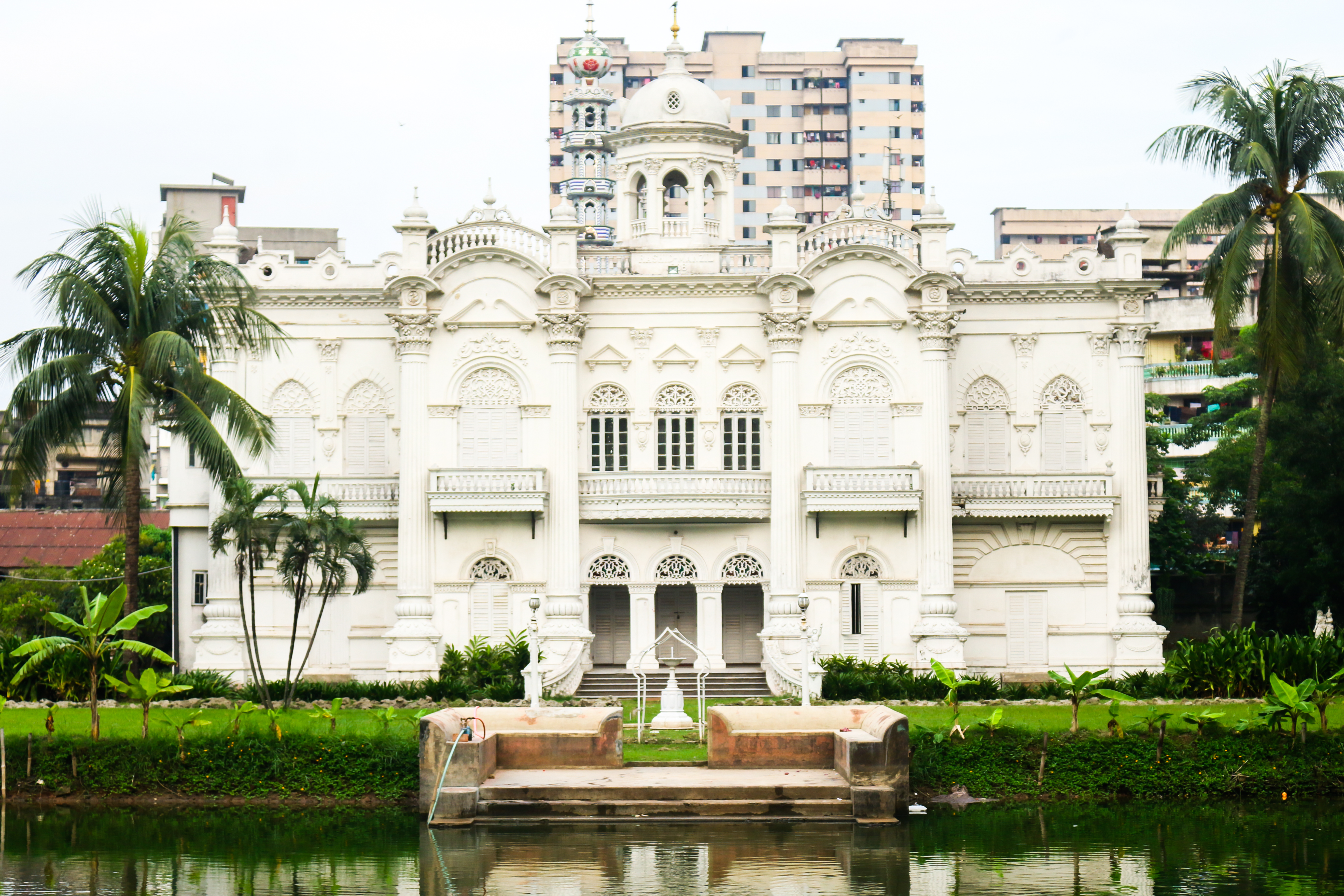
Rose Garden Palace
It started with an insult. In the late 19th century, the social life of wealthy Dhaka revolved around garden parties at the Baldha Garden in the Gopibug area. A Hindu zamindar named Hrishikesh Das attended one of these gatherings and was humiliated -- the specifics have been lost to time, but the response has not. Das resolved to build a garden so extravagant it would make Baldha look modest. He succeeded, then went bankrupt doing it. The mansion he created, known today as the Rose Garden Palace, has outlasted his fortune, his family's ownership, and even the rose garden that gave it its name.
A Stage, Not a Home
The Rose Garden Palace was never intended as a residence. Hrishikesh Das built it as a setting for entertainment -- musical performances, social gatherings, spectacles designed to announce his taste and wealth. The centerpiece was an elegant pavilion surrounded by gardens with ornamental fountains and classical marble statues. The building itself was a declaration: eight apartments on the ground floor including a central hall, five apartments upstairs anchored by a grand dance hall measuring forty-five by fifteen feet. Crystal chandeliers hung from floral-patterned ceilings embellished with green mirrors. Colored Belgian glass, iron, and wood carved with foliage and animal outlines adorned the walls. An ostentatious dome crowned the dance hall, and a spiral staircase of intricate design wound from the ballroom to the roof. Das staged spectacle after spectacle here. But spectacle is expensive, and by 1927 he was bankrupt, forced to sell everything.
From Ballroom to Birthplace
The mansion changed hands twice. First to Boshuruddin Sarkar, a zamindar from Nabinagar in Brahmanbaria district. Then in 1937, the prominent businessman Khan Bahadur Kazi Abdur Rashid purchased it and renamed it Rashid Manzil. His son Kazi Raquib inherited the property, and his wife Laila Raquib maintained it for years. But the building's most consequential moment came on 23 June 1949, when East Bengali liberal and social democrats converged in its halls to form an alternative political force against the Muslim League in Pakistan. The Awami League was born in a bankrupt landlord's entertainment pavilion -- a mansion built for music and display becoming the cradle of a movement that would eventually lead to the creation of Bangladesh.
Glass, Iron, and Vanishing Roses
Walk through the Rose Garden Palace today and the craftsmanship still commands attention. The triple-arched entrance porch on the eastern verandah leads to a staircase for the upper story. Skylights in multiple colors throw patterns across mosaic floors. The cascades surrounding the dance hall remain, though the crystal chandeliers hang in dimmer light than they once did. Outside, marble statues still occupy the garden, but the roses that gave the mansion its name have long since disappeared. The ornamental fountain's structure survives without water. Subsequent owners renovated carefully, maintaining the original character, but time and Dhaka's tropical humidity are relentless opponents. The building stands as one of the finest examples of Indo-Saracenic architecture in Bangladesh -- a style that merged European forms with Mughal and Indian elements, embodied here in Belgian glass set beneath dome-topped towers.
A Museum in Waiting
In August 2018, the government of Bangladesh purchased the Rose Garden Palace for 331.70 crore taka and announced plans to convert it into a museum. The decision recognized what local historians had argued for years: that the building's significance extended far beyond its architecture. It was a site where the social ambitions of the Hindu elite, the political aspirations of Bengali democrats, and the artistic possibilities of late-colonial design all intersected in a single compound on K.M. Das Lane in the Tikatully area of Old Dhaka. Whether the museum materializes, and what story it chooses to tell, will determine how Bangladesh remembers a building that began as an act of revenge and became a birthplace of national identity.
From the Air
Located at 23.718N, 90.426E in the Tikatully area of Old Dhaka, near the Motijheel business district. The palace compound is identifiable from low altitude by its dome and surrounding garden space amid dense urban blocks. Nearest airport is Hazrat Shahjalal International Airport (VGHS), approximately 12 km north. Baldha Garden, the rival garden that inspired Rose Garden's construction, is nearby in Gopibug. Best viewed at 2,000-3,000 ft AGL.