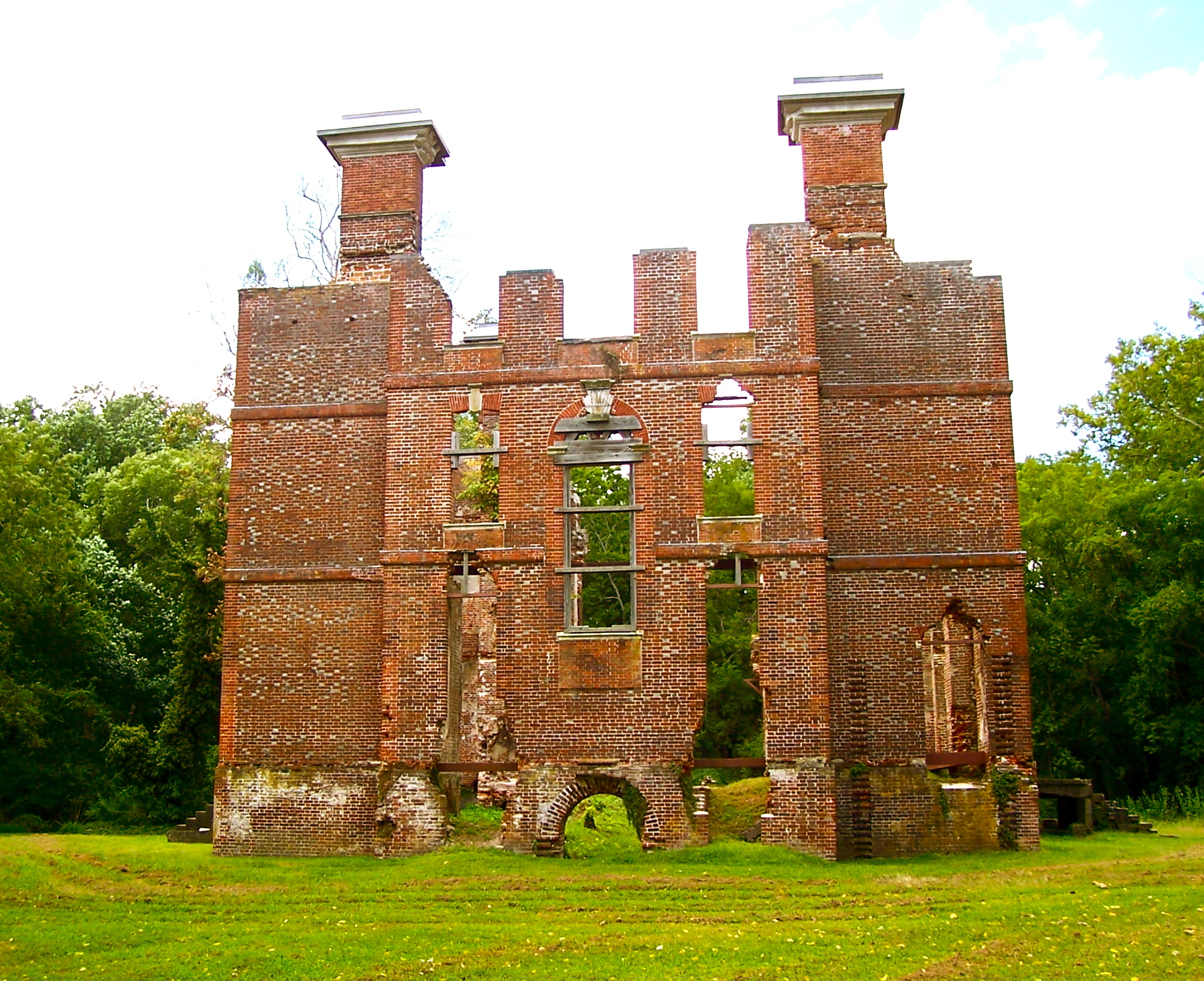
Rosewell Plantation
Thomas Jefferson knew every room of this house. He climbed its stairs, gazed from its upper windows across the York River, and wrote in its Blue Room - possibly drafting his fiery pamphlet "A Summary View of the Rights of British America" within these walls. The mansion he visited was Rosewell, and in the 1770s it was the largest and finest private residence in all the American colonies. Today, only brick walls and empty window frames remain, standing like a skeleton on the Virginia tidewater. The story of how the grandest house in colonial America rose, endured, and finally burned is a story of ambition, debt, revolution, and neglect - an American story told in Flemish bond brickwork.
A Mansion to Outshine the Governor
Mann Page I had a plan that was either visionary or reckless: he would build a house in Gloucester County that would dwarf the newly completed Governor's Palace in Williamsburg. Construction began in 1725 using brick, marble, and mahogany, some imported from England. Architectural historians believe Page may have designed the house himself, drawing inspiration from London townhouses built to the strict codes enacted after the Great Fire of London. The result was three full stories topped by a flat lead roof, a parapet, and twin octagonal cupolas - the first projecting central pavilion in the American colonies. Fiske Kimball, the architectural historian, noted that Rosewell's pavilion design "antedated any other by a score of years." But Page died in 1730, five years into construction, leaving his widow Judith and eventually their son Mann Page II to finish the work. The cost was staggering. Page II sold off vast tracts of land just to complete what his father had started.
The Rooms Where History Breathed
The interior was painted in high colonial style - so vivid that restorers of Colonial Williamsburg later relied on John Page's 1771 paint order to London to understand the palette of the Governor's Palace. That order requested 100 pounds of white lead, 20 pounds of yellow ochre, 20 pounds of Venetian Red, and lamp black among other pigments. Foundation walls ran three and a half feet thick. The reception hall was vast, the ceilings lofty. From the upper windows, visitors looked out across flat tidewater fields to the creeks and the York River beyond. John Page, grandson of the builder, grew up here before attending the College of William and Mary alongside his classmate Thomas Jefferson. Page went on to serve as Governor of Virginia, a colonel in the Revolutionary War, and a U.S. Congressman. Rosewell was the kind of house that shaped the men who shaped a nation.
Stripped to the Bones
The Page family held Rosewell for a century before selling it in 1837 to Thomas Booth. What happened next was a slow dismemberment. Booth removed the parapet and both cupolas. The lead roof was stripped off and sold. The carved marble mantels vanished. Much of the fine interior woodwork was ripped out. The flat roof gave way to a low hip roof with a single cupola and a widow's walk - a lesser crown for a once-royal house. The plantation changed hands several more times, each owner taking something or letting something go. Then, in 1916, fire swept through what remained. The blaze consumed the roof, the floors, the window frames - everything combustible. What survived was the brick shell, standing open to the Virginia sky, its Flemish bond walls refusing to fall.
What the Ruins Remember
Listed on the National Register of Historic Places in 1969, the Rosewell ruins have become one of the most significant archaeological sites in Virginia. Excavations have unearthed artifacts that illuminate aspects of colonial life and architecture previously unclear from documents alone. The site tells stories that the Page family's letters never bothered to record - the lives of the enslaved people who made the plantation function. From the colonial period through the Civil War, Rosewell's enslaved workers served as field hands, cooks, housemaids, blacksmiths, carriage drivers, and woodworkers. They raised produce for the owners and sometimes for themselves. A nearby property called Timberneck, sold by the Pages in 1793 to the Catlett family, still stands inside Machicomoco State Park and is being restored by the Fairfield Foundation. The similar Flemish bond brickwork between Rosewell and Christ Church in Lancaster County suggests the same masons may have worked on both - craftsmen whose names are lost but whose skill endures in every precisely laid brick.
From the Air
Located at 37.33N, 76.58W on the north bank of the York River in Gloucester County, Virginia. The ruins sit on Carter Creek near its confluence with the York River. From the air at 2,000-3,000 feet, look for the rectangular brick shell surrounded by trees on the tidewater peninsula. The York River is the primary visual landmark, running southeast toward the Chesapeake Bay. Nearby airports: Williamsburg-Jamestown (KJGG) approximately 15 nm to the southwest; Newport News/Williamsburg International (KPHF) approximately 20 nm to the southeast; Langley AFB (KLFI) nearby. The terrain is flat tidewater with scattered creeks and marshes. Best viewed in clear conditions from the south or east.