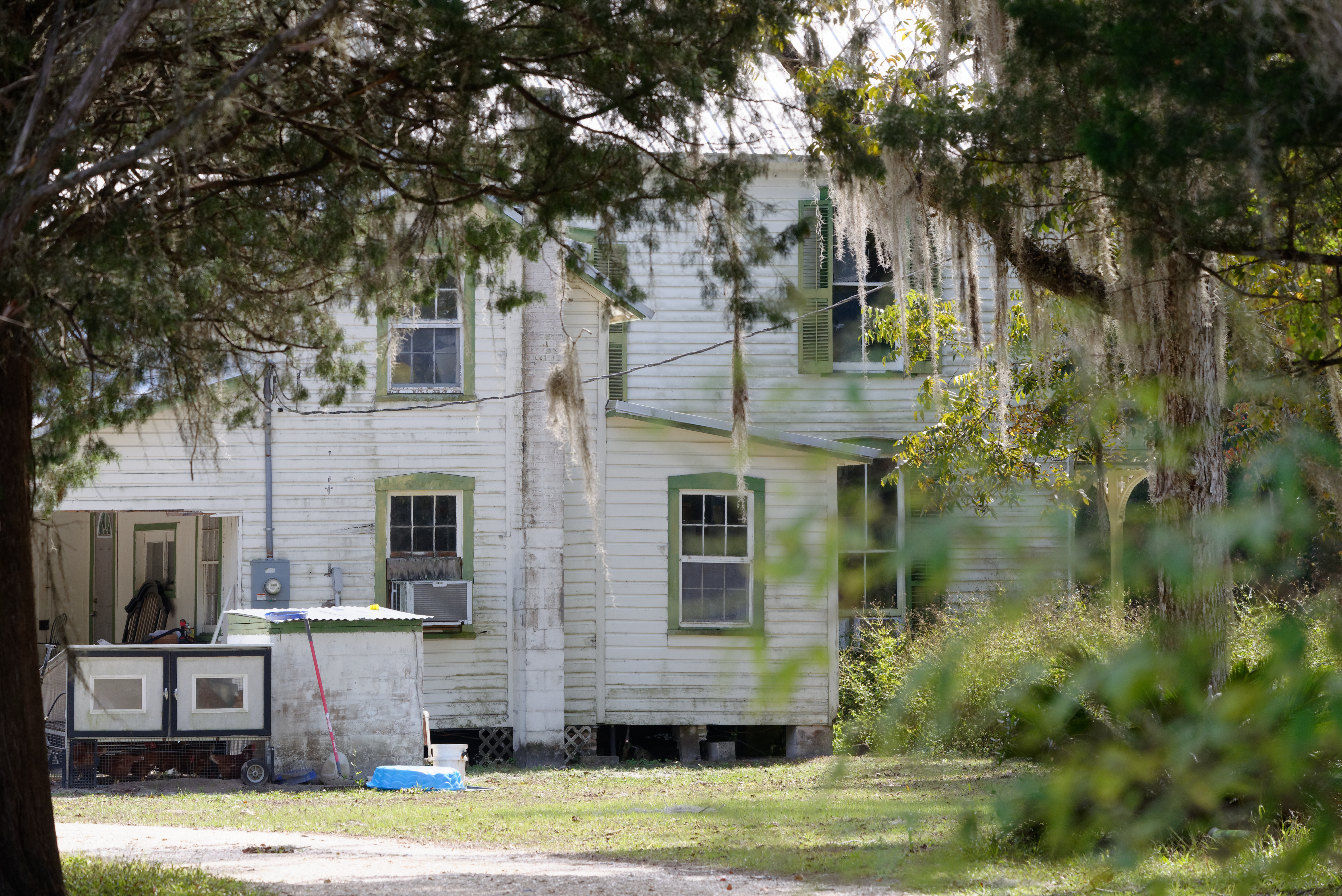
Rosewood, Florida
"Rosewood was a town where everyone's house was painted. There were roses everywhere you walked. Lovely." Robie Mortin spoke those words in 1995, at 79 years old, describing a place that no longer existed. The community she remembered had three churches, a Masonic hall, a baseball team called the Rosewood Stars, and families who owned pianos and organs. By the time Mortin shared her memory, Rosewood had been a ghost town for more than seven decades, its name synonymous not with the reddish cedar wood that inspired it, but with the violence that erased it from the Florida landscape in January 1923.
Cedar and Turpentine
Rosewood took root in 1845 along the Gulf Coast of Florida, a few miles northeast of Cedar Key in Levy County. The name came from the reddish hue of the cut cedar wood that drove the local economy. Pencil mills in Cedar Key processed the timber, while turpentine mills and a sawmill in neighboring Sumner provided additional employment. Farming of citrus and cotton rounded out the livelihood. By 1870, the hamlet had grown enough for a post office and a train depot on the Florida Railroad, though it was never formally incorporated as a town. Two Black families shaped the community above all others. The Goins family established the turpentine industry in the area and became the second-largest landowners in the entire county. The Carriers ran the logging operations. By the 1920s, nearly everyone in the close-knit village was distantly related. When the pencil mills closed around 1890 after the cedar supply dwindled, many White residents relocated to Sumner, and Rosewood became a predominantly Black community.
Self-Sufficient and Proud
Under the weight of Jim Crow segregation, Rosewood's residents built a world of their own. By 1920, the community was largely self-sufficient. Three churches anchored spiritual life. A school educated the children. A large Masonic Hall served as a social center. There was a turpentine mill and a sugarcane mill, two general stores, and a baseball team. The village featured about a dozen two-story wooden plank homes alongside smaller two-room houses. Some families displayed pianos and organs in their parlors, symbols of a middle-class prosperity that defied the era's oppressive racial hierarchy. In 1920, the combined census count for Rosewood and neighboring Sumner recorded 344 Black residents and 294 White residents. Relations between the two communities were described as relatively amicable, though Black residents had been effectively disenfranchised from voting since the turn of the century.
One Week in January
It ended in the first week of January 1923. A White woman in Sumner, Fannie Taylor, claimed she had been assaulted by a Black man. White men from surrounding towns lynched a local blacksmith named Sam Carter. When Black residents defended themselves, several hundred armed White men organized and systematically burned nearly every structure in Rosewood. Survivors hid in swamps for days before being evacuated by train and car to larger towns. The local sheriff refused to intervene. The governor declined to send the National Guard. No arrests were ever made. The town was abandoned by its Black residents during the attacks. Not one ever returned.
Reckoning and Remembrance
For 70 years, Rosewood's destruction lingered in silence. Survivors scattered across Florida, starting over with nothing. Then in 1994, the Florida state legislature voted to award $2 million in compensation to nine surviving family members, each receiving $150,000. A state scholarship was also established for descendants of the massacre families. Governor Jeb Bush placed a memorial plaque in 2004 at John Wright's general store, the only structure that survived the destruction. The plaque was later vandalized when it was shot at from a passing car. Since the 1950s, new life has slowly returned to the area. A general store, fisheries, charter tours, clam and oyster farms, restaurants, and a small airfield now dot the landscape. Several neighborhoods have grown around these enterprises. But Rosewood remains unincorporated, a place defined not by what it is today, but by what was taken from it.
What the Land Holds
From the air, the stretch of State Road 24 between Cedar Key and Sumner gives no hint of what happened here. The Gulf Coast flatlands spread out in a patchwork of scrub and low forest, unremarkable and quiet. There are no ruins to spot, no charred foundations visible from altitude. The landscape has healed in the way that landscapes do, covering scars with new growth. But the name on the map persists. Rosewood sits just off that highway, northeast of Sumner, a place where painted houses once stood in rows and roses lined the walkways. The story the land holds is invisible from above, which makes it all the more important to tell.
From the Air
Located at 29.24°N, 82.93°W in Levy County along Florida's Gulf Coast. The site sits just off State Road 24 between Cedar Key and Sumner. Nearest airports include Cedar Key Airport (a small airfield) and Gainesville Regional Airport (KGNV) approximately 50 miles northeast. The area is flat coastal terrain near the Gulf of Mexico's Big Bend region. Best viewed at 2,000-3,000 feet AGL. The community is not visually prominent from altitude; look for State Road 24 running northeast from Cedar Key.