Rosicrucian Park
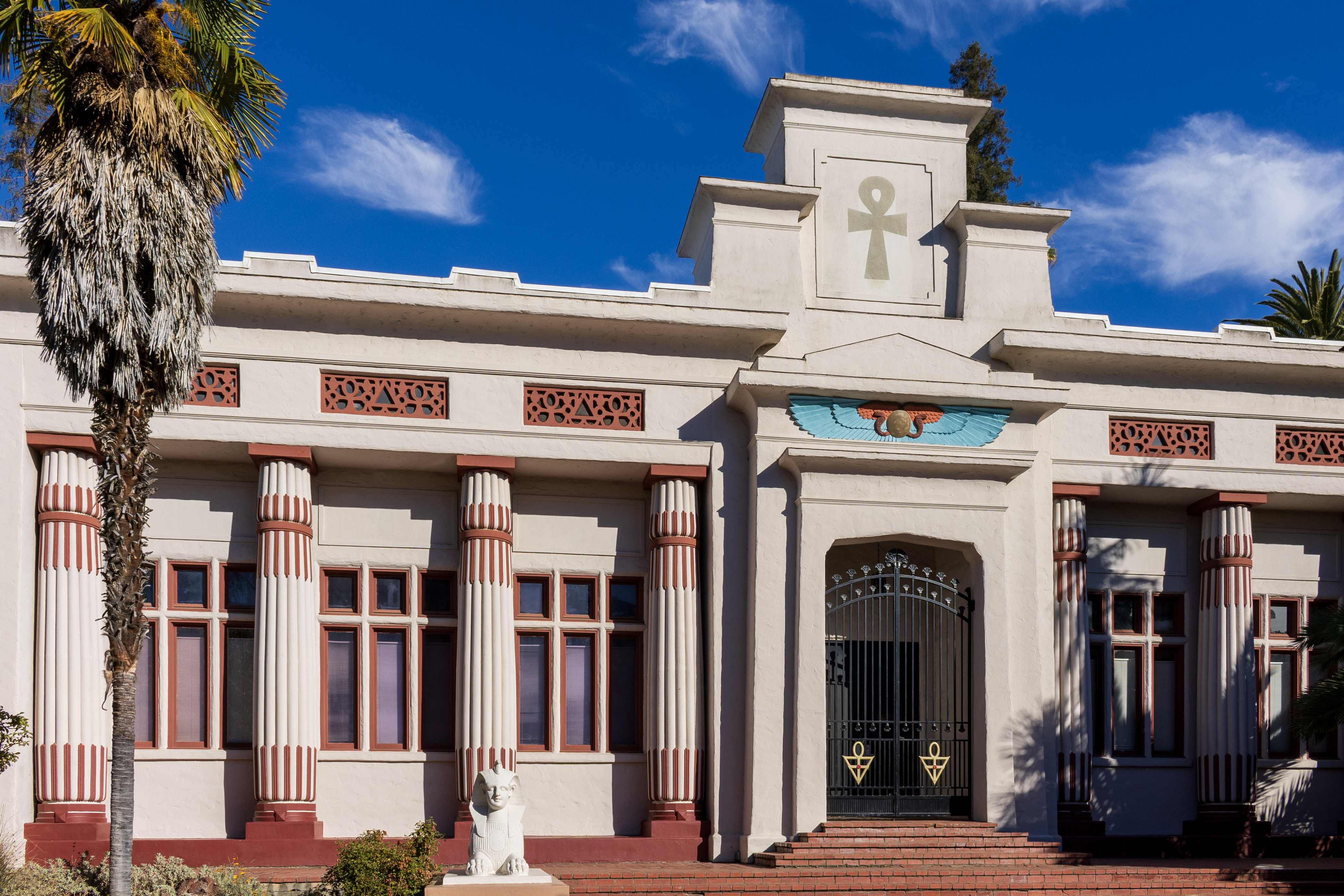
Papyrus grows in San Jose. Not in a greenhouse, not behind glass, but outdoors along the walkways of a five-acre park where pylons modeled on the Temple of Karnak rise above a neighborhood of ranch houses and strip malls. Rosicrucian Park is the kind of place that stops you mid-sentence. A replica obelisk from Heliopolis stands near a statue of Thutmosis III, and the whole compound, with its hieroglyphic friezes and lotus-column facades, looks less like Silicon Valley and more like the Nile Delta by way of a 1930s visionary's ambition. That visionary was Harvey Spencer Lewis, who founded the American branch of the Ancient Mystical Order Rosae Crucis and, in 1927, began transforming a single lot in San Jose into what would become the Order's sprawling Western Hemisphere headquarters.
One Lot, Then a City Block
Lewis started with one parcel and a conviction that esoteric philosophy deserved monumental architecture. Over the next two decades, the compound grew to fill nearly an entire city block. The Rosicrucian Egyptian Museum came first, opening in 1932 with a collection that would eventually become the largest display of Egyptian artifacts in western North America. A planetarium followed in 1936, its dome the one deliberate departure from the Egyptian Revival aesthetic that governs every other structure on the grounds. The Research Library opened in June 1939, and beside it, a rose garden was planted in quiet homage to the Order's name. By 1949, the Akhenaten Shrine stood complete, named for the heretic pharaoh of the 18th dynasty who had attempted his own radical reimagining of tradition. Lewis did not live to see it finished. His ashes rest inside.
A Tree from the Dawn of Time
Outside the Research Library, a dawn redwood reaches toward the sky. The species was thought to be extinct, known only from fossils dating back over sixty million years, until living specimens were discovered in a remote Chinese valley in the 1940s. In 1950, paleobotanist Ralph Chaney helped bring seedlings from China to the United States, and an unnamed donor gave one to the widow of H. Spencer Lewis as a memorial gift. That seedling took root in Rosicrucian Park's soil and grew into one of the property's most quietly remarkable features. There is something fitting about a tree once believed lost to deep time growing in a park devoted to ancient mysteries. It outlived the man it memorializes, the era that planted it, and the assumptions of the scientists who had declared its kind long gone.
Alchemy in the Garden
The park continued to evolve long after its founder's death. In 2004, a Peace Garden was added and dedicated by Rosicrucian Imperator Christian Bernard. Then, in 2013, the Order announced plans for an Alchemy Museum, to be housed in the former Rose-Croix University International building. A preliminary exhibit opened during the summer solstice of June 2015 in the Egyptian Museum's Lecture Gallery. The completed museum would include a working alchemy laboratory, a space where visitors could watch demonstrations of the processes that medieval practitioners believed could transmute base metals into gold. In front of the building, four elemental gardens represent earth, water, fire, and air, each one planted and arranged to evoke the philosophical framework that drove centuries of alchemical inquiry. It is hands-on mysticism, grounded in soil and leaf rather than abstraction.
Ancient Egypt, Suburban California
Walk the grounds and the juxtaposition never quite resolves. Cast-concrete pylons bear carved hieroglyphs. Papyrus plants rustle near a central fountain plaza surrounded by buildings whose exteriors borrow from temples built three thousand years ago on the banks of the Nile. The Grand Temple anchors the north end of the park, its entrance flanked by columns that would not look out of place in Luxor. And yet traffic passes on the street outside, and the rooflines of ordinary houses are visible over the compound walls. Between 2009 and 2015, the park reduced its water consumption by 4.5 million gallons, a distinctly modern concern for a place that styles itself as a bridge to antiquity. That tension between ancient aspiration and contemporary reality is the park's defining quality. Rosicrucian Park does not pretend to be Egypt. It uses Egypt's architectural language to argue that wisdom transcends geography and time, and the argument has been standing in San Jose for nearly a century.
From the Air
Located at 37.334N, 121.923W in San Jose, California, on Naglee Avenue near Park Avenue. The five-acre compound occupies nearly a full city block, with Egyptian-inspired buildings and gardens visible as a distinctive cluster amid surrounding residential neighborhoods. Nearest airports: San Jose International (KSJC, 3nm NW), Reid-Hillview (KRHV, 5nm E). Best viewed at 2,000-3,000 feet AGL, where the Egyptian Revival rooflines, central fountain plaza, and obelisk are distinguishable from surrounding suburban development.