Rossing Uranium Mine
To produce 1,000 tonnes of uranium oxide, you must process 3 million tonnes of ore. That ratio -- one part useful material to three thousand parts rock -- defines the Rossing uranium mine, a vast open pit gouged into the Namib Desert near the town of Arandis, 70 kilometers inland from the coastal city of Swakopmund. Discovered in 1928, operational since 1976, Rossing is the longest-running open-pit uranium mine in the world. It is also one of the most politically complicated, with shareholders that include the governments of China, Iran, South Africa, and Namibia -- a roster that has kept the mine entangled in geopolitical controversy for half a century.
Desert Geology, Industrial Scale
Uranium was first identified in the Namib in 1928, but serious exploration did not begin until the late 1950s. The geology proved extraordinary: a low-grade ore body of enormous extent, requiring industrial-scale extraction to justify the economics. When the mine opened in 1976 under Rio Tinto's ownership, it entered production during the apartheid era, when South Africa administered what was then called South West Africa. In 2005, a peak year, Rossing moved 19.5 million tonnes of rock from the open pit to the processing plant. Of that, 12 million tonnes were uranium ore, which required 226,276 tonnes of sulfuric acid to process into yellowcake -- the powdered uranium concentrate that serves as the basis for nuclear reactor fuel. The mine's production capacity is 4,500 tonnes of uranium oxide per year, and in 2005 its output of 3,711 tonnes represented 8 percent of global uranium production. Namibia now ranks as the world's third-largest uranium producer, behind Kazakhstan and Canada.
A Shareholder List Like No Other
The mine's ownership tells a story of Cold War alliances and their aftermath. Iran purchased its 15 percent stake in 1976, the year operations began, through the Iranian Foreign Investment Company. The Shah fell three years later, but the shares remained. In 2019, Rio Tinto completed the sale of its majority holding to China National Uranium Corporation, which now controls 68.6 percent of the equity. The Industrial Development Corporation of South Africa holds 10 percent. The Namibian government holds just 3 percent of the equity but commands 51 percent of the voting rights -- a structural arrangement that gives the host country veto power over major decisions despite its minority financial position. The remaining 3 percent belongs to local individual shareholders. Reports that Iranian-owned uranium might be diverted for weapons use have surfaced repeatedly since the 1970s; Namibia's government, in power since independence in 1990, has consistently denied any such diversion.
Apartheid's Shadow, Workers' Reality
During the apartheid era, Rossing became a lightning rod for international activism. Anti-apartheid and anti-nuclear groups, particularly in Europe, protested the mine's operations and the conditions under which it extracted a strategically sensitive material from occupied territory. After independence, the mine became one of the largest employers in Namibia's Erongo Region, with approximately 800 workers as of 2005, 96 percent of them Namibian. But labor concerns persisted. On 3 December 2013, a catastrophic structural failure of a leach tank caused a major spill. The French laboratory CRIIRAD reported elevated levels of radioactive materials in the surrounding area. Reports indicated that workers had not been adequately informed about the dangers of handling radioactive materials. The incident underscored a tension that has followed Rossing since its inception: the mine provides jobs and revenue in a region with few alternatives, but the nature of what it extracts demands a standard of safety that critics argue it has not always met.
The Pit and the Desert
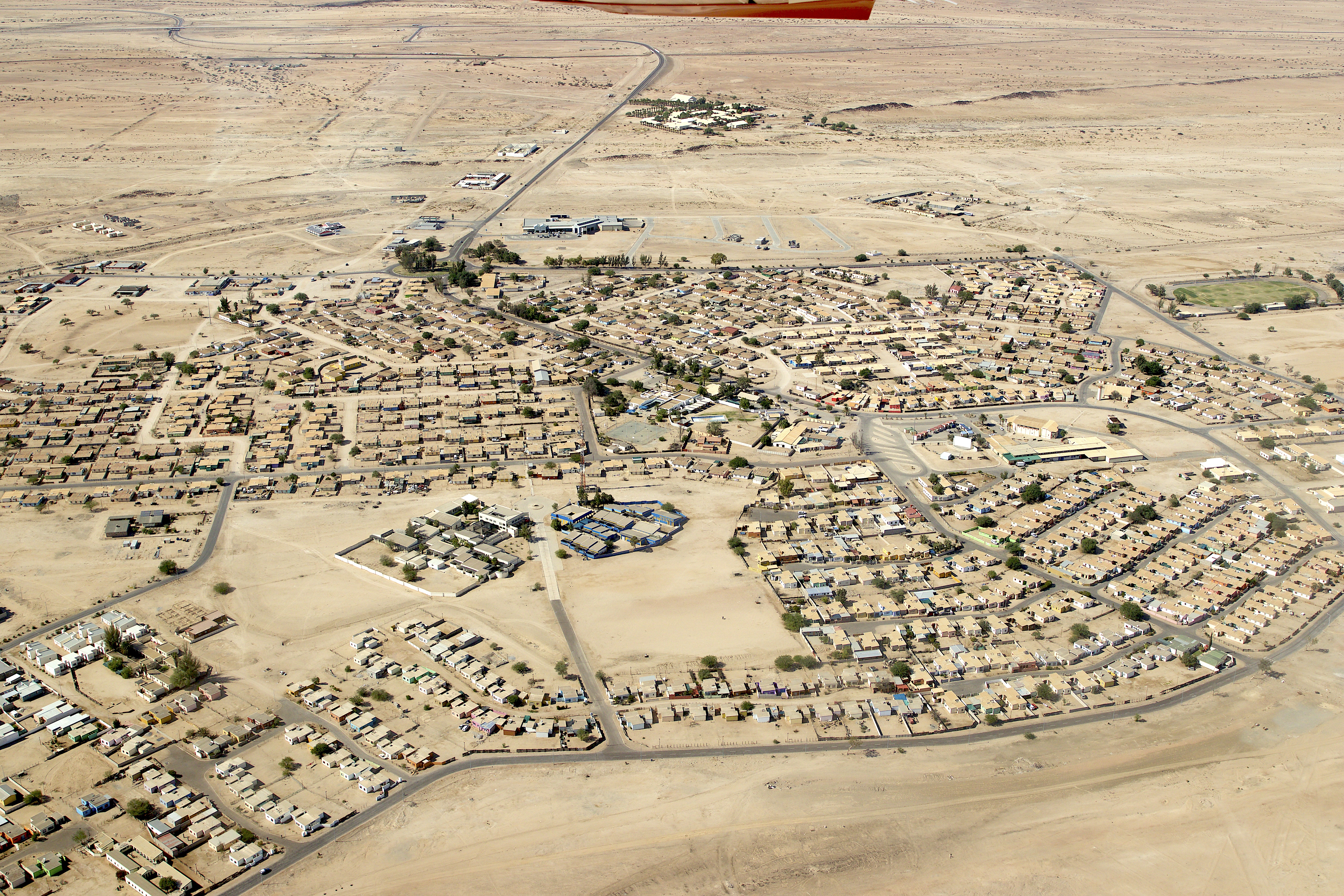
From the air, Rossing is unmistakable. The open pit carves a pale, terraced gash into the desert floor, ringed by haul roads that spiral downward in concentric loops. The town of Arandis, purpose-built to house mine workers, sits a few kilometers to the north -- a small grid of streets in an otherwise empty landscape. Swakopmund and the Atlantic coast lie 70 kilometers to the west. The Namib stretches in every other direction, one of the oldest deserts on Earth, its geology so complex that NASA's Earth Observatory has featured satellite imagery of the Rossing area as a case study in mineral-rich terrain. Rossing is the largest of three uranium mines operating in the Namib; Langer Heinrich and Husab, the latter under Chinese ownership, account for the rest. Together they make Namibia a significant player in the global nuclear fuel chain -- a role that sits uneasily alongside the country's conservation-minded identity and its vast, fragile desert landscapes.
From the Air
Rossing uranium mine is located at 22.48S, 15.06E in the Namib Desert, approximately 70 km east of Swakopmund. The open pit is clearly visible from altitude as a large terraced excavation in the desert terrain. The town of Arandis (nearby company town) is visible to the north. Nearest major airport is Walvis Bay Airport (ICAO: FYWB), approximately 65 km to the southwest. Swakopmund has a smaller airfield. The coastal fog belt from the Atlantic frequently extends inland, sometimes obscuring the mine area in morning hours. The surrounding terrain is flat to gently undulating desert with minimal vegetation.