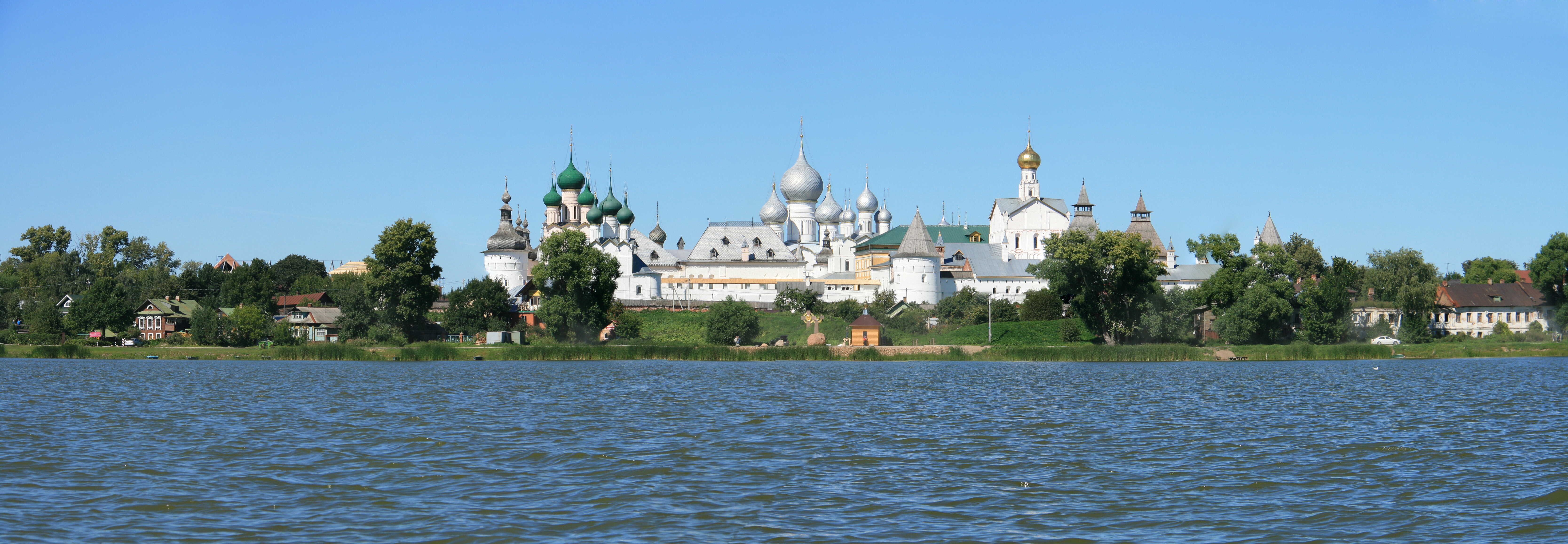
Rostov Kremlin
Fifteen bells hang in the belfry of Rostov Kremlin, and the largest weighs 2,000 poods -- roughly 32 metric tons of bronze cast in 1688 by a master named Flor Terentyev. When all fifteen sound together, the chord carries across Lake Nero and into the flat Yaroslavl countryside, a sound so distinctive that compositions were written specifically for this set of bells. But the Kremlin that houses them is itself a kind of composition: not a military fortress, despite its towers and crenellated walls, but a walled ecclesiastical city built to glorify the Rostov diocese, one of the oldest and most powerful in Russia.
The Bishop Who Built a Paradise
Metropolitan Jonas Sysoevich arrived in Rostov in 1652, and over the next four decades he transformed a modest diocesan compound into one of Russia's most extraordinary architectural ensembles. Jonas had a unified vision, rare for the era, and he executed it with remarkable consistency. The Metropolitan's Court, the Cathedral Court, the Metropolitan Garden, and the Stable Yard were all designed as parts of a single integrated whole. Fortress walls and eleven towers enclosed the complex, complete with loopholes and battlements, but their windows were too wide and their decoration too lavish for serious military purpose. The towers served as stage sets, projecting ecclesiastical authority rather than repelling invaders. Inside, Jonas commissioned churches, ceremonial halls, a bakery, treasury rooms, and gardens -- a self-contained world where the spiritual and the administrative intertwined behind walls of white and brick.
Stone and Fresco
The oldest structure in the Kremlin predates Jonas by more than a century. The Assumption Cathedral was erected between 1508 and 1512 on the foundations of a wooden church first built in 991, just three years after Christianity arrived in Kievan Rus'. An Italian architect from Venice designed the present building, and the fusion shows: the composition follows medieval Russian tradition with its six columns, triple apse, and five domes, while the decorative details carry the signature of late Venetian Gothic. Inside, the original walls were painted to imitate brick, a strange austerity that lasted until 1670, when Metropolitan Jonas commissioned a full program of frescoes. Those 17th-century paintings survive beneath a later oil overlay applied in 1843, partially restored and still luminous. Nearby, the Church of the Resurrection introduced something unprecedented: Russia's first high stone iconostasis executed entirely in fresco, replacing the traditional wooden screen with painted architecture.
A Fortress That Never Fought
Walk the walls and you notice something odd. The loopholes are there -- plantar, oblique, and upper battle positions, exactly as military engineering prescribed. The towers rise with proper defensive geometry. But then you see the ornamental window frames, the polychrome tile work, the elaborate brick patterns that no military architect would waste time on. The Kremlin's fortifications were a theological statement, not a strategic one. Jonas wanted to project the image of a heavenly city, and the crenellated walls were part of the iconography. The Red Chamber, built between 1670 and 1680, exemplifies this fusion of grandeur and impracticality: a reception building with a magnificent double-tent porch, its volumes arranged with a picturesqueness that would make any defensive position commander weep. After Jonas's death, the Rostov diocese declined in importance. The Metropolitan see was transferred to Yaroslavl in 1788, and the Kremlin buildings began a slow deterioration that lasted into the 19th century.
Rescued from Ruin
By the mid-1800s, the Kremlin was crumbling. Locals proposed demolishing the walls to salvage building material. What saved the ensemble was a campaign led by Rostov merchants, who in the 1880s began restoring the complex at their own expense and eventually opened it as a museum. Their timing proved crucial. During the Soviet period, many monasteries and ecclesiastical buildings across Russia were demolished or converted beyond recognition, but the Rostov Kremlin's established museum status offered a measure of protection. In 1998, the ensemble was added to UNESCO's tentative list of World Heritage Sites. Today it stands as one of the best-preserved 17th-century architectural complexes in Russia, its painted interiors and bell tower largely intact, the Metropolitan Garden replanted, the whole ensemble still legible as the single coherent vision Jonas intended three and a half centuries ago.
Bells Over the Lake
The belfry was built around 1682, and Moscow masters Philip and Cyprian Andreev cast the first two great bells that year: Polyeleine at 1,000 poods and Swan at 500. Six years later came Sysoy, named for Jonas's father, so massive it required a dedicated tower extension on the belfry's north facade. The set of fifteen bells was never broken up or melted down, a near-miracle given the centuries of upheaval that followed. Each bell has a distinct voice, and the traditional Rostov bell-ringing patterns, specific compositions that exploit the unique harmonics of this particular set, have been passed down and recorded. From the air, the Kremlin sits at the northern edge of Rostov on the shore of Lake Nero, its white walls and silver domes forming a compact geometric cluster against the flat, watery landscape. It looks exactly like what Jonas intended: a walled city, complete and self-contained, dropped into the Russian plain.
From the Air
Located at 57.18N, 39.42E on the northern shore of Lake Nero in Rostov, Yaroslavl Oblast. The Kremlin complex is visible as a compact walled enclosure with distinctive white walls and silver/green domes. Lake Nero extends south, providing excellent visual contrast. Best viewed at 3,000-5,000 ft AGL. Yaroslavl (Tunoshna) Airport (UUDL) is approximately 50 km northeast. The city of Rostov sits along the Golden Ring route between Moscow and Yaroslavl.