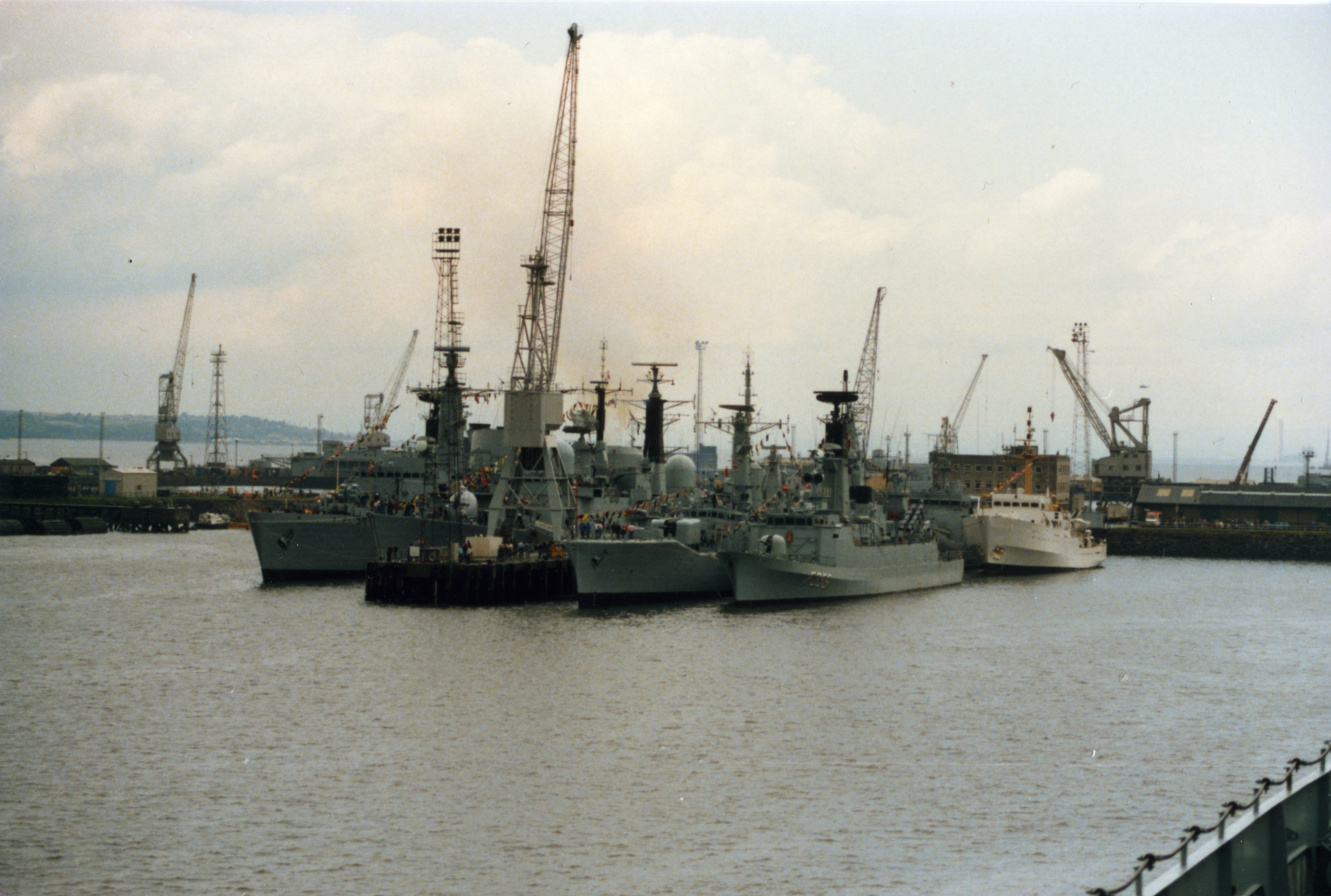
Rosyth Dockyard
In 1903, the British Admiralty approved a plan to build a major naval dockyard on the Firth of Forth. The estimated cost was three million pounds for construction and a quarter of a million for machinery, spread over ten years. The site would encompass 1,184 acres of land and 285 acres of foreshore, with a main basin large enough for eleven battleships -- or twenty-two if they doubled up. The reason was simple: Germany. The Anglo-German naval arms race was accelerating, and the Royal Navy needed a major facility on Britain's eastern seaboard to counter the threat from across the North Sea. Construction began in 1909. Over the following century, Rosyth Dockyard would serve through two world wars, refit nuclear submarines, assemble the largest warships ever built for the Royal Navy, and face the question of what a naval dockyard becomes when the navy it was built for changes beyond recognition.
Two World Wars
The dockyard grew rapidly during the First World War. The first ship to enter dry dock was a pre-dreadnought battleship on 28 March 1916 -- just weeks before the Battle of Jutland sent the Grand Fleet into action from its anchorage in the Firth of Forth. The Metropolitan Police's No. 6 Division was established on 1 January 1916 specifically to patrol the yard, reflecting its importance to national security. Between the wars, the dockyard served as a storage and maintenance facility. During the Second World War, it returned to full operational intensity, servicing warships engaged in the Battle of the Atlantic and operations in the North Sea. The dockyard's strategic position -- sheltered within the Firth of Forth, close to the open sea but protected from direct naval attack -- proved as valuable in 1939 as it had been in 1914.
Nuclear Submarines
In 1984, Rosyth was designated the sole location for refitting the Royal Navy's nuclear submarine fleet, a role it was already specializing in. Extensive rebuilding began in 1986 to accommodate the specialized requirements of nuclear propulsion work -- radiation containment, decontamination facilities, and the infrastructure needed to handle reactor components. Then, in 1993, the government reversed its decision and transferred the refitting role to Devonport Dockyard in Plymouth. Rosyth's new primary role became nuclear submarine decommissioning. By 2007, seven decommissioned nuclear submarines were stored at the dockyard. In 2018, the Public Accounts Committee criticized the slow pace of work, with the Ministry of Defence admitting it had deferred decommissioning due to cost. The process is currently expected to be completed by 2035.
Building Carriers
The most visible transformation of the dockyard came with the Queen Elizabeth class aircraft carriers. At 65,000 tonnes and 280 meters in length, HMS Queen Elizabeth and HMS Prince of Wales are the largest warships ever constructed for the Royal Navy. They were built in sections at six shipyards across the United Kingdom and transported to Rosyth for final assembly -- a process that required a massive Goliath crane and the expansion of the dockyard's facilities. The assembly work gave Rosyth a new identity: not simply a place where ships were repaired but a place where the largest were built. The Type 31 frigates are now under construction at the dockyard, continuing the shipbuilding role.
Privatization and Persistence
Rosyth ceased to be a Royal Naval Dockyard in the 1990s. A consortium of Babcock International and Thorn EMI won the management contract in 1987, and in 1997, Babcock purchased the yard outright after being the only company to submit a bid. The MoD retains a presence at the former dockyard through MoD Caledonia, which holds a small naval garrison. The admiral-superintendent system that had governed the dockyard since 1832 was abolished in 1971, when the title was changed to port admiral -- a distinction without much difference, as the role was itself abolished in 1983. The dockyard's workforce has fluctuated with its changing missions, but the site persists. It was built to counter a threat from Imperial Germany. It now dismantles Cold War submarines and builds warships for a navy its founders would barely recognize.
From the Air
Rosyth Dockyard is at 56.021N, 3.453W on the north shore of the Firth of Forth in Fife, Scotland. The large dockyard basin, dry docks, and Goliath crane are visible from altitude. The Forth Bridge, Forth Road Bridge, and Queensferry Crossing are approximately 2 nm to the east. Nearest airports: Edinburgh (EGPH) approximately 10 nm south; Fife Airport (EGPJ) approximately 20 nm northeast. Best viewed at 2,000-4,000 ft.