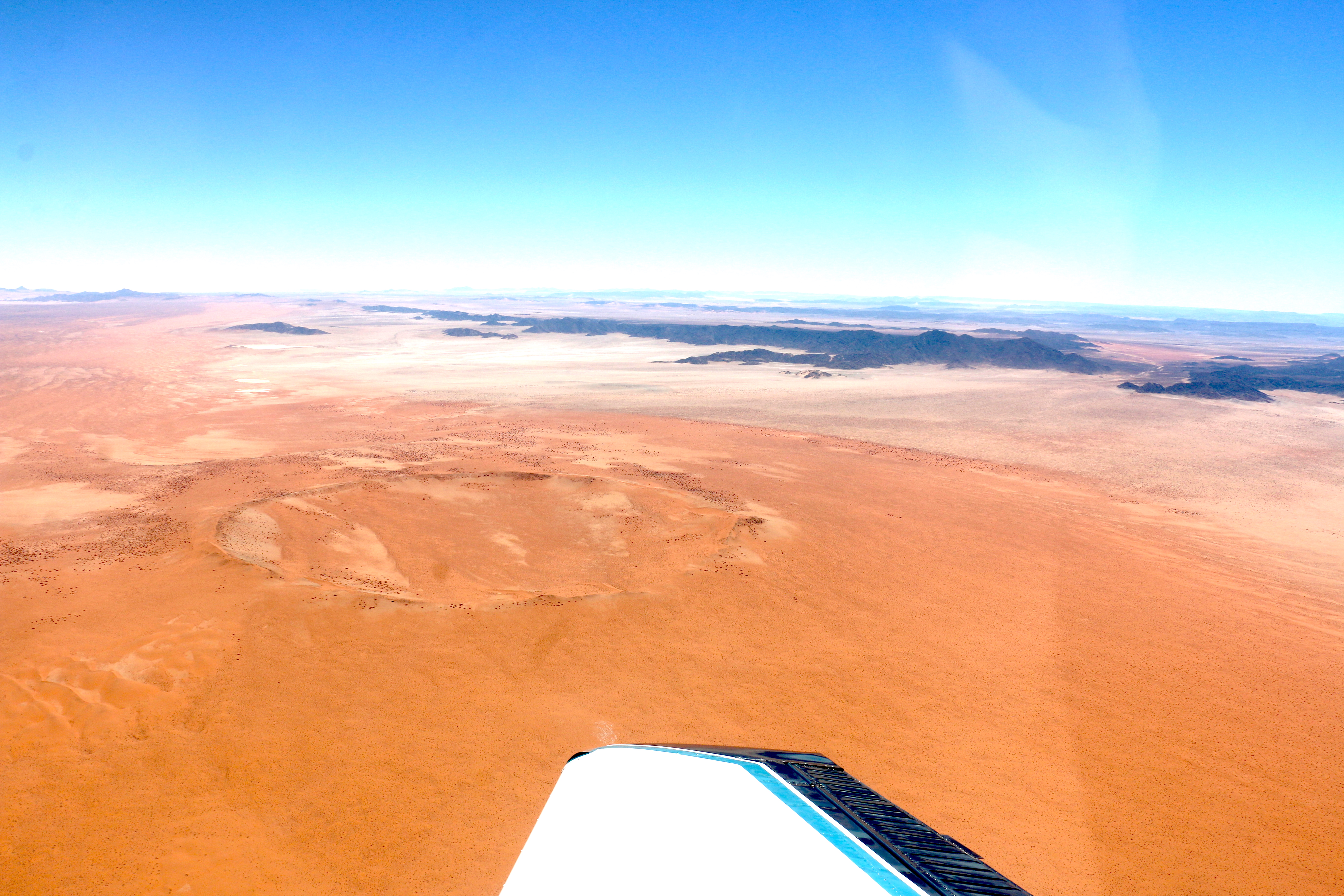
Roter Kamm Crater
Something the size of an SUV hit the ground here at cosmic velocity, and the Earth has spent nearly five million years trying to forget. Roter Kamm -- German for "Red Ridge" -- is a 2.5-kilometer-wide impact crater buried in the Sperrgebiet, the forbidden diamond zone of southern Namibia. From the air, it appears as a near-perfect circle notched into the rust-colored desert, its rim rising above the surrounding gravel plains while sand dunes creep steadily across its floor. No fragment of the meteorite has ever been found. The impact vaporized it entirely, leaving only shattered rock and a wound in the Earth's crust that geologists have studied for decades.
A Blow to Ancient Bedrock
When the meteorite struck, it slammed into Precambrian granitic gneiss belonging to the Namaqua Metamorphic Complex -- rock that was already more than a billion years old at the time of impact. The collision, estimated at 4.81 million years ago during the Pliocene, produced a crater 130 meters deep and scattered breccias and pseudotachylites through the basement rock, signatures of the catastrophic pressures involved. For a crater this small, the volume of shattered and melted rock is unusual. Anomalous quartz found along the rim preserves fluid inclusions that point to hydrothermal activity after the impact, suggesting that the collision's heat drove mineral-laden water through fractures in the surrounding rock long after the initial blast had subsided.
The Desert's Slow Burial
Roter Kamm is a crater in the process of disappearing. The Namib's migrating sand dunes have filled its interior with deposits at least 100 meters thick, masking the original crater floor and much of the ejecta blanket. Wind -- the dominant sculptor here -- has been reshaping the structure for millions of years, scouring the exposed rim while simultaneously burying the basin. Alluvial processes played a role in earlier phases of erosion, but today it is the relentless aeolian action that defines the crater's evolution. From ground level, the rim reads as a low ridge in the desert. From altitude, the geometry is unmistakable: a clean circular depression surrounded by the chaotic dune fields of the central Namib.
Locked Behind the Diamond Fence
The Sperrgebiet -- literally "forbidden territory" -- was declared off-limits by the German Empire in 1908 after the discovery of diamonds near the coast. More than a century later, access remains tightly controlled by Namdeb, the joint venture between De Beers and the Namibian government. This accident of geology and economics has kept Roter Kamm remarkably undisturbed. There are no roads to the crater, no visitor facilities, no footpaths worn across its rim. Scientists who have studied it -- notably Wolf Uwe Reimold, Christian Koeberl, and R. McG. Miller across dozens of published papers from the 1980s through the 2000s -- required special permits and expedition logistics to reach the site. The crater sits approximately 80 kilometers north of Oranjemund and 12 kilometers southwest of Aurus Mountain, isolated even by Namibian standards.
Reading the Scar from Above
Roter Kamm is one of those geological features that reveals itself best from altitude. NASA's Landsat satellites and the Space Shuttle's SAR-C/X-SAR radar have both imaged the crater, and it has appeared in false-color radar composites that cut through the sand cover to reveal the underlying structure. From a flight path at 10,000 to 15,000 feet, the crater's circular rim stands out against the orange-brown monotony of the surrounding desert -- a geometry too perfect to be anything but an impact. It is one of fewer than 200 confirmed impact craters on Earth, and one of a handful in Africa. In a landscape where the wind erases almost everything, the crater endures as evidence that some events leave marks even a desert cannot fully erase.
From the Air
Roter Kamm crater is at 27.77°S, 16.29°E in the Sperrgebiet of southern Namibia. Best viewed from 10,000-15,000 feet AGL, where the 2.5 km circular rim is clearly visible against the surrounding dune fields. The crater lies approximately 80 km north of Oranjemund. The nearest airfield is Oranjemund Airport (FYOE), roughly 80 km to the south. Alexander Bay Airport (FYAB) across the South African border is another option. Note that the Sperrgebiet is restricted airspace; overflight clearance may be required. Visibility is generally excellent in this arid region, though sand haze can reduce contrast.