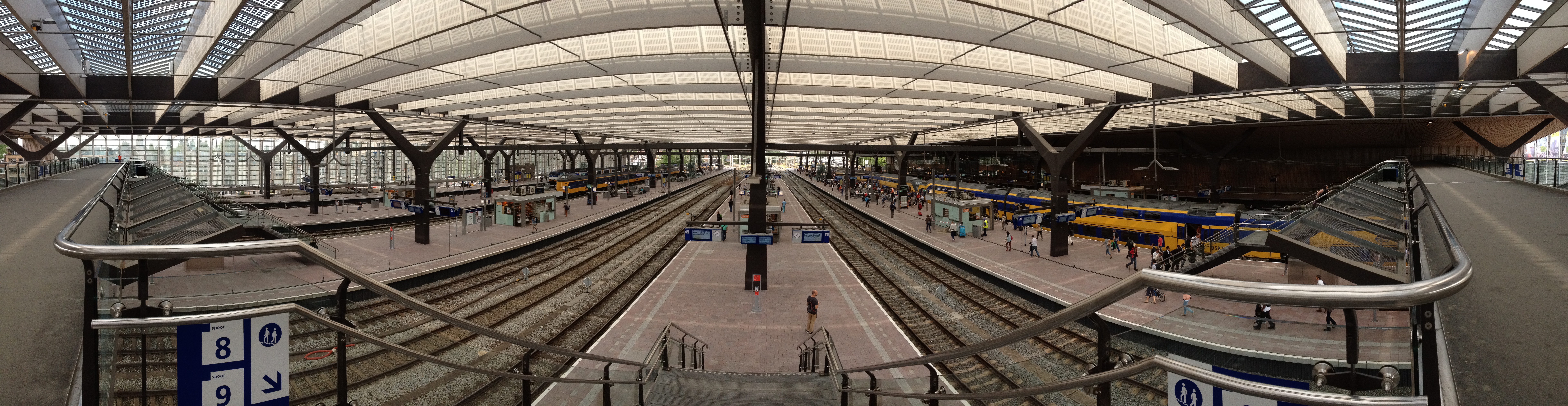
Rotterdam Centraal station
Stand on Stationsplein and look up. The roof of Rotterdam Centraal does not so much cover the entrance as point at it, a long wedge of stainless steel and glass aimed directly down the Kruisplein toward the city center. The architects, a collective called Team CS, drew it that way on purpose. Before World War II Rotterdam had four different railway stations and no single front door. After the Blitz, after the postwar rebuild, and after a second teardown in 2007, the city finally has one: a building that arrived on 13 March 2014 when King Willem-Alexander cut the ribbon, and that now handles an average of 112,000 passengers every day.
Before There Was a Centraal
Pre-1940 Rotterdam was a transportation puzzle. Four separate stations served the city: Delftsche Poort handled westbound trains to Schiedam, The Hague, and Amsterdam plus eastbound traffic to Dordrecht. Rotterdam Beurs connected to Delftsche Poort. Rotterdam Maas was the eastern terminus for trains to Gouda and Utrecht. Rotterdam Hofplein ran an alternative line to The Hague and Scheveningen. Travelers transferred between them on foot or by tram. The Rotterdam Blitz, the German bombing campaign of May 1940 that destroyed much of the old city center, did not spare the stations. Delftsche Poort was wrecked. Maas was badly damaged and closed for good in 1953. After the war, the city's planners drew up a single replacement just west of the old Delftsche Poort site.
Van Ravesteyn's Modernist Front Door
The first Rotterdam Centraal opened in two stages: completed on 13 March 1957, officially opened on 21 May. The architect was Sybold van Ravesteyn, working in a postwar modernist register. The lettering Centraal Station that he placed on the roof became part of the city's visual identity. Princess Beatrix opened the first Dutch metro line at the same station on 9 February 1968. Maas station's traffic was rerouted in, then the Hofpleinlijn was converted to light rail in 2006 and folded into RandstadRail. By the early 2000s the station was handling about 110,000 passengers a day in a building designed for far fewer. Projections suggested 320,000 daily passengers by 2025. Something had to change.
TRAAN LATEN
On 2 September 2007 Mayor Ivo Opstelten presided over the final closure of Van Ravesteyn's station. As a goodbye gesture, the artists Peter Hopman and Margien Reuvekamp rearranged some of the old roof letters from Centraal Station into the Dutch phrase TRAAN LATEN, Shed a Tear. Demolition followed from January to March 2008. Rotterdam Centraal became the first major postwar Dutch railway station to be deliberately taken down to make way for a new one. For years passengers used a smurf-blue temporary shelter on Conrad Street while the rebuild proceeded around them. The bicycle tunnel served as the passenger tunnel. Then on 28 November 2012 the new passenger tunnel opened, six times larger than the one it replaced. On 13 March 2014, fifty-seven years to the day after the original opened, King Willem-Alexander reopened the rebuilt station.
Team CS and the Angled Roof
In June 2004 ProRail, NS, and the City of Rotterdam awarded the design contract to Team CS, a collaboration between Benthem Crouwel Architekten, MVSA Meyer & Van Schooten Architects, and West 8. They produced the now-famous angled stainless-steel canopy on the south facade, pointing toward the Weena and the city center, with the original Centraal Station lettering returned to its place at the explicit request of Rotterdam's residents. Underneath, the station now carries Eurostar services to London. Some additional security infrastructure was finished in March 2018. On 4 February 2020 the Dutch Minister of Infrastructure and the UK Transport Secretary announced that juxtaposed border controls would let Eurostar passengers clear UK entry checks in the station before boarding. The COVID-19 pandemic delayed the launch. Juxtaposed controls finally went live on 26 October 2020.
Thirteen Tracks and a Living Room
The mainline platforms at Rotterdam Centraal carry seven island platforms and thirteen platform tracks. The metro station was completely rebuilt and opened on 28 September 2009, with three tracks and two island platforms; on the middle track, the train doors open on both sides, a small acrobatic detail. Almost every line in Rotterdam's tram network calls here. Underneath the south side sits an underground bicycle parking facility with room for more than five thousand bikes. There is a Station Living Room, two supermarkets, a HEMA, two Starbucks branches. From Stationsplein you can ride a Eurostar to London or a 44 bus to the Erasmus Medical Center. Or you can simply stand and watch the angled roof catch the late afternoon light, and understand why the city insisted on getting the lettering exactly right.
From the Air
Coordinates 51.93 N, 4.47 E. Rotterdam Centraal sits just north of the city center, with the distinctive angled stainless-steel canopy clearly visible from cruising altitude. Cruise at 3,000 to 5,000 feet for the best view of the station and the surrounding Weena and Kruisplein area. Nearest airports: Rotterdam The Hague (EHRD) 6 km north; Amsterdam Schiphol (EHAM) 55 km northeast. The station's roof points southeast, lining up with the high-rise spine of the modern city center.