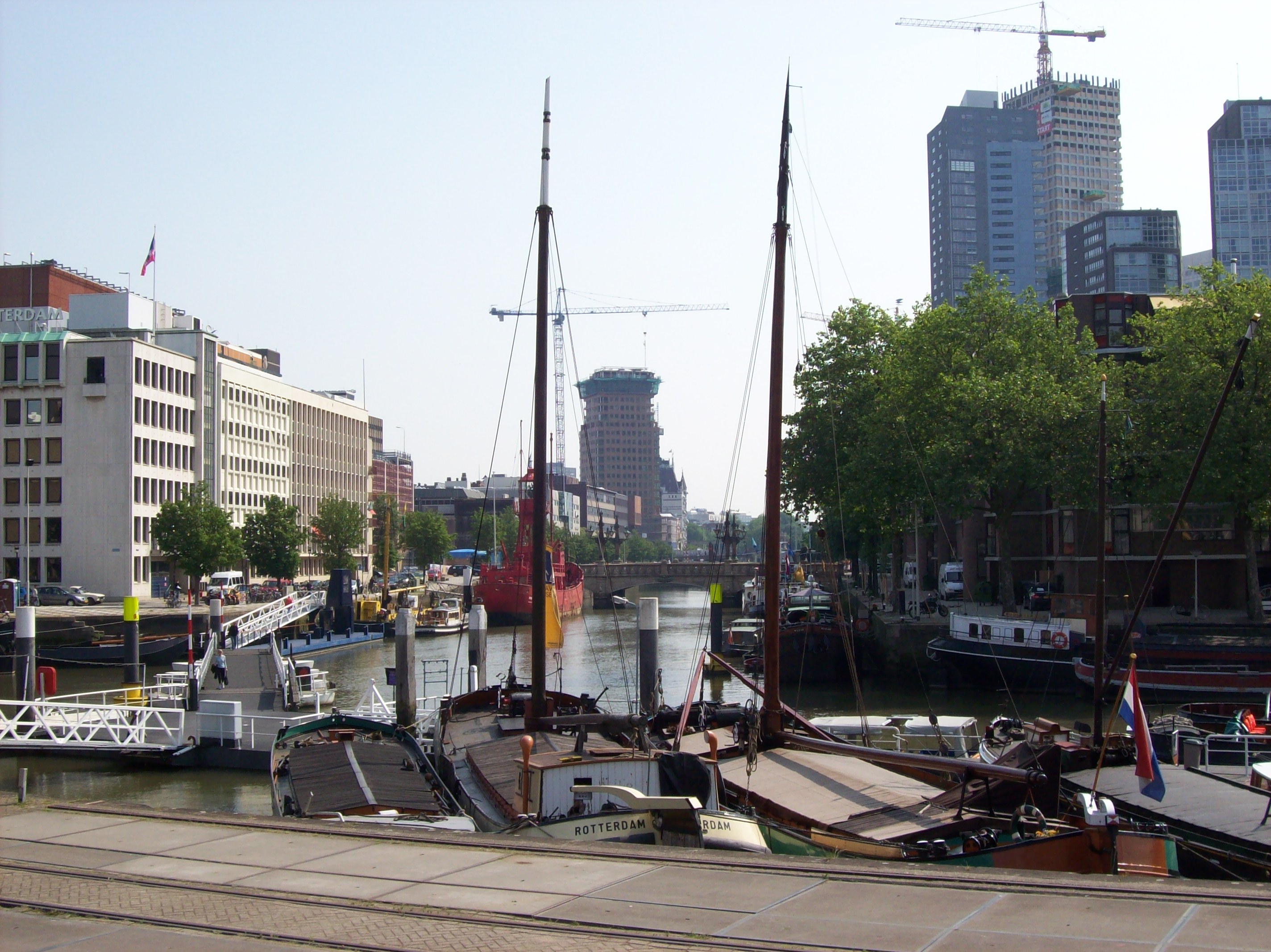
Rotterdam Centrum
On the afternoon of 14 May 1940, the medieval heart of Rotterdam ceased to exist. German bombers turned the Stadsdriehoek - the City Triangle that had organized this place since the late medieval period - into a smoking field of foundations and bent tram rails. Eighty-five years later, that absence is what makes Centrum extraordinary. Where Amsterdam preserves its golden age in canal-house amber and Delft polishes its tiles, Rotterdam's central district has no choice but to look forward. The Erasmusbrug arcs like a white harp across the Nieuwe Maas. The Cube Houses tilt at forty-five degrees as if frozen mid-tumble. The Markthal vaults a horseshoe of apartments over a food hall painted with cornucopia. The Dutch have a phrase for cities like this one - Manhattan aan de Maas - and they mean it as a compliment.
The Triangle That Stayed
Pull up a Google satellite view and the bones are still visible: a rough triangle bordered by the Coolsingel to the west, the Goudsesingel to the northeast, and the Nieuwe Maas to the south. This is the Stadsdriehoek, and it has held this shape since the late medieval period, when the southernmost point of Rotterdam was a spot called Blaak - still the name of the metro station that drops you beside the Cube Houses today. In the sixteenth century, merchants reclaimed land east of the old wall and named it the Waterstad, the Water City, a grid of basins where Rhine barges and seagoing ships exchanged cargo. Almost none of that survives as buildings. But the street pattern, the kink in the river, the way the city tilts toward the water - that geometry is older than any wall in town.
Het Witte Huis
Walk to the Oude Haven at sunset and you will see a slender white tower watching over a basin of pleasure boats. This is Het Witte Huis - the White House - completed in 1898 and, for a brief moment, the tallest office building in Europe at forty-three meters. Ten stories felt vertiginous on a Dutch skyline that rarely cleared four. The art-nouveau building survived the May 1940 bombing almost untouched while the city around it burned, an accident of geography that left it stranded among ruins, then among postwar voids, and finally among the steel-and-glass towers of the Kop van Zuid across the river. Tourists who arrive expecting only Cube Houses are usually startled to find this nineteenth-century skyscraper still standing watch, drink in hand, on the edge of its rebuilt city.
The First Pedestrian Street
Two ideas were born in Rotterdam Centrum that would later travel the world. The first was the Lijnbaan, opened in 1953 - the first purpose-built pedestrianized shopping street anywhere. Architects Van den Broek and Bakema laid it out as a series of low concrete blocks with wide flagstone promenades between them, and shoppers walked it without dodging cars from the very first day. Within a decade, planners from Coventry to Stockholm were studying the Lijnbaan drawings. The second idea is harder to admire but harder to forget: the Koopgoot, literally Buying-Gutter, a sunken shopping street that dips below street level near Beurs metro station and connects the city's department stores in a subterranean promenade. Locals nicknamed it before the official name caught on, and the official name lost. Ask for the Koopgoot. You will be understood.
Witte de With and the Night
After dark the Centrum scatters. Around the Oude Haven, business and law students cluster at terraces watching the lights flicker on the Hef railway lift bridge in the distance. On the Pannenkoekstraat, designers and boutique owners pour mojitos. The Eendrachtsplein-Nieuwe Binnenweg axis draws the music-school crowd into cafes like Rotown and Stalles. But the street locals will send you to is Witte de Withstraat, named for a seventeenth-century admiral and now the most concentrated stretch of contemporary-art galleries, cocktail bars and good restaurants in the south of the Netherlands. The Witte de With Center for Contemporary Art occupies a former school. MAMA shows moving-image work in a converted shop. In February the International Film Festival Rotterdam takes over half the venues on this single street. It is a Rotterdam-specific kind of nightlife: low ceilings, loud talk, no pretense.
Saint-Lawrence and the Architect
One building did survive 14 May 1940, and it survived only as a shell. The Sint-Laurenskerk - Saint Lawrence Church - lost its roof, its windows and most of its furnishings, but the late-Gothic walls held. For years after the war, Dutch architects argued bitterly over whether to demolish the ruin and replace it with something modern, or rebuild what had been lost. The traditionalists won; the church was painstakingly restored across two decades and reopened in 1968. It now sits among glass towers and shopping galleries as the last medieval breath of a vanished old town, the only building in the Stadsdriehoek that remembers what Rotterdam looked like before the planes arrived. Stand inside on a quiet morning and the silence is unusually thick. The city outside has decided to be something else; the church has decided to remember.
From the Air
Rotterdam Centrum centers at 51.92 N, 4.47 E, on the north bank of the Nieuwe Maas. The Erasmusbrug - a single 139-meter white pylon supporting an asymmetric cable-stay span - is the most reliable visual landmark from cruising altitude. The Euromast tower (185 m) and the cluster of Kop van Zuid skyscrapers across the river also catch the eye. Rotterdam The Hague Airport (EHRD) lies about 6 km north-northwest with a single runway 06/24; Amsterdam Schiphol (EHAM) is roughly 55 km north-northeast. North Sea proximity means frequent low overcast and persistent westerlies; expect visibility under 5 km in autumn and winter.