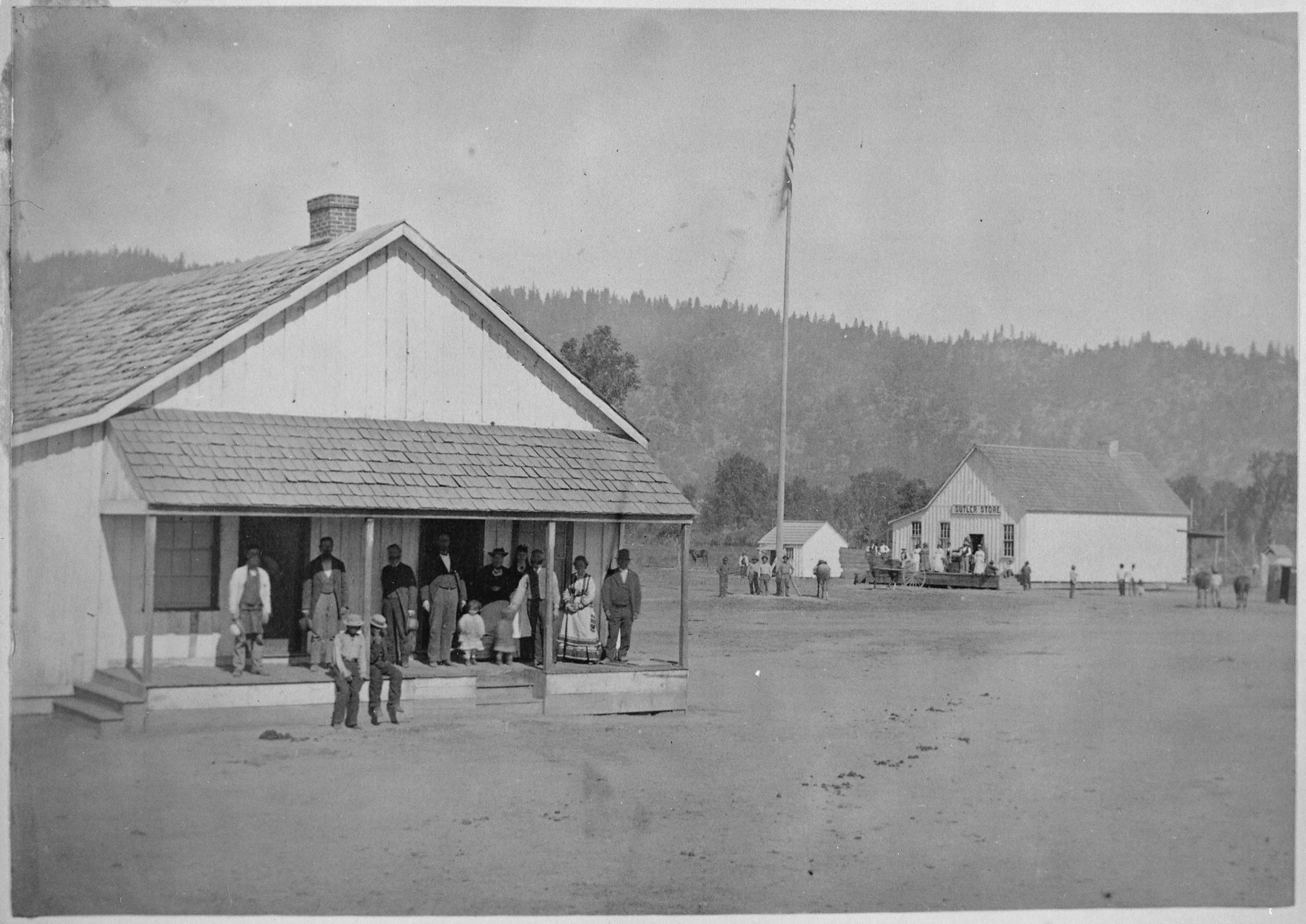
Round Valley Indian Reservation
The word used to describe what happened here was 'drive.' Federal agents and settlers would round up Native Americans like cattle and drive them across mountain passes to Round Valley, corralling them behind high picket fences. The elderly and sick often did not survive the journey. One hundred miles of forced marching in 1863 became known as the Concow Trail of Tears. Today, the Round Valley Indian Tribe represents seven distinct peoples who found unity not through choice, but through collective survival of genocide and displacement.
The Valley of Strangers
In 1856, the federal government designated Round Valley as the Nome Cult Farm, an extension of the Nomi Lackee Reservation in the Sacramento Valley. But Round Valley was already home to the Yuki people, and the government's plan was unprecedented: they would be forced to share their ancestral homeland with their traditional enemies. The Wailaki, Concow, Little Lake Pomo, Nomlaki, and Pit River peoples arrived speaking different languages, practicing different beliefs, using the land in different ways. Seven distinct cultures were compressed into a single valley, expected to survive together under armed guard. The Yuki watched as strangers were driven onto their land year after year, each group carrying the trauma of displacement, each struggling to find place and meaning in this forced community.
Blood in the Valley
Between 1850 and 1870, the violence in Round Valley reached catastrophic proportions. Future California Supreme Court Chief Justice Serranus Clinton Hastings funded militia campaigns that killed at least 283 men, women, and children in and around the valley. The perpetrators were paid or reimbursed by the State of California for their expenses. Fort Wright was established in December 1862 on the valley's western edge, ostensibly to protect Native Americans from settler attacks. But the soldiers soon found different work: as part of the Bald Hills War, they were deployed to capture Indigenous people throughout the region and bring them to confinement on the reservation. What was meant to be protection became enforcement of imprisonment.
Paper and Land
President Ulysses S. Grant formally established the reservation by Executive Order on March 30, 1870. Then came the laws that would reshape everything. The Dawes Act of 1887 subdivided reservation land into individual plots distributed to families, opening the door to private ownership but also to loss. By 1920, when allottees could obtain deeds and pay taxes, many Round Valley people lost their land, unable to afford the new tax burden or pressured into selling. The Indian Reorganization Act of 1934 attempted to reverse course, putting land back into trust status and requiring elected tribal councils. The peoples of Round Valley wrote a constitution and formed a government that still functions today, though the land that was lost did not return.
Seven Voices, One People
The linguistic diversity of Round Valley presented its own challenge. The Yuki language belongs to the Northern Yukian family, distinct from any of the surrounding language families. The forced confederation brought together speakers of Athabascan, Penutian, and Hokan languages with no common tongue. The Round Valley Indian Tribe today acknowledges the difficulty this posed for their ancestors but affirms that cultural unification was reached through collective experience on the reservation. The 2020 census counted 454 residents on the reservation, which spans approximately 36 square miles across northern Mendocino County with a small portion extending into Trinity County. Two-thirds of the tribal land area is off-reservation trust land, including about 405 acres in the community of Covelo.
Memory and Continuity
In recent years, members of the Round Valley Indian Tribe have retraced the 1863 route of the Nome Cult walk, the forced relocation that brought the Concow Maidu from Chico to Covelo. The march is an act of remembrance and reclamation, a refusal to let the Trail of Tears fade from memory. The valley itself remains as it was when the Yuki first called it home: ringed by mountains, isolated from the main arteries of California commerce, a world apart. The confederation born of federal violence has become something its creators never intended: a community that chose to remain, to remember, and to persist.
From the Air
Round Valley lies at 39.89 degrees N, 123.33 degrees W in a bowl-shaped valley surrounded by the Coast Ranges of northern Mendocino County. The community of Covelo marks the valley floor at approximately 1,400 feet elevation. Approach from the east following Highway 162 through the Mendocino National Forest, or from the west via Laytonville. The nearest significant airport is Ukiah Municipal (KUKI), roughly 45 miles south. The valley's isolated geography is immediately apparent from the air: a green basin enclosed by forested ridges with limited road access.