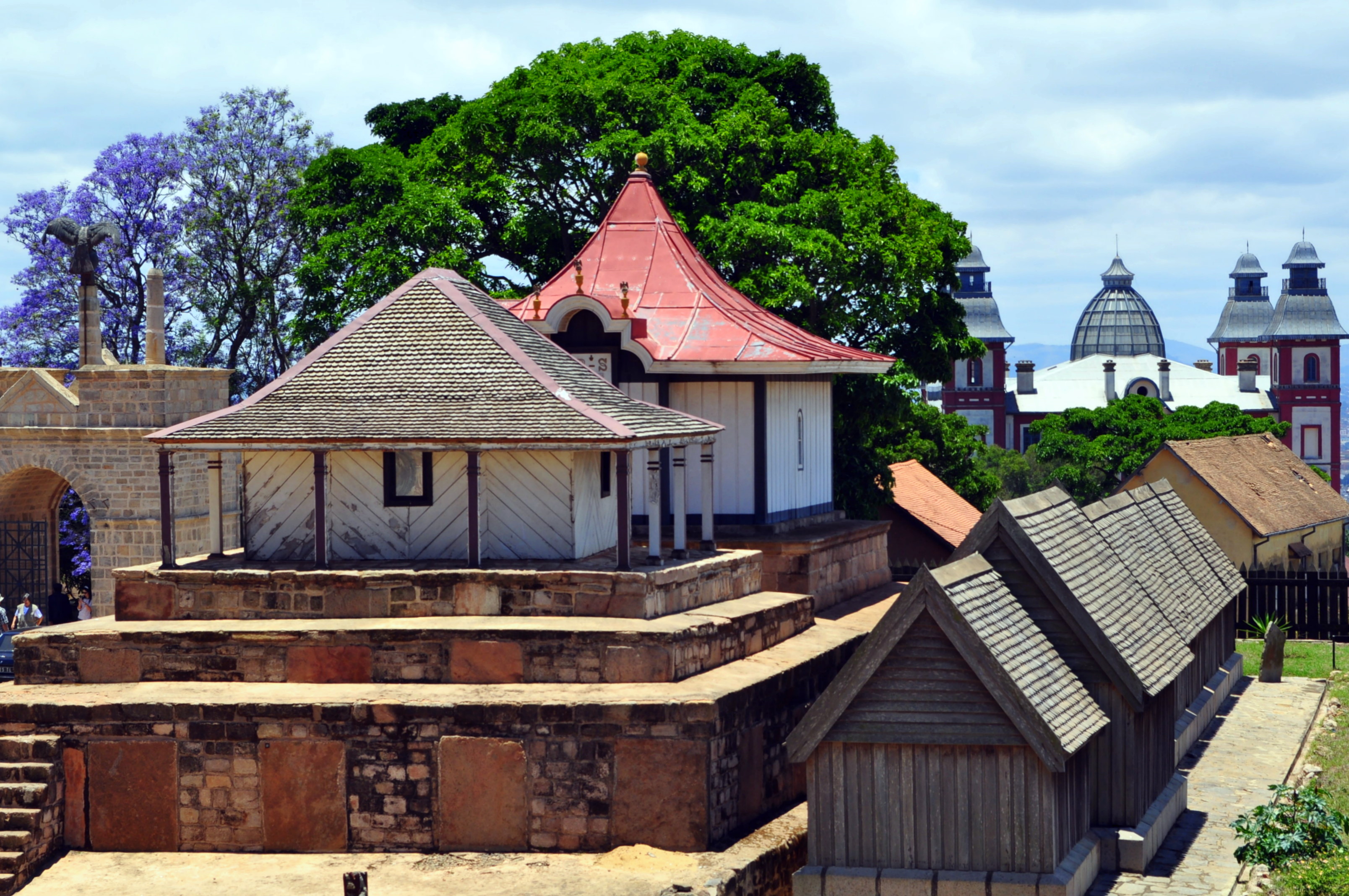
Rova of Antananarivo
On the night of 6 November 1995, fire consumed the Rova of Antananarivo. The royal palace complex had stood on Analamanga -- the highest hill in Madagascar's capital -- since roughly 1610, when Merina King Andrianjaka captured it from a Vazimba ruler and erected the first fortified structures. For nearly three centuries it served as the seat of Merina sovereignty, accumulating palaces, tombs, and sacred buildings that embodied the kingdom's political authority. It was about to be inscribed as a UNESCO World Heritage Site. Then, in one night, it burned. The official verdict was accident. The persistent rumor is arson.
Silver Hands on the Rooftop
The Rova grew by accretion. Andrianjaka founded it with three buildings and a tomb site in the early 17th century. By the late 18th century, under King Andrianampoinimerina, the compound held approximately twenty structures. Each bore a name that revealed its purpose or character. Manjakamiadana -- "Where It Is Pleasant to Rule" -- was also called Felatanambola, "Silver Hands," for the hand-shaped sculptures crafted from melted silver coins and mounted on its four roof horns. Marivolanitra -- "Beneath the Heavens" -- reportedly featured a staircase to a rooftop observation deck from which the king surveyed the plains below. Besakana, erected by Andrianjaka himself, was considered the throne of the kingdom. These were not merely residences but expressions of cosmological order, their positions within the compound arranged according to systems that assigned sacred significance to cardinal directions, with the northeast holding the highest spiritual value.
A Palace Encased in Stone
The 19th century transformed the Rova from a collection of wooden buildings into something grander. When King Radama I returned from a military campaign on the east coast in 1817, he brought with him a Creole craftsman named Louis Gros from Mauritius. Gros built Tranovola -- the "Silver House" -- introducing a revolutionary design: two stories, a veranda, glass windows, multiple interior rooms, and a shingled roof. The building became the template for highland architecture throughout Madagascar. But the most dramatic change came later. Between 1839 and 1841, French artisan Jean Laborde constructed a massive wooden palace for Queen Ranavalona I, also called Manjakamiadana. In 1867, Scottish missionary James Cameron encased the entire wooden structure in stone for Queen Ranavalona II, giving it the imposing European facade that dominated Antananarivo's skyline for more than a century. The blending of Malagasy wooden tradition with European stone masonry made the building a physical symbol of Madagascar's negotiation between its own identity and outside influence.
Desecration by Design
When France colonized Madagascar in 1896, the Rova became a target of calculated cultural dismantling. General Joseph Gallieni, the colonial administrator, converted the palace complex into a museum -- stripping it of political meaning. More provocatively, he ordered the royal tombs at Ambohimanga, the kingdom's spiritual capital, to be exhumed. The bodies of sovereigns were transferred to the Rova's grounds, a deliberately sacrilegious act designed to break popular belief in the power of the royal ancestors. By desecrating both the political and spiritual centers of Merina royalty simultaneously, Gallieni sought to relegate Malagasy sovereignty to a museum piece -- a relic of what France characterized as an unenlightened past. The Rova remained largely closed to the public through the First and Second Republics that followed independence in 1960.
What the Fire Took
By the late 20th century, the Rova's structures had been reduced to eleven, representing architectural styles spanning three centuries. The compound held nine royal tombs, the stone-encased Queen's Palace, the wooden Tranovola, a Protestant chapel, and several traditional aristocratic houses. Plans were underway for UNESCO World Heritage inscription when the 1995 fire destroyed or damaged everything within the walls. The blaze left Madagascar's only comparable heritage site, the fortified village of Ambohimanga, as the sole surviving monument of precolonial Merina civilization -- Ambohimanga received the UNESCO inscription originally intended for the Rova in 2001. Restoration began slowly and continues today, funded partly by UNESCO. The tombs, the chapel, the stone exterior of Manjakamiadana, and two traditional wooden houses -- Besakana and Mahitsy -- have been rebuilt. Visitors can tour the site and view the royal tombs, though much of what once stood on the hill exists now only in historical descriptions and old photographs.
From the Air
Located at 18.92S, 47.53E atop Analamanga, the highest hill in Antananarivo at approximately 1,480 meters elevation. The Rova compound is visible from altitude as the prominent hilltop structure crowning the city. Ivato International Airport (FMMI) is 16 km northwest. From the air, the Rova's position at the apex of the city illustrates the Merina principle that elevation equals rank -- everything in Antananarivo descends from this point. The sister site of Ambohimanga is visible 24 km to the northeast.