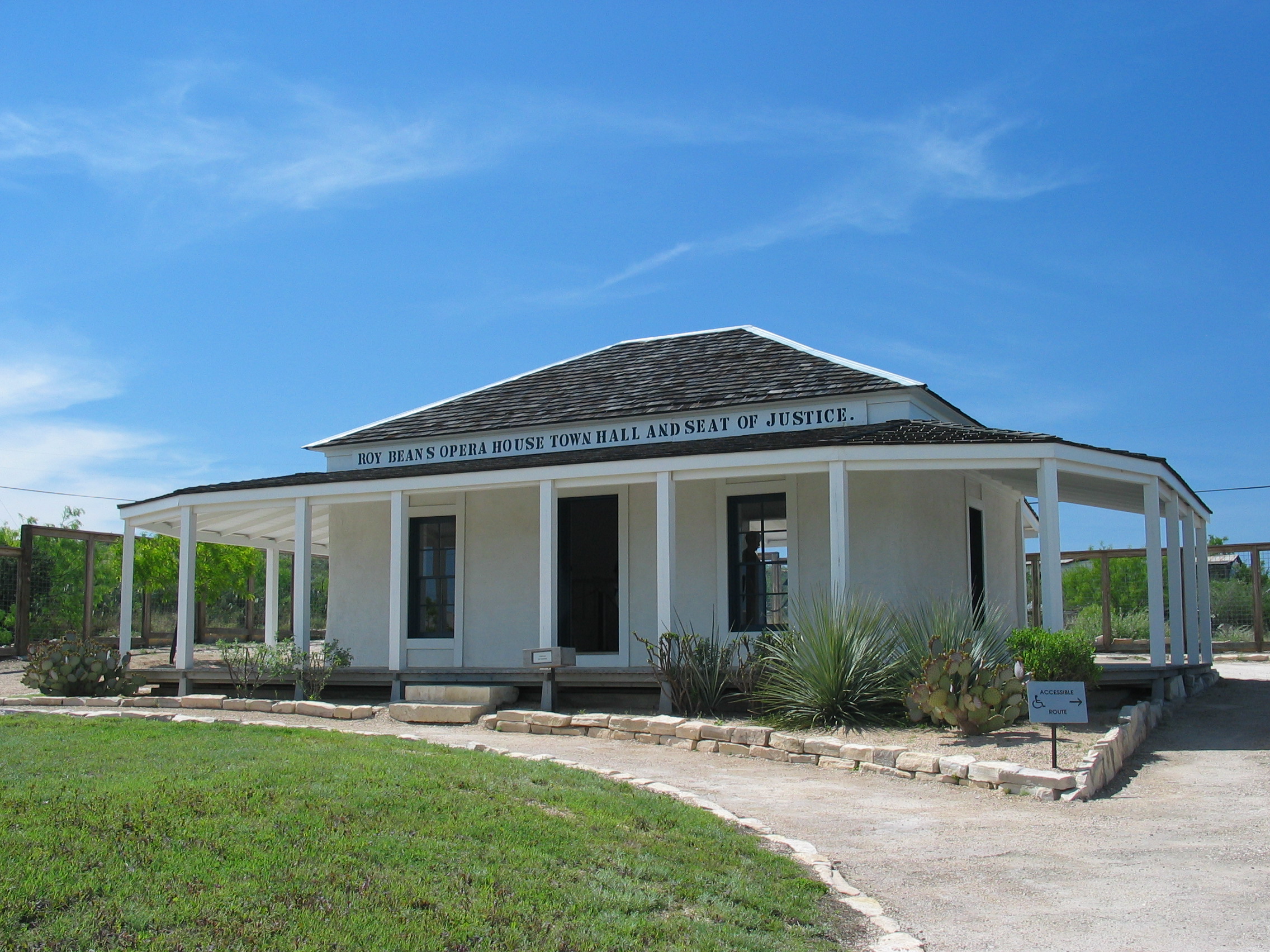
Roy Bean
He called himself 'The Only Law West of the Pecos,' and nobody in Langtry, Texas, was in a position to argue. Roy Bean held court inside his saloon, The Jersey Lilly, where a single room served as bar, courtroom, and billiard hall. His youngest son slept on the pool table. Outside, a heavy log chain wrapped around an oak tree passed for a jail. Bean pocketed every fine he levied and never forwarded a cent to the state. Though legend branded him a hanging judge -- 'hang 'em first and try 'em later' -- he never actually had anyone hanged.
A Rope Burn and a Long Road West
Born around 1825 in Mason County, Kentucky, Roy Bean grew up in extreme poverty, the youngest of five children. At sixteen he left home on a flatboat bound for New Orleans. Trouble followed him south: after a violent incident, he fled to San Antonio to join his brother Sam. By 1848, the two had opened a trading post in the Mexican state of Chihuahua. There, Bean shot and killed a desperado who had threatened to kill an American. The aftermath nearly cost Bean his own life -- he was strung up by a rope before a woman hiding behind a tree cut him free. The experience left him with a permanent rope burn on his neck and a stiff neck for the rest of his days. During the Civil War, Bean ran the Union naval blockade by hauling cotton from San Antonio to British ships off the coast at Matamoros, returning with scarce supplies.
The Saloon That Became a Courthouse
In 1882, the railroad was pushing west through the desolate Chihuahuan Desert, and 8,000 workers pitched tents along the route. The nearest court sat at Fort Stockton, impossibly far away. A Texas Ranger asked for a local jurisdiction, and on August 2, 1882, Bean was appointed Justice of the Peace for Precinct 6 in Pecos County. One of his first official acts was to shoot up a competitor's saloon. As construction moved westward, Bean followed, relocating his combined courtroom and saloon to Langtry, a sun-blasted speck along the Rio Grande. Fines settled all cases. There was no jail -- just that oak tree and chain outside The Jersey Lilly. During his years on the bench, Bean sentenced only two men to hang, one of whom escaped. Horse thieves, routinely sentenced to death elsewhere in Texas, walked free in Bean's court as long as the horses came back.
Flagging Down a Railroad Baron
In 1890, Bean learned that railroad speculator Jay Gould planned to pass through Langtry aboard a special train. Bean positioned himself on the tracks and waved a danger signal. The engineer, convinced the bridge ahead had collapsed, slammed the brakes. Bean calmly invited Gould and his daughter into the saloon for a visit. They stayed two hours, during which rumors reached New York that Gould had been killed in a train wreck. A brief panic rippled through the New York Stock Exchange before the truth caught up. It was a stunt entirely characteristic of Bean's frontier audacity -- no law broken, no harm done, and a billionaire held hostage by hospitality.
The Legend That Outlived the Man
Bean died peacefully in his bed on March 16, 1903, after a heavy drinking session in San Antonio. He and his son Sam are interred at the Whitehead Memorial Museum in Del Rio. But Bean's story was only beginning. Walter Brennan won a Best Supporting Actor Academy Award for playing him in the 1940 film The Westerner alongside Gary Cooper. Paul Newman starred as Bean in the 1972 comedy-drama The Life and Times of Judge Roy Bean. A 1955 television series, a Lucky Luke Belgian comic, and references in The Sopranos all kept the legend alive. In 1965, an official Texas Historical Marker was erected at the Whitehead Memorial Museum. Bars and restaurants bearing his name still operate from Alabama to Ireland -- a lasting tribute to a man who turned a desert saloon into the most famous courtroom in the American West.
From the Air
Located at 29.35N, 100.90W in Val Verde County, Texas, along the Rio Grande in the Chihuahuan Desert. The town of Langtry sits on the Southern Pacific rail line in deeply arid, rugged terrain. Best viewed at 3,000-5,000 ft AGL. Nearest airports: KDRT (Del Rio International, approximately 40 nm SE), KLRD (Del Rio Laughlin AFB, approximately 35 nm SE). The terrain is sparse desert scrub with dramatic canyon scenery along the Rio Grande gorge. The Pecos River bridge and its high desert surroundings are visible landmarks.