Royal Academy of Art, The Hague
On a Saturday in The Hague in the 1680s, five painters would gather to argue about art. Willem Doudijns, Theodor van der Schuer, Daniel Mijtens the Younger, Robert Duval, and Augustinus Terwesten had formally founded their drawing academy on 29 September 1682, splitting off from the city's existing guild of painters, the Confrerie Pictura. Tuesday through Friday evenings the apprentices drew from plaster casts and live models. Saturdays were for debate. The Haagsche Teeken-Academie - the Hague Drawing Academy - was already a different kind of institution from the painters' guild it left behind. It was less a craft monopoly and more a school. Three and a half centuries later, that school is still operating. It is the oldest art academy in the Netherlands and among the oldest still teaching anywhere in the world.
From Drawing Academy to Royal Academy
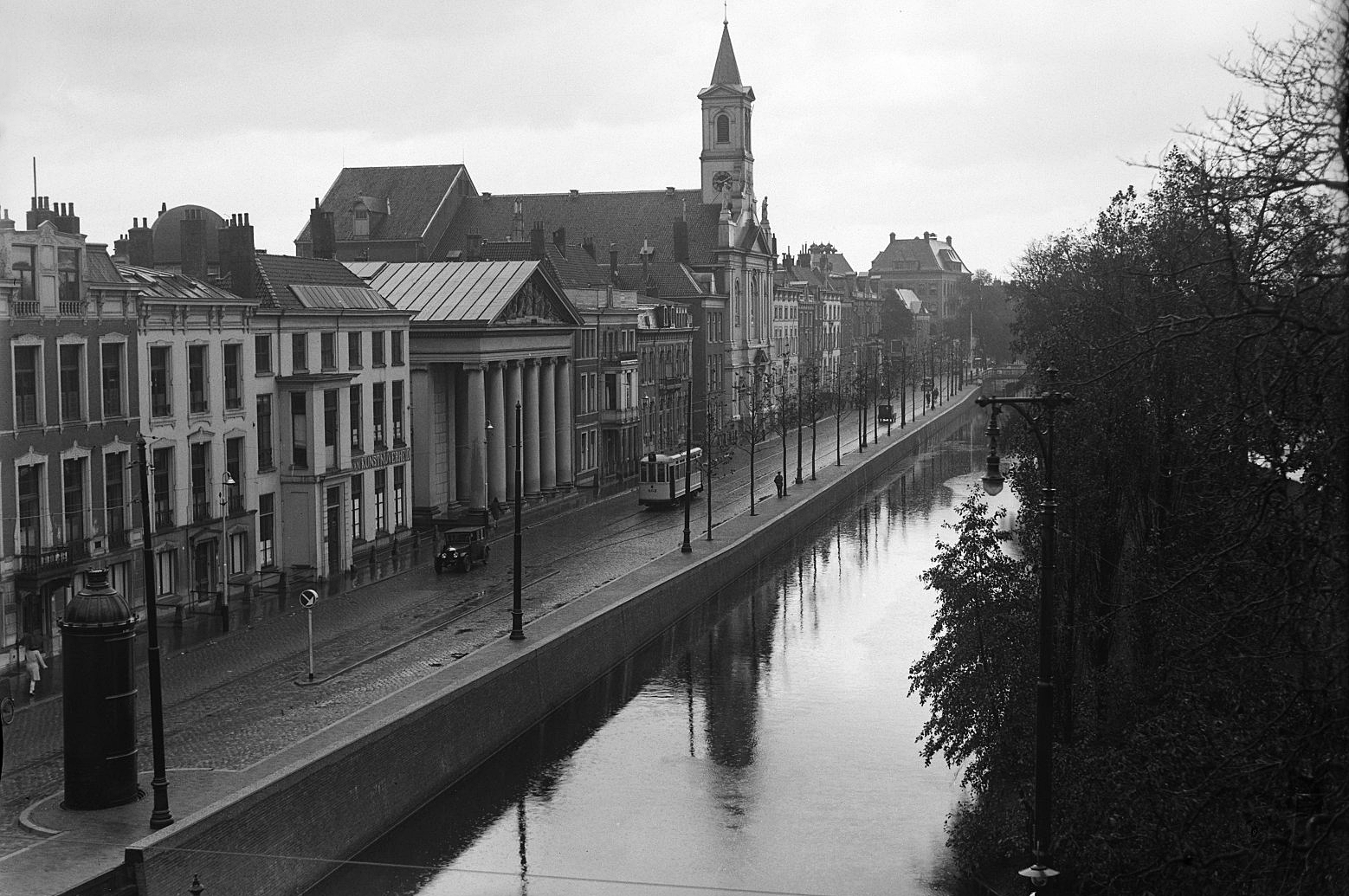
The 18th century was a thriving stretch for the Hague academy, but by 1800 financial support had dried up and the school was working with fewer than ten students. Recovery came under King William I after 1815, who treated arts education as part of the project of building a Dutch national identity. In 1821 the drawing classes were combined with a new School of Civil Engineering - a forced marriage of fine art and practical craft that proved unexpectedly productive. After working spaces in the city's Grain Exchange and butter weighing-house, the academy finally got its own neoclassical building in 1839 on the Prinsessegracht, designed by the city architect Zeger Reyers. The royal title came late, in 1957, when the Dutch crown granted the predicate "royal" to mark the academy's 275-year anniversary. The school is still on Prinsessegracht 4, in a Bauhaus-influenced 1937 building that replaced Reyers's neoclassical one on the same site.
The Names That Came Through These Rooms
The 19th-century student rolls at KABK read like a roster of Dutch painting at its peak. Johannes Bosboom studied here. So did Isaac Israels - son of Jozef - and Willem Maris, and Jan Hendrik Weissenbruch, and George Hendrik Breitner. These were the Hague School, the Dutch counterpart to French Impressionism, who painted Scheveningen's fishing fleet and the polders and the silver light of the North Sea coast. The academy was their training ground; the artists' society Pulchri Studio, founded in 1847, became their professional home. The two institutions were a few blocks apart and almost completely overlapping. Earlier and later names ran wider still. Piet Mondrian trained at the Rijksakademie in Amsterdam from 1892, though his early work drew deeply on the Hague School tradition he absorbed in part through his uncle Frits Mondriaan, a pupil of Willem Maris. M. C. Escher attended the School of Architecture and Decorative Arts in Haarlem from 1919 to 1922, before his eyes turned toward Italy and his impossible architectures. The pattern, looking back across centuries: this is one of the rooms where Dutch artists became themselves.
Bauhaus Arrival
Around 1930, KABK did something quietly radical for a 250-year-old institution: it threw open the windows. Bauhaus ideas were arriving from Germany - the integration of fine art with design, photography, and industrial production - and the academy moved hard in that direction. Avant-garde teachers like Gerrit Kiljan, Paul Schuitema, Paul Citroen, and Cor Alon dominated through the 1930s, and the school was one of the first in the Netherlands to teach industrial design as part of a fine-arts curriculum. The new 1937 building was itself Bauhaus-influenced, designed by the firm of Plantenga, Buijs and Lursen with clean lines and large windows. The shift mattered. The Hague School had defined Dutch painting by going outside to look at light. The next generation defined Dutch design by going inside to think about how objects and images function. KABK has never quite stopped having both conversations at once.
An International School, with Tensions
Today KABK runs bachelor's, master's, and doctoral programs in fine art, design, photography, graphic design, and newer disciplines with names like ArtScience and Non Linear Narrative. The graphic design program is one of the most competitive art-school programs in Europe: in the 2023 to 2024 academic year, roughly 1,200 applicants competed for about 50 places. Around 63 percent of students are international, which the academy treats as a defining strength and which the Dutch parliament has, in recent years, treated as a problem to be managed. Like much of Dutch higher education, KABK sits in the middle of a national debate about the language of instruction and the country's appetite for foreign students. The academy maintains close ties with Leiden University - a joint Combined Degree program with Leiden's Art History department lets students earn two bachelor's degrees together - and with the Royal Conservatory next door, with which it shares the University of the Arts The Hague umbrella since 1990. The institution that started as five painters arguing on Saturdays now graduates several hundred artists a year.
Walking the Prinsessegracht
The KABK building on Prinsessegracht 4 sits on one of The Hague's quieter canals, a short walk east of the Binnenhof and the Mauritshuis. The 1990s acquisition of the historic building at Bleijenburg 38 expanded the campus a block south. There is no public museum at the academy - this is a working school, not an institution that displays its collections - but the year-end graduation show in late June and early July, called Graduation, opens the building to the public and is, in a city full of museums, one of the more interesting things to see. The walls are hung with the senior projects of the next generation of Dutch artists and designers, the same way the walls were hung in 1685 with drawings the academy's first apprentices brought to be argued over on Saturdays. The conversation has not particularly changed. The students are simply different each year.
From the Air
KABK occupies Prinsessegracht 4 in central The Hague, at approximately 52.082N, 4.319E, three blocks east of the Binnenhof. The Hague is 50 km southwest of Amsterdam Schiphol (EHAM) and 18 km north of Rotterdam The Hague Airport (EHRD). From cruising altitude the easiest visual cues are the Binnenhof and Hofvijver complex, the green wedge of the Haagse Bos to the east, and the wide beach of Scheveningen to the northwest where the Hague School painters worked.