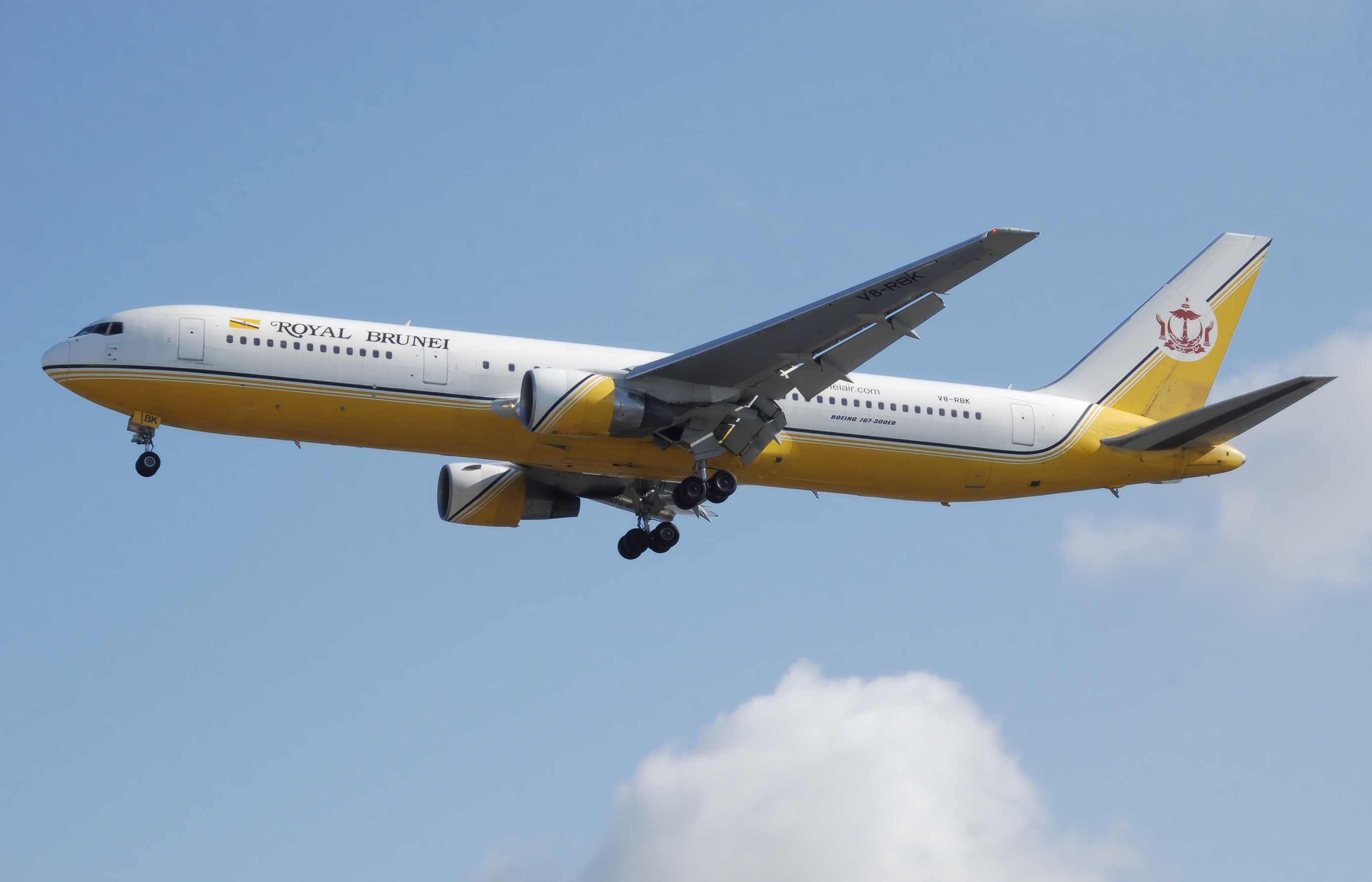
Royal Brunei Airlines: The Sultan's Flag in the Sky
The delivery flight broke a world record, and almost nobody outside the aviation press noticed. When the first Boeing 767 ordered by Royal Brunei Airlines left the factory in Seattle, it flew 17 hours and 22 minutes non-stop to Jomo Kenyatta International Airport in Nairobi before continuing to Brunei -- the longest non-stop delivery flight of its kind at the time. That a tiny sultanate on the coast of Borneo, population well under half a million, was taking delivery of widebody jets at all was the real story. Royal Brunei Airlines had been founded just two decades earlier with a pair of Boeing 737-200s and four destinations. By the mid-1990s, it was flying to three continents.
Two Planes and a Dream
Royal Brunei -- the airline did not add "Airlines" to its name until later -- was established on November 18, 1974, less than a decade before Brunei gained full independence from Britain in 1984. The government created it as a flag carrier, wholly owned by the state and operated from a hub at Brunei International Airport in Berakas, just north of the capital. Its maiden voyage took place on May 14, 1975, connecting Bandar Seri Begawan to Singapore, Hong Kong, Kota Kinabalu, and Kuching. Two brand-new Boeing 737-200s constituted the entire fleet. For a country that would gain sovereignty partly on the strength of its oil and gas revenues, an airline was both a practical necessity and a statement of intent: Brunei would not be isolated.
The Expansion That Swallowed the Map
The 1990s transformed Royal Brunei from a regional connector into something far more ambitious. The 737s were sold, replaced first by Boeing 757-200s for routes to the Middle East and London Gatwick, then by a fleet of eight 767s. New destinations appeared at a dizzying pace: Abu Dhabi and Bali in 1993, then Zurich via Kuala Lumpur and Bahrain, then Beijing and Cairo before the year was out. Frankfurt, Jeddah, and London Heathrow followed. Some of the London flights routed through Yangon and Abu Dhabi; others via Singapore and Dubai. The airline even sold its last 737 to Aloha Airlines in Hawaii to fund further growth. It was expansion fueled by oil wealth and national ambition, and it pushed a carrier based in a country the size of Delaware to operate on routes spanning from New Zealand to Switzerland.
The Reckoning
Ambition outran economics. By the early 2000s, routes to Beijing, Osaka, and Taipei had proven unprofitable and were suspended. The fleet of Fokker F-100s was sold to an Italian carrier. Kuwait was added in 2000, served via a routing so circuitous -- Singapore, Kolkata, Dubai -- that it lasted barely a year. In September 2002, the board brought in Peter Foster as CEO to restructure what had become a financially struggling operation. Foster's plan was bold: grow the fleet from nine to twenty-four aircraft over a decade, introduce new Airbus A319s and A320s for regional routes, and phase out the aging Boeings. Auckland became the first new destination under the plan, with the inaugural flight touching down in October 2003. But restructuring is brutal work. Kuching was dropped, then reinstated, then dropped again. Darwin was cut after 24 years of service. Foster himself resigned in 2005.
Dreamliners Over the South China Sea
The airline's modern chapter began in earnest in 2013, when the first of five Boeing 787 Dreamliners arrived. Registration V8-DLA, powered by Rolls-Royce Trent 1000 engines, it made its inaugural revenue flight from Bandar Seri Begawan to Singapore on October 18. London Heathrow service via Dubai followed on the 787 in December. The Dreamliner was not just a new aircraft type -- it was a declaration that Royal Brunei intended to remain a long-haul carrier despite its modest size. The airline outlined plans for an all-Dreamliner fleet on long-haul routes. Meanwhile, new Airbus A320neos began arriving in 2018 to modernize the short-haul fleet. Four Boeing 787-9s are on order, with deliveries expected to begin in the second half of 2028. Today the airline operates 32 destinations and holds codeshare agreements with carriers including Singapore Airlines, Emirates, Qatar Airways, Cathay Pacific, and Japan Airlines.
World's Leading, Four Times Running
For all the route turbulence and fleet shuffling, Royal Brunei Airlines has built a reputation for something harder to quantify than on-time performance: service. The airline's cabin crew won the World Travel Awards' "World's Leading Cabin Crew" designation five consecutive times, through 2024. It earned a five-star passenger experience rating, a distinction shared with only a handful of carriers worldwide. The accolade reflects something about both the airline and the country it represents. Brunei is a Muslim-majority nation, and the carrier has been recognized for excellence in Muslim-friendly tourism services. In a global aviation industry dominated by mega-carriers and budget airlines, Royal Brunei occupies an unusual niche: small enough to feel personal, well-funded enough to fly Dreamliners, and culturally distinct enough to stand out on routes where it competes with some of Asia's giants.
From the Air
Royal Brunei Airlines is based at Brunei International Airport (ICAO: WBSB), located at 4.949°N, 114.937°E in Berakas, just north of Bandar Seri Begawan. The airport shares its 3,685-meter runway 03/21 with the adjacent Royal Brunei Air Force Base, Rimba. The RB Campus (airline headquarters) is visible near the terminal complex. From 3,000 feet, the airport layout -- commercial terminal to the north, military hangars to the south -- is clearly distinguishable against the surrounding tropical lowlands. The South China Sea coast is approximately 8 km north.