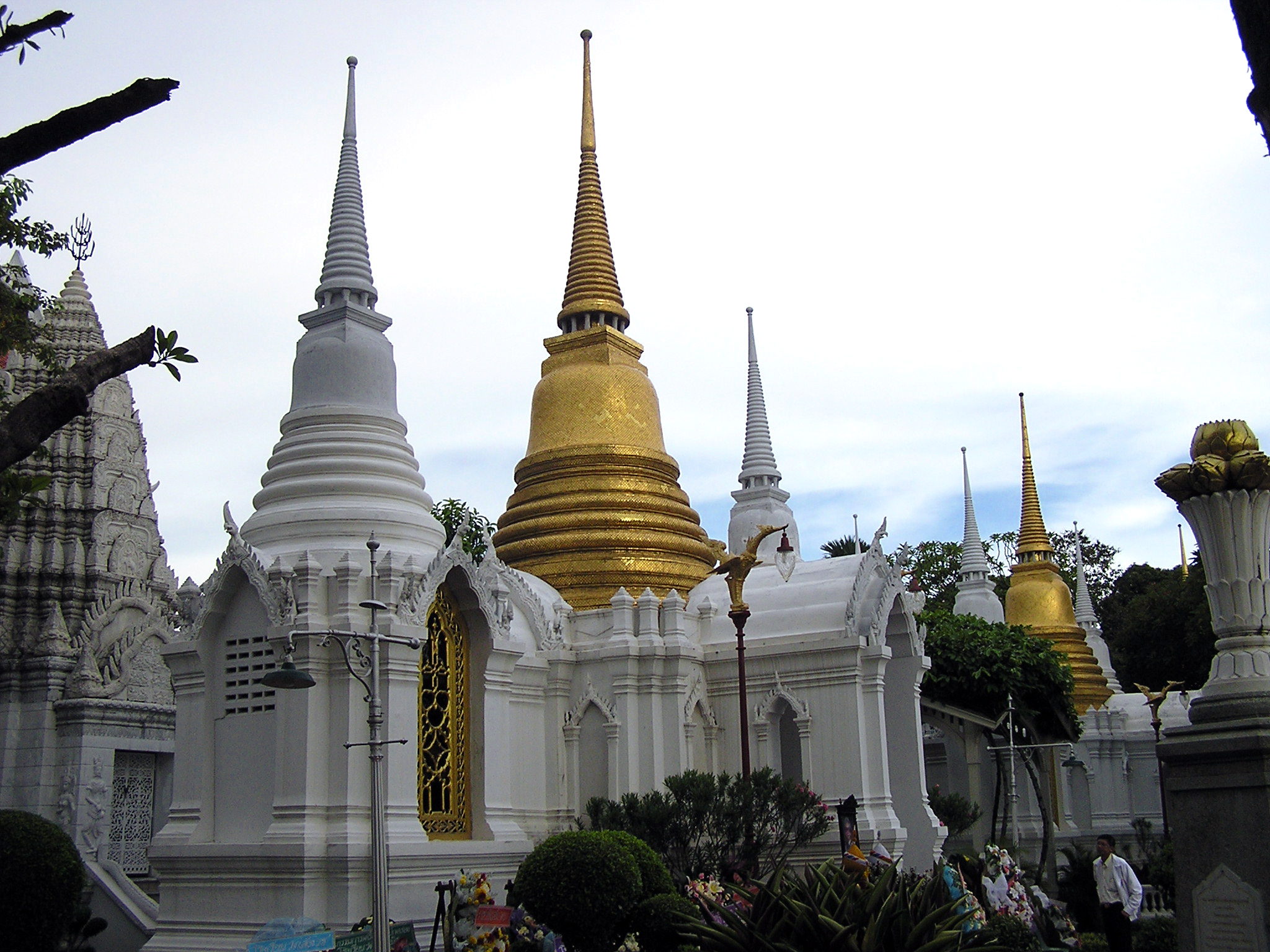
Royal Cemetery at Wat Ratchabophit
Thirty-three numbered monuments stand in a walled garden that most Bangkok visitors never find. Tucked behind Wat Ratchabophit, away from the tourist crush of the Grand Palace just a few hundred meters north, the Royal Cemetery is where the Chakri dynasty buried not its kings but the people closest to them -- queens consort, royal mothers, infant princes who lived only days, and the consorts whose family names thread through generations of Thai history. King Chulalongkorn, Rama V, is the gravitational center here. Nearly every monument traces back to his reign, his wives, his children, or their descendants. The cemetery is not grand in the way of royal cremation grounds. It is intimate, architectural, and strange -- a place where Gothic masonry sits beside Khmer-style prangs, where lotus-petal sculptures rise from hexagonal plinths, and where marble slabs bear names spanning from the 1830s to the twenty-first century.
Four White Memorials
The most prominent structures are four white buildings, each dedicated to one of Chulalongkorn's four principal queens consort. The Sunandha Nusavarya Memorial holds the ashes of Queen Sunanda Kumariratana, who drowned in 1880 at age nineteen along with her young daughter -- a tragedy compounded by a royal law forbidding commoners to touch the queen, which reportedly prevented onlookers from saving her. The Rangsi Vadhana Memorial shelters the line of Queen Savang Vadhana, including Crown Prince Maha Vajirunhis, who died at sixteen, and Prince Mahidol Adulyadej, father of two future kings. The Saovabha Pratisthana Memorial holds descendants of Queen Saovabha Phongsri, among them Prince Chakrabongse Bhuvanath and his wife Elisabeth, born a Hunter from England. The Sukhumala Narumitra Memorial anchors the fourth queen's lineage, stretching back to a consort of Rama IV born in 1835 and forward to Princess Marsi Paribatra, who died in 2013.
Stone in Every Style
Walk the cemetery paths and you encounter an improbable catalog of architectural forms compressed into a single garden. Monument No. 1 is Gothic masonry with marble floors and a base adorned with carved mountains. The so-called Little Temple, Monument No. 2, is a single-story European-style house with stained glass panels in its wooden doors and windows, sheltering the ashes of two consorts from the powerful Bunnag family and their sprawling descendants. Monument No. 7 reproduces Prang Sam Yot, the famous Khmer-influenced triple tower in Lopburi, complete with naga staircases and ornate brick-and-stucco cornices. Monument No. 8 takes a different path entirely -- lace-like lotus petals emerge from a pleated vase atop a tall hexagonal plinth. There is a round column topped with a cloth-draped urn sculpture. There is a simple plinth with inscribed tablets on a short stairway. Each structure was built to honor a specific person or lineage, and the variety suggests that personal taste mattered more than architectural consistency.
The Weight of Royal Numbers
Chulalongkorn fathered 77 children by 36 consorts. Many of those children died young -- infant mortality spared no one in the nineteenth century, not even royalty. The cemetery holds their names with quiet matter-of-factness. Princess Oraongka Ankayuba lived from 1881 to 1882. Prince Khajera Chirapradidha was born and died in 1888. The 84th child of Rama V, unnamed, survived barely a year. Her monument is a round column decorated with flowers. These are not footnotes to history; they are the private grief of a dynasty recorded in stone. The numbering system itself -- each monument assigned a Thai numeral displayed at its base, 34 in all with No. 3 having been removed and its contents relocated to No. 2 -- gives the cemetery the feel of a carefully maintained archive, where loss is cataloged but not diminished.
Lineages That Shaped a Nation
Among the names inscribed here are figures whose influence extended far beyond the palace walls. Prince Mahidol Adulyadej, the Prince of Songkla, studied medicine at Harvard and public health at MIT before dying at 37 -- his son would become King Bhumibol Adulyadej, the longest-reigning monarch in Thai history. Srinagarindra, the Princess Mother, born Sangwan Talapat in 1900, rose from a commoner background to become one of the most beloved figures in modern Thai history, living until 1995. Princess Galyani Vadhana, elder sister of King Bhumibol, rests here after a life devoted to education and cultural patronage. The Bunnag family, whose members appear across multiple monuments, were kingmakers and administrators who shaped Siamese governance for generations. The cemetery, in this way, reads as a compressed genealogy of modern Thailand itself -- not just its kings, but the mothers, consorts, and children from whom the nation's leadership descended.
From the Air
Located at 13.749N, 100.497E in Bangkok's Phra Nakhon district, on the western grounds of Wat Ratchabophit. The temple's distinctive circular cloister and tall prang are visible from the air. The cemetery is behind the main temple structures, shielded by walls. Best viewed at 1,500-2,500 feet. The Grand Palace and Wat Phra Kaew complex is visible just to the north. Nearest airports: Don Mueang (VTBD) approximately 15 nm north; Suvarnabhumi (VTBS) approximately 17 nm east-southeast.