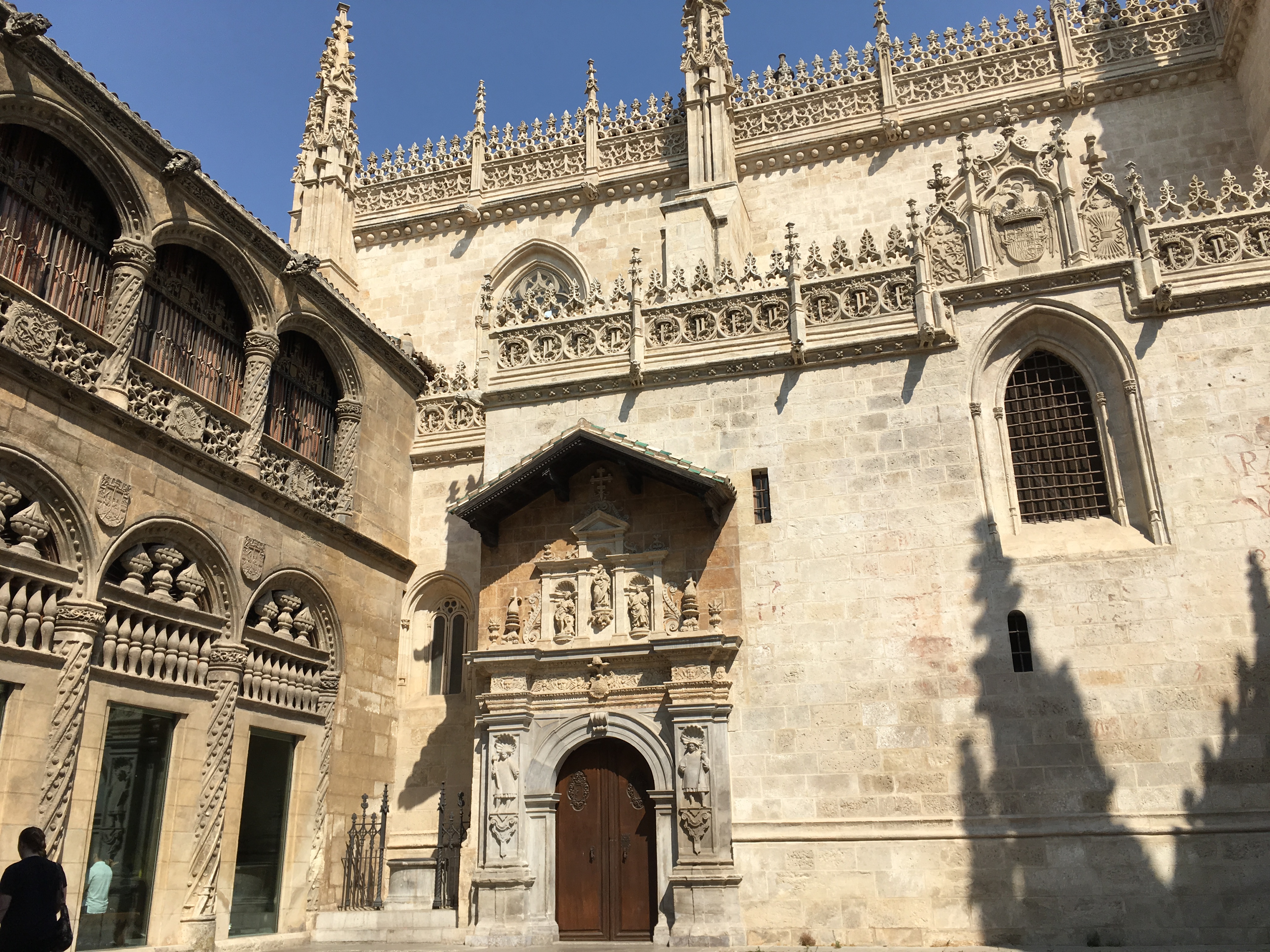
Royal Chapel of Granada
Five lead coffins lie in a crypt beneath the marble floor, each marked only with the initials of its occupant. Above them, carved in Italian marble by Domenico Fancelli, the effigies of Queen Isabella I and King Ferdinand II rest in attitudes of serene authority, their stone faces turned toward the altar they commissioned but never lived to see completed. The Royal Chapel of Granada is not merely a church -- it is a statement of dynastic will, the place where the Catholic Monarchs chose to anchor their legacy to the city they considered their greatest conquest.
A City Worth Dying For
When Granada fell to the Catholic Monarchs on January 2, 1492, it marked the end of nearly eight centuries of Moorish rule on the Iberian Peninsula. The Nasrid dynasty's surrender concluded the Reconquista, and Isabella and Ferdinand regarded the victory as the defining achievement of their reign. So deeply did they identify with this conquest that on September 13, 1504, they issued a royal charter from Medina del Campo declaring their wish to be buried in Granada. Construction of the chapel began the following year under the direction of architect Enrique Egas, who designed it in the ornate Isabelline Gothic style -- a Spanish variant of late Gothic architecture named, fittingly, for the queen herself. The chapel was completed in 1517, dedicated to Saints John the Baptist and John the Evangelist.
Marble, Iron, and Dynastic Ambition
The interior speaks the language of political theology. A monumental wrought-iron grille, forged by Bartolome de Jaen, separates the nave from the transept, where the royal tombs occupy the sacred space typically reserved for saints. The tombs stand nearly level with the altar -- a deliberate architectural statement placing the monarchs in proximity to God. Fancelli's tomb for Isabella and Ferdinand was carved in Genoa and shipped to Granada, its Renaissance elegance contrasting with the Gothic architecture surrounding it. Beside it, a second tomb by Bartolome Ordonez holds Joanna of Castile and her husband Philip the Handsome, whose heart was buried separately in Bruges. In the crypt below rests one more occupant: the infant Miguel da Paz, Prince of Portugal, a grandson of the Catholic Monarchs who died as a child, his tiny sarcophagus a reminder of how fragile even royal succession could be.
An Unexpected Gallery
Isabella was a collector of serious taste, and the Sacristy-Museum preserves her personal art collection alongside the crown and scepter she wore. Visitors who come expecting relics of Spanish piety find instead a gallery of Northern European masterworks: paintings by Hans Memling and Rogier van der Weyden, a rare Botticelli depicting the Agony in the Garden, and works by Dirk Bouts and Perugino. The Flemish and Italian paintings reflect the cosmopolitan cultural networks of the late 15th century, when Granada's new Christian rulers looked to Europe's finest artists to adorn their conquest. Juan de Flandes, Isabella's court painter, is also represented. The collection transforms what might have been a purely devotional space into one of southern Spain's most surprising art destinations.
Where Music Echoed Through Centuries
From its founding, the Royal Chapel maintained a tradition of sacred music that endured for centuries. Chapel masters were appointed through competitive examination, tested on their compositional skill and musical knowledge. Rodrigo de Ceballos served from 1561 to 1581, followed by Ambrosio Cotes through 1596. Antonio Cavallero held the position for an extraordinary span from 1757 until around 1822, his tenure bridging the Enlightenment and the Napoleonic upheavals. These musicians composed liturgical works, directed performances, and educated the choirboys known as seises. The tradition connected the chapel to broader currents of European sacred music while rooting it firmly in the particular acoustics of Egas's Gothic nave, where ribbed vaults still carry sound with remarkable clarity.
The End of an Era, the Beginning of a Pilgrimage
The Royal Chapel served as the mausoleum of the Spanish monarchy until Philip II established El Escorial near Madrid, redirecting the bones of kings northward to Castile. Granada's chapel became a monument to a specific moment -- the end of the Reconquista, the dawn of Spain's global empire, the year Columbus sailed west. It remains a functioning Catholic place of worship, closed to tourists during services, a reminder that the building serves purposes older than tourism. The Lonja, a banking and commercial exchange built in 1518 in the angle between the chapel and the cathedral, has been restored and opened to visitors, its coffered ceilings and civic purpose a counterpoint to the devotional spaces next door. Together, the chapel and its surroundings form a compact monument to the ambitions of monarchs who understood that choosing where to be buried was itself an act of statecraft.
From the Air
Located at 37.18°N, 3.60°W in central Granada, adjacent to Granada Cathedral. The chapel sits in the historic core near the Alhambra complex. Nearest airport: LEGR (Federico Garcia Lorca Granada-Jaen Airport), approximately 15 km west. Best viewed at 3,000-5,000 ft AGL where the cathedral complex and Alhambra are both visible against the Sierra Nevada backdrop.