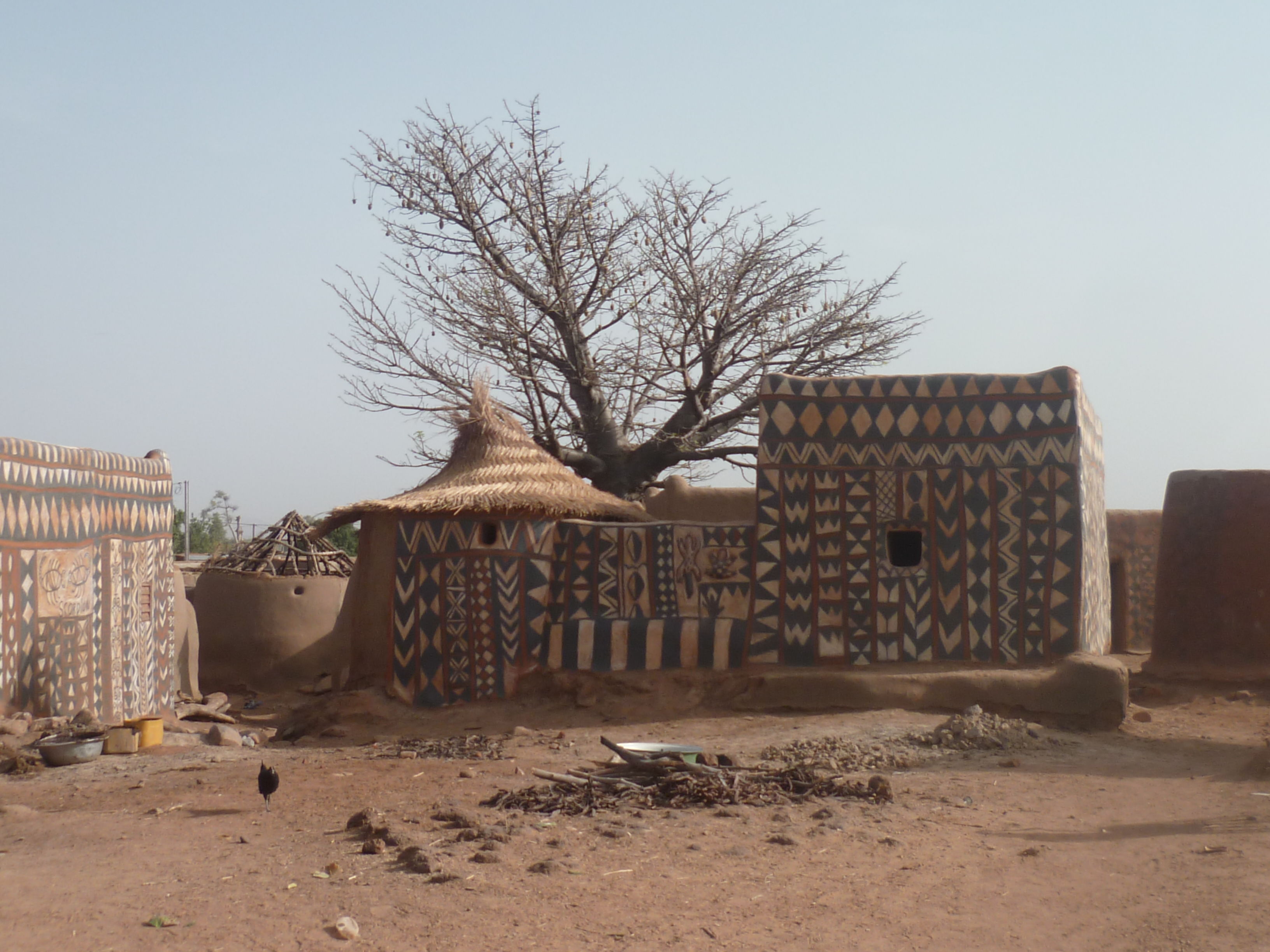
Royal Court of Tiébélé
Every house here is a canvas. From a distance, the Royal Court of Tiébélé looks like any cluster of low adobe buildings baking in the West African sun -- rounded walls, flat roofs, the muted tones of dried earth. Step closer and the walls erupt into geometric patterns: interlocking triangles, zigzag lines, spiraling coils, stylized calabashes and serpents, all rendered in black, white, and deep terracotta red. This is not decoration for decoration's sake. Each motif carries meaning, each pigment is ground from local stone, and every brushstroke is applied by the hands of Kassena women passing knowledge to the next generation.
Five Centuries of Earth and Rule
The compound was founded in the sixteenth century by Patyringomie, a chief of the Kassena people, one of the oldest ethnic groups to have settled in what is now southern Burkina Faso. He established Tiébélé as the seat of the Pè -- the Kassena king -- and the complex grew over five hundred years into a dense cluster of royal residences, mausoleums, shrines, sacred groves, and stone courts. The walls are thick, the windows nearly nonexistent -- only small ventilation openings puncture the adobe. Doorways stand barely a meter high, a defensive choice that forced anyone entering to stoop, making surprise attacks nearly impossible. These were buildings designed to protect against both human raiders and the predators of the savanna, and their forms have endured because the logic behind them never became obsolete.
The Women's Language on the Walls
Mural painting at Tiébélé is exclusively women's work, and it is far more than craft. Working in groups under the guidance of an elder, women mix their pigments from the landscape itself: laterite soil rich in iron oxide produces the deep reds, kaolin clay yields white, and graphite or boiled leaves create black. They apply the paint with improvised tools -- guinea fowl feathers for fine lines, small stones for pressing patterns into wet plaster, sticks for broader strokes. Some designs are painted directly onto cured walls; others are sculpted in relief so they stand proud of the surface, catching shadow and light. The motifs are symbolic. Snakes ward off disease. Lizards and crocodiles repel evil spirits. The calabash, shown as half circles or broken diagonal shards, represents sustenance and continuity. Red symbolizes courage, black evokes night and the spirit world, white signals honesty. In a culture that historically transmitted knowledge orally rather than through text, these walls function as a living library.
A Heritage Under Shifting Rains
In July 2024, UNESCO inscribed the Royal Court of Tiébélé as a World Heritage Site during the 46th World Heritage Committee session in New Delhi -- recognition that had been building since 2012, when the site was added to both Burkina Faso's Tentative World Heritage List and the World Monuments Watch. But the same climate that shaped these buildings now threatens them. The adobe must dry completely before painting can begin, and increasingly erratic rains shorten the window for that drying. Downpours can wash away freshly applied designs before they set, undoing weeks of communal labor. The materials themselves are growing harder to source as the Sahel shifts. Tiébélé is one of the last places where the full tradition of Kassena mural painting persists -- a practice that was once widespread across the region has contracted to this single compound and a handful of nearby villages.
Geometry in the Dust
From the air, the Royal Court reads as a tight cluster of rounded and rectangular forms, their flat roofs blending into the red-brown earth of the Centre-Sud Region. It takes getting close -- on foot, ducking through the low doorways -- to understand what makes this place extraordinary. The geometric precision of the murals, achieved without rulers or stencils, reflects generations of trained hands and eyes. Young women learn by watching elders, then practicing on less prominent walls before graduating to the royal residences. The result is a built environment where architecture, art, and social structure are inseparable. The buildings are not decorated -- they are complete only when painted, and painting them is an act of cultural renewal performed by the community each year after the rains.
From the Air
Located at 11.090N, 0.962W in Burkina Faso's Centre-Sud Region, approximately 170 km south of Ouagadougou and close to the Ghana border. The compound appears as a dense cluster of adobe structures amid flat savanna and scattered trees. Nearest major airport is Thomas Sankara International (DFFD/OUA) in Ouagadougou. The terrain is gently rolling with sparse vegetation typical of the southern Sahel. Overfly at 1,500-2,500 ft AGL for best visibility of the compound's layout and surrounding village.