Royal Gorge Route Railroad
Bat Masterson brought a cannon to a railroad fight. In the spring of 1879, the sheriff of Ford County, Kansas, arrived in Pueblo, Colorado, with 60 armed men, seized the Santa Fe Railroad's roundhouse, and reportedly trained a borrowed cannon down the street approach. He had been hired to defend the Atchison, Topeka and Santa Fe Railway's claim to one of the most valuable stretches of railroad corridor in America -- the Royal Gorge of the Arkansas River, a sheer-walled chasm where the canyon narrows so tightly that only one set of tracks could ever fit. Today, a 1950s-era domeliner makes daily two-hour excursion runs from Canon City through that same gorge, following rails that were literally fought over with guns, dynamite, and legal injunctions.
The Canyon Only One Railroad Could Have
In the late 1870s, miners flooded the upper Arkansas River valley chasing lead and silver in what would become the Leadville district. Two railroads wanted to build tracks to reach them: the Denver and Rio Grande (D&RG), already near Canon City, and the Atchison, Topeka and Santa Fe, based in Pueblo. The route required laying track through the "Grand Canyon of the Arkansas," a valley with a railroad-friendly one-percent grade. The problem was the Royal Gorge itself -- a plateau of igneous rock where the Arkansas River had carved a spectacular gorge with sheer walls plunging into the water. At its narrowest point, there was room for one railroad and nothing more. On April 19, 1878, a hastily assembled Santa Fe construction crew began grading at the mouth of the gorge. The D&RG raced crews to the same spot but arrived hours too late. The Royal Gorge War had begun.
Forts, Gunfighters, and a Stolen Cannon
What followed was two years of corporate warfare fought with injunctions, sabotage, and hired guns. Grading crews from both sides had rocks rolled down on them and tools thrown in the river. The Rio Grande built 17 stone forts along the canyon to block Santa Fe crews. The Santa Fe, flexing its larger corporate muscle, leased the entire D&RG system for 30 years, then immediately raised freight rates to favor its own routes. When the Rio Grande went to court to break the lease, Santa Fe hired Bat Masterson to seize Rio Grande stations from Denver to Canon City. Masterson enlisted Doc Holliday to recruit 33 men, including notorious gunfighters "Dirty" Dave Rudabaugh, Josh Webb, Ben Thompson, and "Mysterious" Dave Mather. When a court finally ruled for the Rio Grande, its men marched to the Pueblo roundhouse, distributed rifles in front of the Victoria Hotel, and broke down the telegraph office door. Masterson's men fled through the back windows. Despite dramatic accounts, no reliable evidence confirms anyone was actually killed.
The Treaty of Boston
The war ended not with a battle but with a business deal. On March 27, 1880, the two railroads signed what became known as the "Treaty of Boston" -- Boston being the corporate home of the Santa Fe. The D&RG paid $1.8 million, including a $400,000 bonus over actual costs, for the railroad the Santa Fe had built in the gorge, plus grading, materials, and interest. Jay Gould, the railroad robber baron, had bankrolled the D&RG's fight with a $400,000 loan and a 50-percent stake in the company. With the gorge secured, D&RG construction resumed, and rails reached Leadville on July 20, 1880. Passenger service ran from 1880 through 1967. Freight continued until mergers folded the line into the Union Pacific system, which closed the Tennessee Pass route in the late 1990s.
A Bridge Hung from the Walls
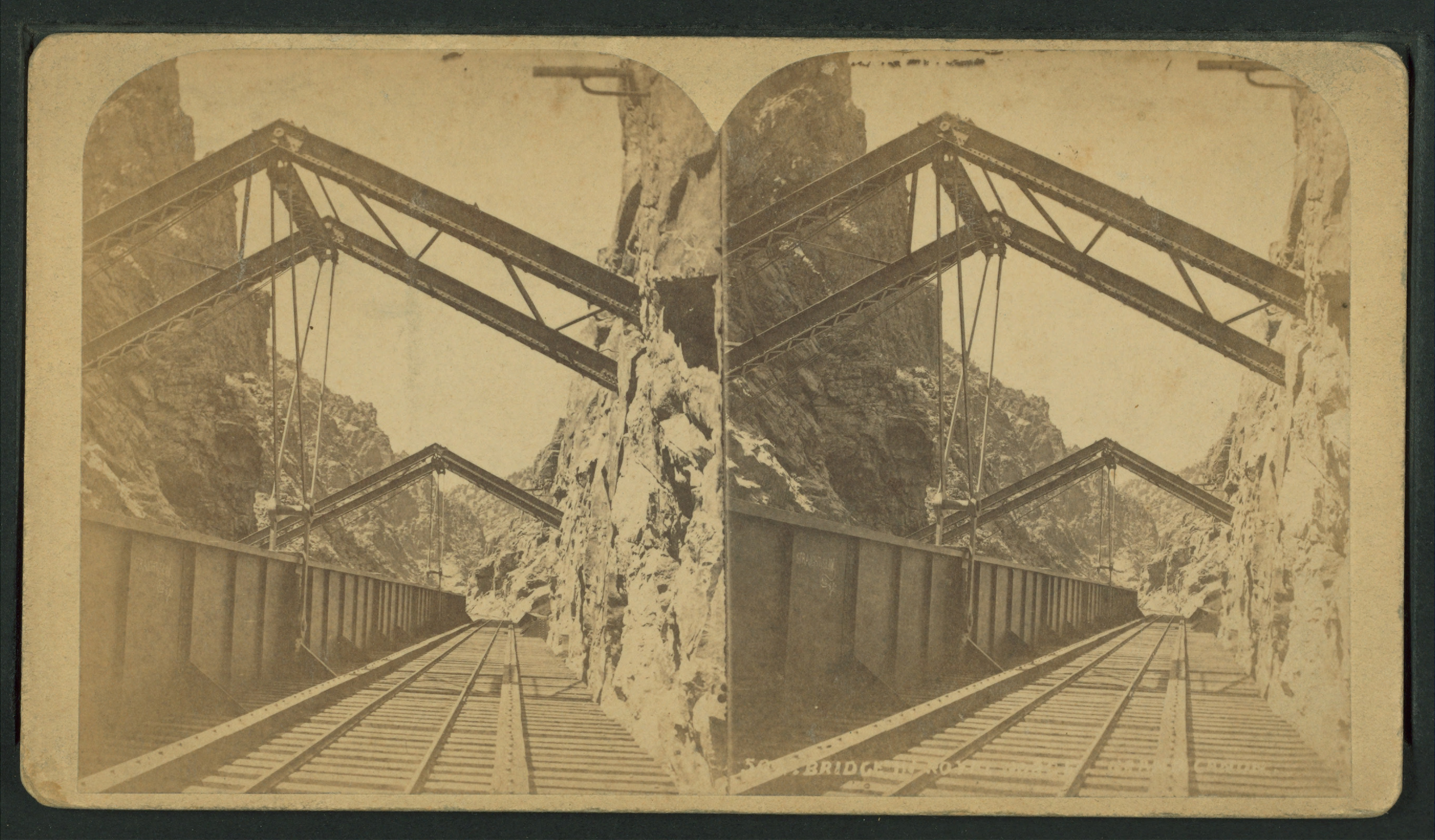
The engineering highlight of the gorge is the 1879 hanging bridge, built where the canyon narrows so severely that sheer rock walls plunge directly into the Arkansas River. Kansas engineer C. Shallor Smith designed it, and Santa Fe construction engineer A.A. Robinson built it for $11,759. The bridge consists of a plate girder suspended under A-frame girders that span the river and anchor directly into the rock walls on either side. It is not a bridge over the gorge but alongside it -- hung from the canyon itself. Strengthened multiple times over the decades, the hanging bridge remains in active service today, carrying the domeliner trains through the narrowest point of one of Colorado's most dramatic landscapes.
Tracks Preserved
In 1997, Union Pacific agreed to sell the stretch of track through the Royal Gorge to preserve the scenic route. Two new corporations -- Canon City and Royal Gorge Railroad, LLC, and Rock and Rail, Inc. -- formed Royal Gorge Express to purchase the line. Passenger service on the reborn Royal Gorge Route Railroad began in May 1999. Today's excursion departs from the Canon City Santa Fe Depot, the same station that served as a staging point during the gorge war more than a century ago. The train passes through the hanging bridge, beneath walls of ancient igneous rock, and along the Arkansas River -- a two-hour journey through a canyon that two railroads once went to war to claim.
From the Air
The Royal Gorge is located at 38.44N, 105.24W, west of Canon City, Colorado. From altitude, the gorge is visible as a dramatic narrow cut in the plateau where the Arkansas River flows. The Royal Gorge Bridge (a separate attraction) spans the gorge at over 900 feet above the river and is visible from the air. Canon City (elevation ~5,332 feet) lies to the east. Nearest airport is Fremont County Airport (1V6). Colorado Springs Airport (KCOS) is approximately 45 nm northeast. Expect canyon turbulence at lower altitudes.