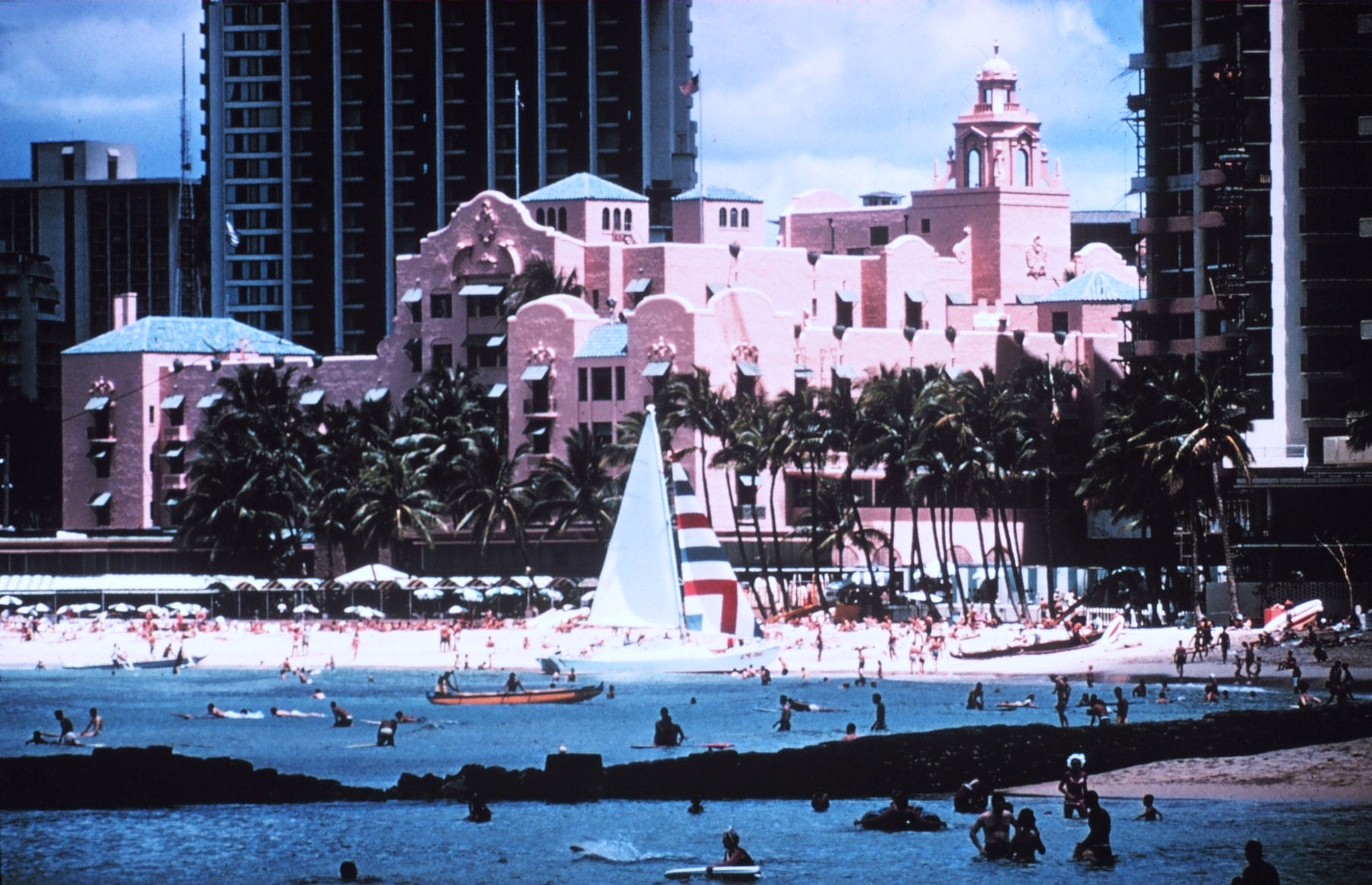
Royal Hawaiian Hotel
Joni Mitchell called it "the pink hotel" in Big Yellow Taxi, and that is all anyone needs to hear. On a beach lined with glass-and-steel towers, the Royal Hawaiian Hotel glows the color of a hibiscus blossom, its Moorish arches and mission-style cupolas looking as if they belong on the Mediterranean rather than the Pacific. The building has stood on Waikiki Beach since 1927, when it opened as the most ambitious link in a chain connecting San Francisco's wealthiest families to a tropical paradise two thousand miles offshore. Nearly a century later, the sand is more crowded and the guests arrive by jet instead of ocean liner, but the Pink Palace of the Pacific still commands its strip of shoreline with the quiet confidence of a building that has outlasted every trend in Hawaiian tourism.
A Grand Scheme in Pink Stucco
The Royal Hawaiian was never just a hotel. It was the middle act of a three-part plan hatched in 1925 by the Matson Navigation Company and Castle & Cooke, one of Hawaii's powerful Big Five corporations. First came the SS Malolo, billed as the fastest and safest ocean liner ever built for the Hawaiian run. Then came the hotel itself, designed by Warren and Wetmore of New York, the same firm behind Grand Central Terminal. Last came the Waialae Country Club, an exclusive course for guests who needed something to do between beach and dinner. Together, these three investments were meant to transform Hawaii from a distant curiosity into America's premier luxury destination. The hotel cost over four million dollars in 1927 money and sprawled across fifteen acres of landscaped gardens. Its H-shaped layout held four hundred rooms, each with a private bath and balcony, a genuine extravagance for the era. The design drew inspiration from Rudolph Valentino's Arabian films, which explains the cupolas and archways that give the building its distinctive silhouette against Diamond Head.
War, Wire, and Recovery
The Pink Palace's golden age of steamer-era glamour lasted barely fourteen years. After Pearl Harbor, the U.S. military requisitioned the Royal Hawaiian as a rest and recreation center for servicemen returning from combat in the Pacific. Concertina wire replaced the manicured hedges along the beach, and the guest ledger shifted from Rockefellers and movie stars to exhausted soldiers on brief leave from the fighting. The hotel served this role throughout the war, and while it lost its civilian sheen, it gained something else: a place in the memories of thousands of young Americans who might never have seen Hawaii otherwise. After 1945, the hotel slowly reclaimed its prewar identity. It passed from Matson to Sheraton Hotels in 1959, the same year Hawaii achieved statehood. In a surreal collision of eras, a new Dodge Dart was unveiled on the hotel grounds during a taping of The Lawrence Welk Show that October. Through the 1960s, the Armed Forces Radio Network broadcast a daily program called Concert by the Sea from the hotel, threading the military's wartime connection into peacetime entertainment.
Borrowed Ground, Lasting Presence
One of the more remarkable facts about the Royal Hawaiian is that it does not own the land beneath it. The ground belongs to Kamehameha Schools, the educational trust established by Princess Bernice Pauahi Bishop in 1883 to benefit Native Hawaiian children. The hotel operates on a lease, a quiet reminder that even Waikiki's most famous landmark exists at the pleasure of Hawaiian institutions far older than any tourism venture. Ownership of the hotel itself has crossed the Pacific more than once. In 1974, Japanese businessmen Kenji and Masakuni Osano purchased it from ITT Sheraton, forming the Kyo-ya Company as their management entity. After major renovations in 2008 and 2009, the Royal Hawaiian reopened as a member of Marriott's Luxury Collection. Throughout these changes, the building has kept its signature pink hue and its membership in Historic Hotels of America, the program of the National Trust for Historic Preservation that recognizes properties of enduring architectural and cultural significance.
The Color That Became a Character
Strip away the history, and what people remember about the Royal Hawaiian is the color. That particular shade of coral pink, applied in thick concrete stucco, has made the building the most photographed hotel in the Pacific. It is visible from the water, from Diamond Head, and from the upper floors of every neighboring high-rise. Warren and Wetmore's six-story structure was designed with Spanish and Moorish flourishes that read as exotic rather than kitschy because the architects understood scale: broad arches, deep loggias, and bell-tower cupolas that catch shadow and light in ways that flat modern facades cannot. Frances Elkins, the celebrated interior designer and sister of architect David Adler, redecorated the public rooms in 1946, adding a layer of midcentury sophistication. The hotel has appeared in films from the 1931 Charlie Chan mystery The Black Camel to the 2002 Adam Sandler vehicle Punch-Drunk Love, and its exterior served as a backdrop throughout the original Hawaii Five-O's twelve-year run. But the building does not need a camera crew to hold attention. Standing on Waikiki at sunset, watching the stucco walls shift from pink to amber to violet as the light drops behind the Waianae Range, you understand why the nickname stuck.
From the Air
Located at 21.2774N, 157.829W on the Waikiki beachfront of Oahu's south shore. The distinctive pink building is visible from low altitude against the white sand and blue water. Diamond Head (Leahi) crater sits 1.5 miles to the southeast, providing an unmistakable landmark. Nearest airport is Daniel K. Inouye International Airport (PHNL), approximately 7 miles northwest. Waikiki's dense hotel corridor runs along the coast here. Best viewed from over the water at 1,500-3,000 feet AGL on approach from the south or east.