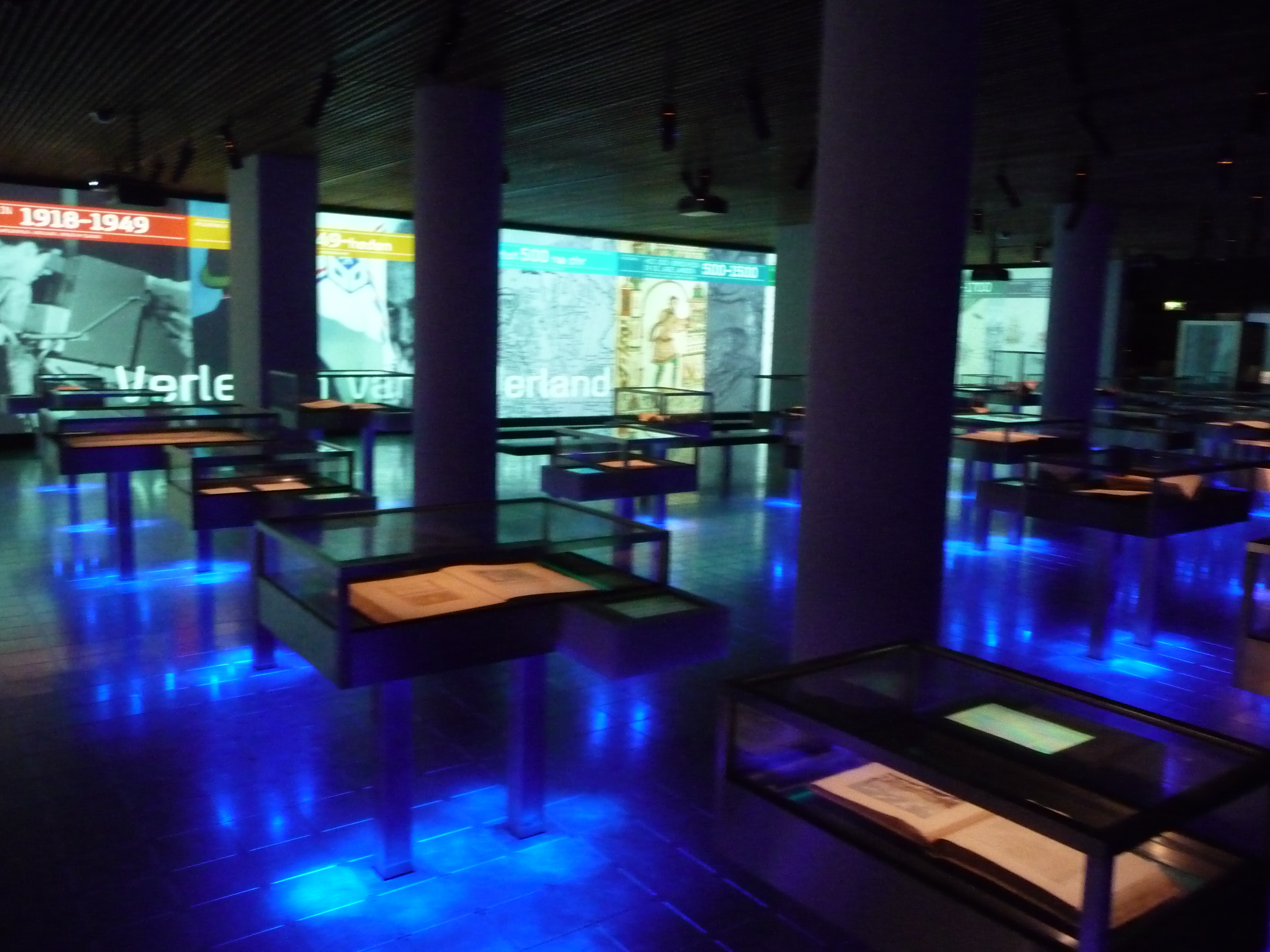
Royal Library of the Netherlands
The library began with a revolution and someone else's book collection. In January 1795, French revolutionary armies crossed the frozen rivers and swept through the Netherlands. The hereditary stadtholder William V of Orange fled to England. His library stayed behind. Three and a half years later, on 17 August 1798, a representative named Albert Jan Verbeek stood up in the new Batavian Republic's assembly and proposed that the confiscated books should become the foundation of a national library. The committee agreed the same day. By 8 November 1798, the Nationale Bibliotheek was formally founded - initially open only to members of the assembly, who could read at last in the rooms of the Binnenhof what their ousted prince had collected.
From Confiscation to Crown
The new library bounced through ownership and titles the way the Netherlands bounced through governments. In 1806, when Napoleon installed his brother Louis Bonaparte as king of Holland, the new king gave the library the predicate "Royal," the title it has never since lost. Napoleon himself then transferred the library to The Hague and helpfully allowed his Imperial Library in Paris to extract any volumes it wanted from the Dutch collection - a kind of imperial pruning that French institutions still occasionally have to give books back for. When William I returned to a restored Dutch monarchy in 1815, he confirmed the royal title by decree. The library moved through addresses: the Binnenhof from 1798, the Mauritshuis from 1807, the Huis Huguetan on Lange Voorhout from 1821 to 1982, and finally a modern building next to The Hague Central Station, clad in 5,200 white aluminum plates, where it has lived since 1982. Through all of it, the institution kept doing what national libraries do, which is to refuse to throw anything away.
The Oldest Dutchmen, and Other Treasures
In 975, Count Dirk II of Holland and his wife Hildegard donated a manuscript to Egmond Abbey - a Gospel book with miniatures inside it, including a picture of themselves as donors. Those small painted figures are the oldest surviving depictions of identifiable Dutchmen. The Egmond Gospels went missing for about three centuries after the Reformation, surfaced again in the early 19th century, and were purchased by the Dutch government for the Royal Library, where they are now KW 76 F 1. The library holds other treasures of similar caliber. The Trivulzio Book of Hours from around 1465 measures nine by thirteen centimeters - a hand-sized book of prayers, painted with Flemish miniatures so fine they almost defeat the eye. The Atlas van der Hagen from around 1690 fills four volumes with more than 400 hand-colored maps and prints, illuminated in gold by Dirk Jansz van Santen, one of the great afzetters of the Dutch Golden Age. And the Biblioteca van der Linde-Niemeijeriana holds roughly 40,000 items on chess - one of the great chess libraries of the world, accumulated from two private collections.
The Job of Keeping Everything
Since 1974 the library has run the Depot van Nederlandse Publicaties - the Depository of Dutch Publications - which collects, as completely as possible, everything published in the Netherlands, written by Dutch people abroad, or written about the Netherlands by anyone. Books, magazines, maps, government documents. In 2016 the collection ran to about seven million items, equivalent to 115 kilometers of shelving. Sheet music was excluded because there is simply too much of it. Braille books were excluded because their copies are needed in libraries for the blind. Everything else, in principle, comes in. The library also runs Delpher, a digital archive of more than 100 million pages of digitized Dutch newspapers, books, and magazines that researchers in the Netherlands and abroad use daily. And the KB's web-archive of pages hosted by the early Dutch internet provider XS4ALL was, in 2022, the first born-digital collection ever inscribed on a UNESCO Memory of the World register.
Looking at What Was Stolen
Like other major European libraries and museums, the KB has spent recent decades doing provenance research on objects that arrived during, or just after, the Nazi occupation. In 2015 the library identified a 17th-century Gillis Neyts painting in its collection as having belonged to Dr. Arthur Feldmann, a Jewish art collector from Brno who was murdered in the Holocaust. In 2020, an 1876 watercolor by Felicien Rops was identified as having belonged to the French collector Armand Dorville, whose collection was sold under duress during the war. The work is uncomfortable and necessary - going back through the acquisition books, finding the names, restoring what can be restored to descendants, and being honest about what was lost in ways that no return can repair. Most major Dutch cultural institutions are doing some version of this now. It is part of what it means to be a national library in this century.
Reading in the White Building
The current KB building at Prins Willem-Alexanderhof 5, next to The Hague Central Station, is open to anyone aged sixteen or older who wants to become a member, with day passes available for visitors. The reading rooms are quiet and modern; requests for material take about thirty minutes. The complex also houses the Literatuurmuseum, dedicated to Dutch literature, and the Kinderboekenmuseum - the Children's Book Museum - which is, in a country that takes its children's literature very seriously, one of the most charming small museums in the Netherlands. The Nationaal Archief stands next door. Together the buildings form a kind of memory district at the edge of central Hague, a place where the Dutch state has decided, very deliberately, to put everything it has decided to keep.
From the Air
The KB occupies Prins Willem-Alexanderhof 5 in The Hague, at approximately 52.082N, 4.327E, immediately adjacent to The Hague Central Station. The Hague sits 50 km southwest of Amsterdam Schiphol (EHAM) and 18 km north of Rotterdam The Hague Airport (EHRD). From cruising altitude the white-aluminum facade of the KB and the Nationaal Archief next to it can be picked out near the obvious landmark of Hague Central Station, just east of the Binnenhof.