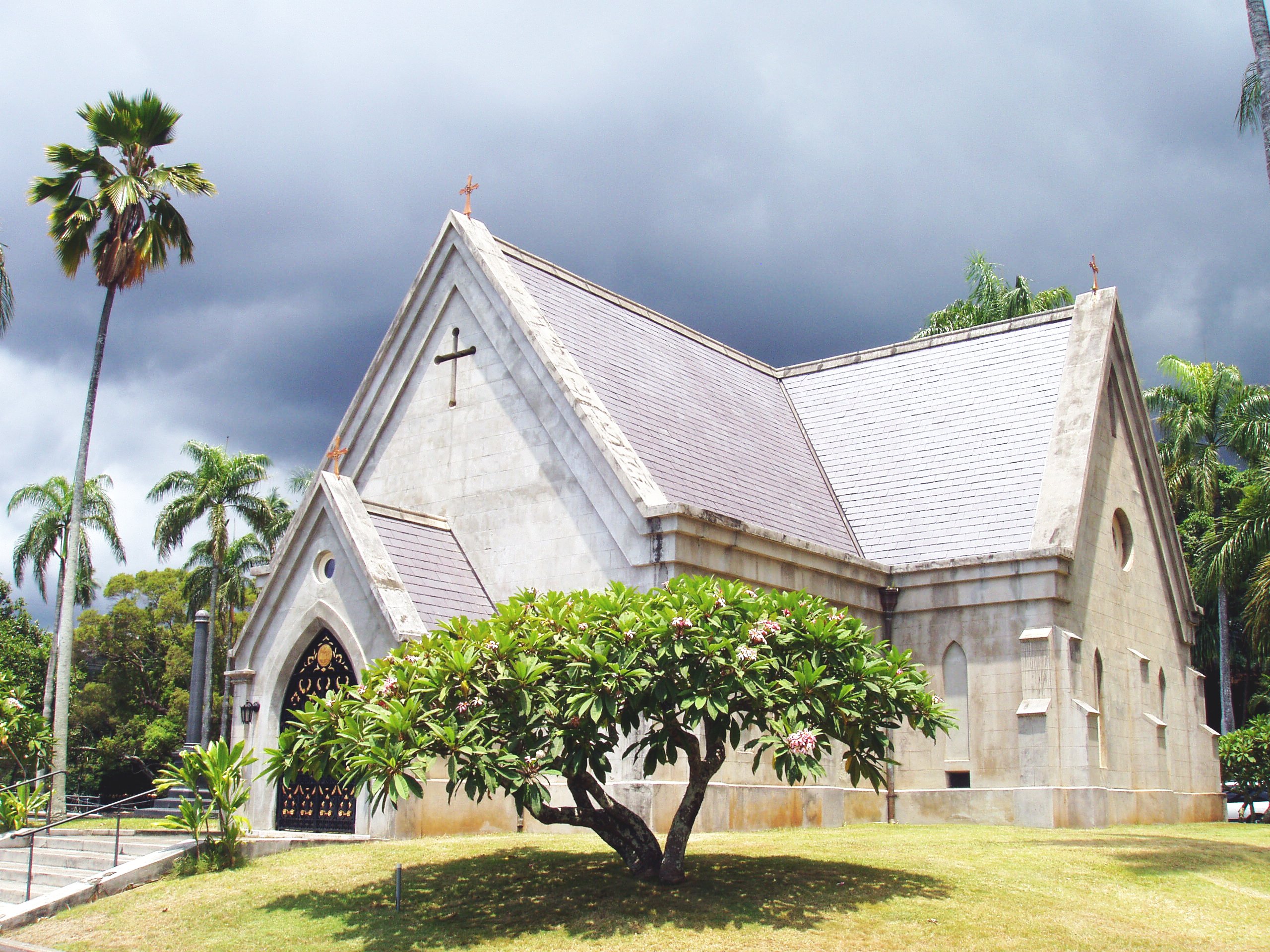
Royal Mausoleum (Mauna Ala)
There are only four places in Hawaii where the state flag can fly alone, without the Stars and Stripes beside it. One is Iolani Palace. Another is Thomas Square. A third is Puuhonua o Honaunau, the ancient place of refuge on the Big Island. The fourth is a small, shaded cemetery in Nuuanu Valley called Mauna Ala, the Fragrant Hills, where nearly every Hawaiian monarch, consort, prince, and princess of the past two centuries lies at rest. It is not a place that announces itself. No tall monument rises above the tree line. But within its walls, the full weight of Hawaiian sovereignty, loss, and remembrance gathers in stone and silence.
From Coral Blocks to Westminster Dreams
The story of Hawaii's royal burials begins not at Mauna Ala but near what is now Iolani Palace, where in 1825 a small tomb of coral blocks and thatch was built for King Kamehameha II and his queen Kamamalu. The young king had died of measles during a visit to London, and the experience of seeing Westminster Abbey had inspired the idea of a Western-style royal crypt. The original tomb was a modest structure, windowless, with an iron-locked koa wood door guarded day and night by two chiefs. No one could enter except for burials or on the Hawaiian Memorial Day, observed each December 30. Over the following decades, as more royals died, the tomb beside the palace grew crowded. By the 1860s, it was clear that the growing collection of royal remains needed a permanent, dedicated home. The site chosen was a stretch of valley land in Nuuanu that had belonged to Kekauluohi, who had served as Kuhina Nui, the kingdom's co-ruler. The name Mauna Ala, Fragrant Hills, came from the flowers and trees that already perfumed the grounds.
Two Dynasties, Three Crypts
Mauna Ala holds members of both the Kamehameha and Kalakaua dynasties, Hawaii's two royal lines. As the main mausoleum building filled, separate underground vaults were constructed to organize the dead by family. In 1887, Charles Reed Bishop, husband of Princess Bernice Pauahi Bishop, commissioned the Kamehameha Tomb, an underground vault to receive the caskets of the Kamehameha dynasty. The Territory of Hawaii added the Wyllie Tomb in 1904 for Robert Crichton Wyllie, the Scottish-born Minister of Foreign Affairs, and relatives of Queen Emma. Then in 1907, the territorial government allocated twenty thousand dollars for a Kalakaua family crypt. Queen Liliuokalani, the deposed last monarch, was consulted on its design. On the night of June 24, 1910, she supervised the transfer of her family's caskets to the new vault in a torchlit ceremony that blended Hawaiian tradition with Victorian formality. By 1922, all royal remains had been moved to the grounds, and the original mausoleum building was converted into a chapel. It was added to the National Register of Historic Places in 1972.
The Absent Kings
Not every Hawaiian monarch rests at Mauna Ala, and the absences tell their own stories. Kamehameha the Great, the warrior who unified the islands, was buried according to ancient custom: his bones were hidden to preserve his mana, the spiritual power of a high chief. To this day, no one knows where his remains lie. The secrecy was deliberate, a final act of protection by attendants who understood that a king's power could be stolen through his bones. William Charles Lunalilo, who reigned for just one year and twenty-five days, chose a different kind of separation. He requested burial not among the other royals but in the churchyard of Kawaiahao Church, the coral-block cathedral in downtown Honolulu sometimes called the Westminster Abbey of Hawaii. His tomb stands in the church courtyard, apart from both the commoners and the kings. Princess Nahienaena and Queen Keopuolani rest even farther away, at Waiola Church on Maui, where the Kamehameha family had deep roots.
Guardians of the Fragrant Hills
For more than a century and a half, the mausoleum has been tended by a succession of kahu, or guardians, whose responsibility extends beyond groundskeeping into the spiritual care of the royal dead. The earliest recorded kahu was Nahalau, who served until 1873. The role has passed through families over generations, with the Kahea and Maioho lineages carrying the duty across most of the twentieth century. Maria Angela Beckley Kahea served as kahu from 1893 to 1909, having been appointed just days after the overthrow of the monarchy, as though the guardianship of the dead had become even more urgent once the living kingdom was gone. The Maioho family continued the tradition into the twenty-first century, with William Bishop Kaiheekkai Maiioho serving until 2023. Congress removed Mauna Ala from public lands in 1900, two years after annexation, granting it a protected legal status that reflects its sacred character. The mausoleum remains a place where Hawaiian sovereignty is not debated but simply present, expressed in the flag that flies alone and in the unbroken chain of guardians who tend the graves of kings.
From the Air
Located at 21.3253N, 157.8473W in Nuuanu Valley on Oahu's south shore, approximately 2.5 miles north-northeast of downtown Honolulu. The mausoleum grounds are nestled in a residential valley below the Koolau Range and are not prominently visible from high altitude, but the distinctive green valley corridor leading from Honolulu toward the Pali is identifiable. Nearest airport is Daniel K. Inouye International Airport (PHNL), approximately 5 miles west. The Nuuanu Pali Lookout is visible higher in the valley to the northeast. Best viewed at 1,000-2,000 feet AGL following the Nuuanu Valley corridor inland from Honolulu Harbor.