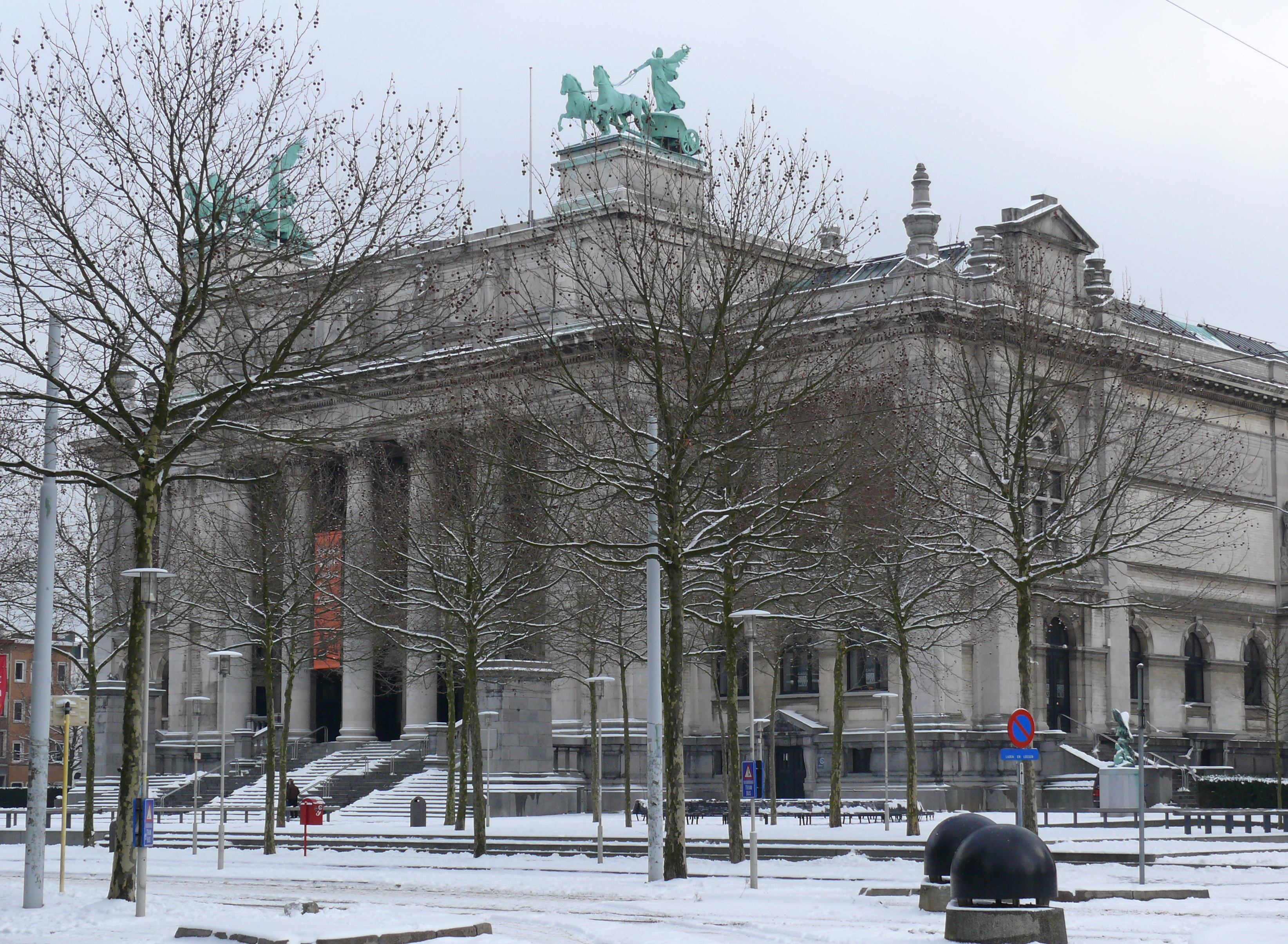
Royal Museum of Fine Arts Antwerp
Florent van Ertborn collected the wrong paintings. In the 1820s and 1830s, while other gentlemen of taste were paying real money for grand history scenes and polished Italians, the former mayor of Antwerp kept buying the small, strange, intensely detailed panels that an earlier age had produced in his own city and across the Low Countries - work by Jan van Eyck, Hans Memling, Rogier van der Weyden, Quinten Massys. Early Netherlandish painting was, at the time, deeply out of fashion. When Van Ertborn died in 1840 he left 144 of those unfashionable panels to his city's museum. The bequest is now the reason the Royal Museum of Fine Arts Antwerp matters internationally.
A Citadel Becomes a Garden
The KMSKA stands on land where soldiers once stood. The site was previously occupied by the Antwerp Citadel, the Spanish fortress that had brooded over the city's southern approaches for three centuries. When the citadel came down in the 1870s, the city used the cleared ground to build a new district - the Zuid - and dropped a museum into its centre. Architects Jean-Jacques Winders and Frans Van Dijk began work in 1884; the building opened in 1890 and was finished in 1894. Their neoclassical pile carries two bronze figures of Pheme driving horse-drawn chariots above the cornice, and seven roundel medallions naming the Antwerp painters - Van Eyck, Rubens, Massys, Floris and the rest - whose city this museum claims to represent. The gardens around it are bounded by streets named for the trades that built the collection: Schildersstraat (Painters' Street), Beeldhouwersstraat (Sculptors' Street), Plaatsnijdersstraat (Engravers' Street).
Eleven Years Dark
At the end of 2011 the museum closed its doors for what was meant to be a few years of refurbishment. It reopened on 24 September 2022. The renovation took eleven years and inserted, into the heart of the nineteenth-century building, an entirely new vertical extension - a tall white-cube hall hidden inside the historic envelope - designed for the museum's modern and contemporary holdings. From outside the building looks essentially unchanged. Inside, visitors now move between gilded historic galleries and stark daylit modern spaces stacked above them. The New York Times called it 'the Royal Museum with a white-cube gallery inside.'
What Van Ertborn Bought
Van Ertborn's 1840 bequest brought in Jan van Eyck's Saint Barbara of 1437 - a silverpoint-sharp panel of the saint with her tower under construction behind her - and his Madonna at the Fountain, plus Rogier van der Weyden's Portrait of Philip de Croy, half of a small devotional diptych, and the Seven Sacraments Altarpiece, one of the most ambitious Netherlandish paintings of the fifteenth century. Memling, Dieric Bouts, Joachim Patinir, Jean Fouquet, Simone Martini, Antonello da Messina and Lucas Cranach came in with the same gift. To this earlier core the museum has added what Antwerp has always done best: Rubens, Jordaens, Van Dyck. The Rubens holdings include Venus Frigida (1611), The Prodigal Son (1618), and an Adoration of the Magi - works the city has gathered back from the chapels and churches the French stripped during the occupations of 1794 and 1796.
Ensor in the Same Building as Van Eyck
What gives the KMSKA its peculiar density is the way it lets fifteenth-century devotion stand a few rooms from twentieth-century provocation. James Ensor's The Intrigue (1890) hangs in the same building as Memling and Fouquet. Modigliani's Sitting Nude (1917) shares the collection with Rubens. Magritte, René Magritte the Belgian Surrealist, sits in the modern wing along with Pierre Alechinsky and Rik Wouters - whose Ironing (1912) catches a woman in a moment of luminous domestic effort. There are also Vincent van Gogh's Peasant Woman Digging Up Potatoes (1885), Frans Hals's late portrait of Stephan Geraedts, and an Ingres self-portrait of 1864. The collection traverses six centuries without losing its specifically Antwerp gravitational pull.
Quiet Things to Look For
Two Girls as Saint Agnes and Saint Dorothea by Michaelina Wautier rewards anyone who pauses. Wautier was one of the few Flemish women painters of the seventeenth century to produce large-scale history pictures, and the museum has been instrumental in her recent rehabilitation. The Cabanel Cleopatra Testing Poisons on Condemned Prisoners (1887) is here too, an enormous Salon-machine of an image that combines opulent setting and quiet horror in a way only the nineteenth century thought worth painting. The museum's first foreign acquisition still hangs as well: Titian's small panel of Jacopo Pesaro being presented to Saint Peter by Pope Alexander VI, donated in 1823 by King William I of the Netherlands, three paintings into what would have been a much larger royal patronage if the Belgian Revolution of 1830 had not put an abrupt end to it.
From the Air
Located at 51.2088°N, 4.3943°E in the Zuid district of Antwerp, on the Leopold de Waelplaats. From the air, the building's neoclassical mass and its garden plot are visible just south of the Scheldt bend. Antwerp International (EBAW) lies 7 km east; Brussels Zaventem (EBBR) 45 km south. Approach from the west over the Scheldt gives the best view; afternoon light from the south-west picks out the rooftop chariots.