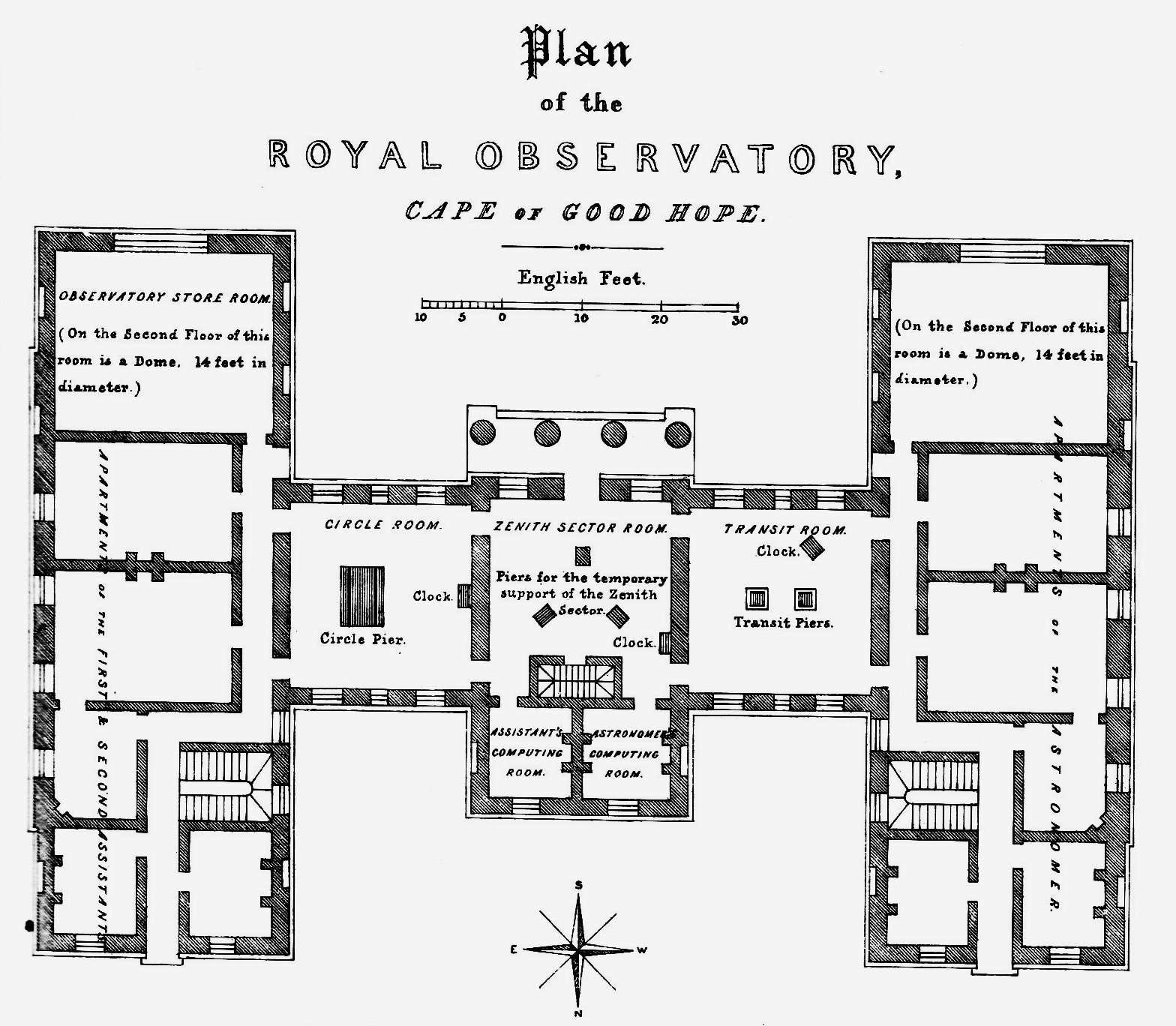
Royal Observatory, Cape of Good Hope
Thomas Henderson measured the distance to Alpha Centauri from here in the 1830s, but he took so long to publish his results that Friedrich Bessel beat him to the claim of first stellar parallax with observations of a different star. That blend of scientific achievement and maddening delay captures something essential about the Royal Observatory, Cape of Good Hope -- a place where landmark discoveries were made under conditions that would have defeated less determined astronomers. Founded by the British Board of Longitude in 1820 on a small hill five kilometers southeast of Cape Town, the observatory became one of the most important astronomical institutions in the Southern Hemisphere.
First Light at the Southern Sky
The proposal for a southern observatory likely originated among the same circle of astronomers who founded the Royal Astronomical Society in the United Kingdom. The Cape was chosen because the entire southern sky was effectively unmapped by European science. Henderson, the second His Majesty's Astronomer at the Cape, made the observations that should have earned him the title of first person to measure stellar parallax, but his assistant Lieutenant William Meadows and the difficult working conditions made him cautious about publishing. Bessel's parallax of 61 Cygni appeared in print first. Around 1840, Thomas Maclear used the observatory to re-measure the meridian of Nicolas-Louis de La Caille, vindicating the French astronomer's geodetic measurements and showing that nearby mountains had distorted his latitude readings.
The Comet That Changed Photography
In 1882, astronomer David Gill obtained long-exposure photographs of the Great Comet of that year and noticed something unexpected: background stars appeared in the images. The realization that photography could catalogue stars more efficiently than the human eye transformed astronomy. Gill collaborated with J.C. Kapteyn of Groningen to produce the Cape Photographic Durchmusterung, the first stellar catalogue created by photographic means. In 1886, Gill proposed an international congress to promote a photographic catalogue of the whole sky, and the resulting 1887 Paris congress launched the Carte du Ciel project -- regarded as the precursor to the International Astronomical Union. The Cape Observatory was assigned the zone between declinations minus forty and minus fifty-two degrees.
Rings and Stars
The discoveries continued into the twentieth century. In 1897, Frank McClean used an objective prism on the Astrographic Telescope to discover oxygen in the spectra of several stars. In 1911, Chief Assistant J.K.E. Halm published a pioneering paper on stellar dynamics that contained the first suggestion of a mass-luminosity relationship for stars. Alan Cousins, the last serious observer to work from the site, established precise southern photometric standards that earned international recognition. And in 1977, Joseph Churms observed the occultation of a star from the observatory grounds, providing crucial confirmation of the rings of Uranus that had been discovered from the Kuiper Airborne Observatory. Each discovery was a small revolution, and each happened on the same modest hill.
Cannonballs, Leopard Toads, and a Rare Iris
The observatory's buildings are remarkable in their own right. The main building, completed in 1828 in Greek Revival style by architect John Rennie, now houses offices and a notable astronomical library. The photoheliograph building from 1849 has a dome that rotates on cannonballs. The McClean building, designed by Herbert Baker in 1896, features a hydraulically driven rising floor. The former spectroscopic laboratory was converted into an astronomical museum in 1987, preserving original nineteenth-century fittings alongside telescope models, calculating machines, and a clockwork telescope drive. The site sits in the Two Rivers Urban Park, a wetland area on Malmesbury shale, and supports surprising biodiversity: it marks the northern limit of the Western Leopard Toad and hosts the only remaining natural habitat of the rare iris Moraea aristata. Declared a National Heritage Site in December 2018, the observatory is a place where the cosmos and the local ecology are equally worth studying.
From the Air
Located at 33.93°S, 18.48°E in the Observatory suburb of Cape Town, approximately 5 km southeast of the city center. Nearest airport: Cape Town International (FACT). The observatory sits on a small hill in the Two Rivers Urban Park wetland area. The distinctive dome buildings may be visible from lower altitudes. The suburb of Observatory, named after this institution, surrounds the site.