Royal Observatory, Greenwich
There is a brass strip set into the courtyard at the Royal Observatory, and on any given day you will find tourists straddling it, one foot in the Eastern Hemisphere, one in the Western, posing for photographs. The line is the Prime Meridian, longitude zero, the invisible seam that runs from pole to pole and divides the globe in two. That this particular hill in southeast London became the starting point for measuring the entire world was not inevitable. It was the product of centuries of painstaking astronomical observation, fierce international rivalry, and one king's determination to solve the deadliest navigational problem of his age.
A King's Command
Charles II founded the observatory in 1675, not for the glory of science but for the safety of his ships. English sailors were dying because they could not determine their longitude at sea, and the king charged his new institution with rectifying the tables of the motions of the heavens and the places of the fixed stars, so as to find out the so much desired longitude of places for the perfecting of the art of navigation. He appointed John Flamsteed as the first Astronomer Royal with a salary of one hundred pounds per year, from which Flamsteed was expected to buy his own instruments. Christopher Wren, himself a former professor of astronomy, designed Flamsteed House, the original observatory building, which was completed in 1676. Its foundation included recycled materials from a demolished gatehouse at the Tower of London, a practical economy that set the tone for an institution perpetually short of funds.
Mapping the Heavens
Flamsteed spent forty years making observations with such precision that his star catalogue, the Historia Coelestis Britannica, remained a standard reference for generations. His successors, including Edmond Halley and Nevil Maskelyne, expanded the observatory's work. Maskelyne established the Nautical Almanac in 1767, providing navigators with the lunar tables they needed to calculate longitude at sea. By the nineteenth century, the observatory had become the world's authority on positional astronomy and timekeeping. The time ball atop Flamsteed House, installed in 1833, dropped at precisely one o'clock each day so ships on the Thames could set their chronometers. When the International Meridian Conference of 1884 voted to establish a single prime meridian for the world, Greenwich won, beating out Paris, Berlin, and several other contenders. The vote was not close: twenty-two nations in favour, one opposed, two abstaining.
The Line That Moved
The meridian line visitors photograph today is not quite the same one used by the observatory's astronomers. When satellite-based geodesy arrived in the twentieth century, it revealed that the traditional transit instrument was slightly offset from the true geodetic meridian, which runs approximately 102 metres to the east. The discrepancy arises from the deflection of the vertical caused by local gravitational variations. The observatory's brass strip retains its historical position, a reminder that even the most precise measurements are products of their time and technology. The observatory holds IAU observatory code 000, the first in the international list, a numerical distinction that honors its foundational role in global astronomy.
From Stargazing to Storytelling
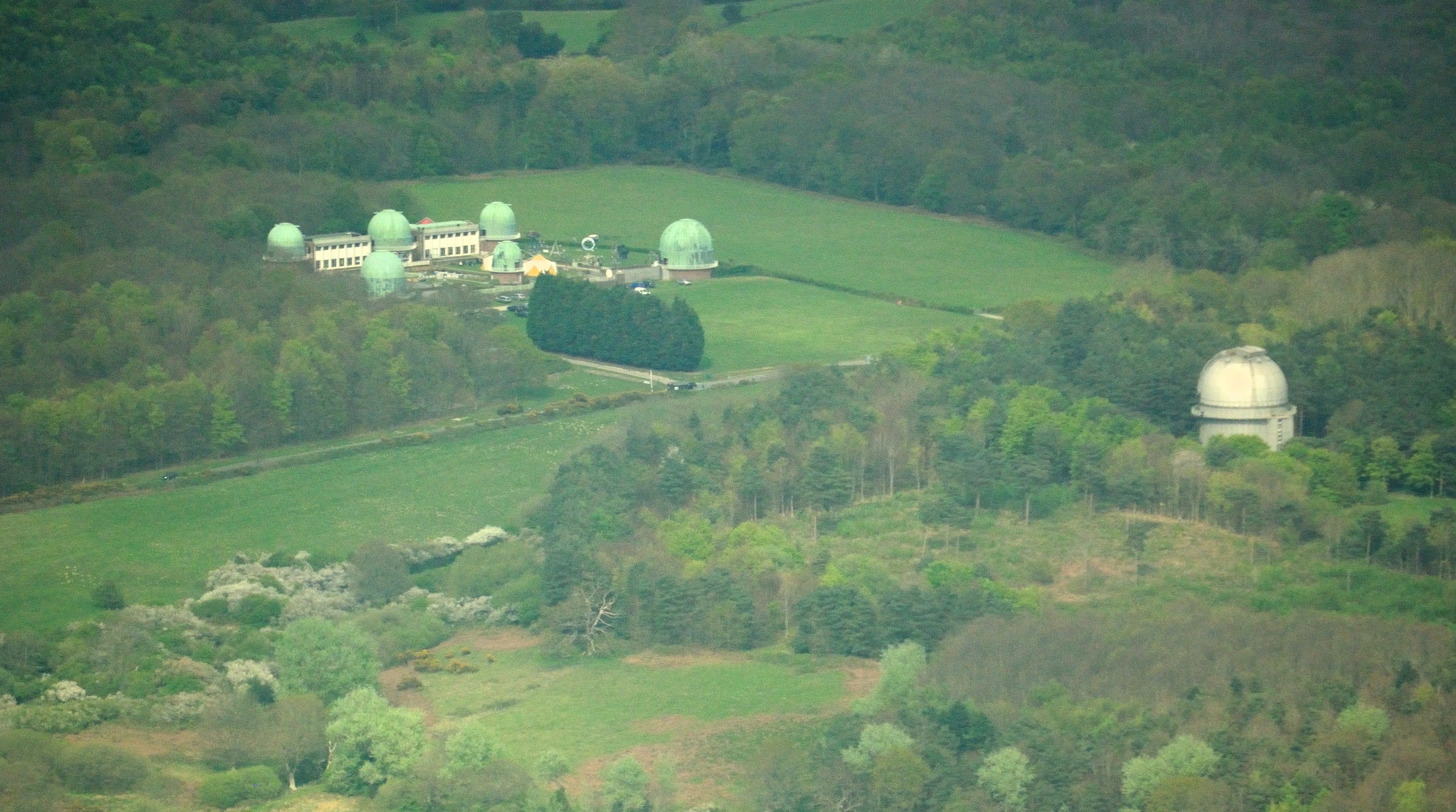
By the mid-twentieth century, light pollution and vibrations from London traffic had rendered the Greenwich site unsuitable for serious observation, and the working observatory relocated to Herstmonceux Castle in Sussex in 1957. The Greenwich buildings became a museum, part of Royal Museums Greenwich alongside the National Maritime Museum, the Queen's House, and the clipper ship Cutty Sark. A Peter Harrison Planetarium was added in 2007, the first public planetarium in London. From the hilltop, visitors look north across the Thames to the towers of Canary Wharf, a view that compresses four centuries of British ambition into a single panorama: the place where the world's coordinates were fixed, gazing across at the financial district that trades on global time zones the observatory helped create.
From the Air
Located at 51.4769N, 0.0005W atop a hill in Greenwich Park, southeast London, overlooking the Thames. The observatory complex is visible as a cluster of buildings on the park's highest point. Nearest airports: London City (EGLC) 4 nm north, London Heathrow (EGLL) 18 nm west. Best viewed at 1,500-2,500 ft AGL. The Queen's House and National Maritime Museum are visible directly below to the north.