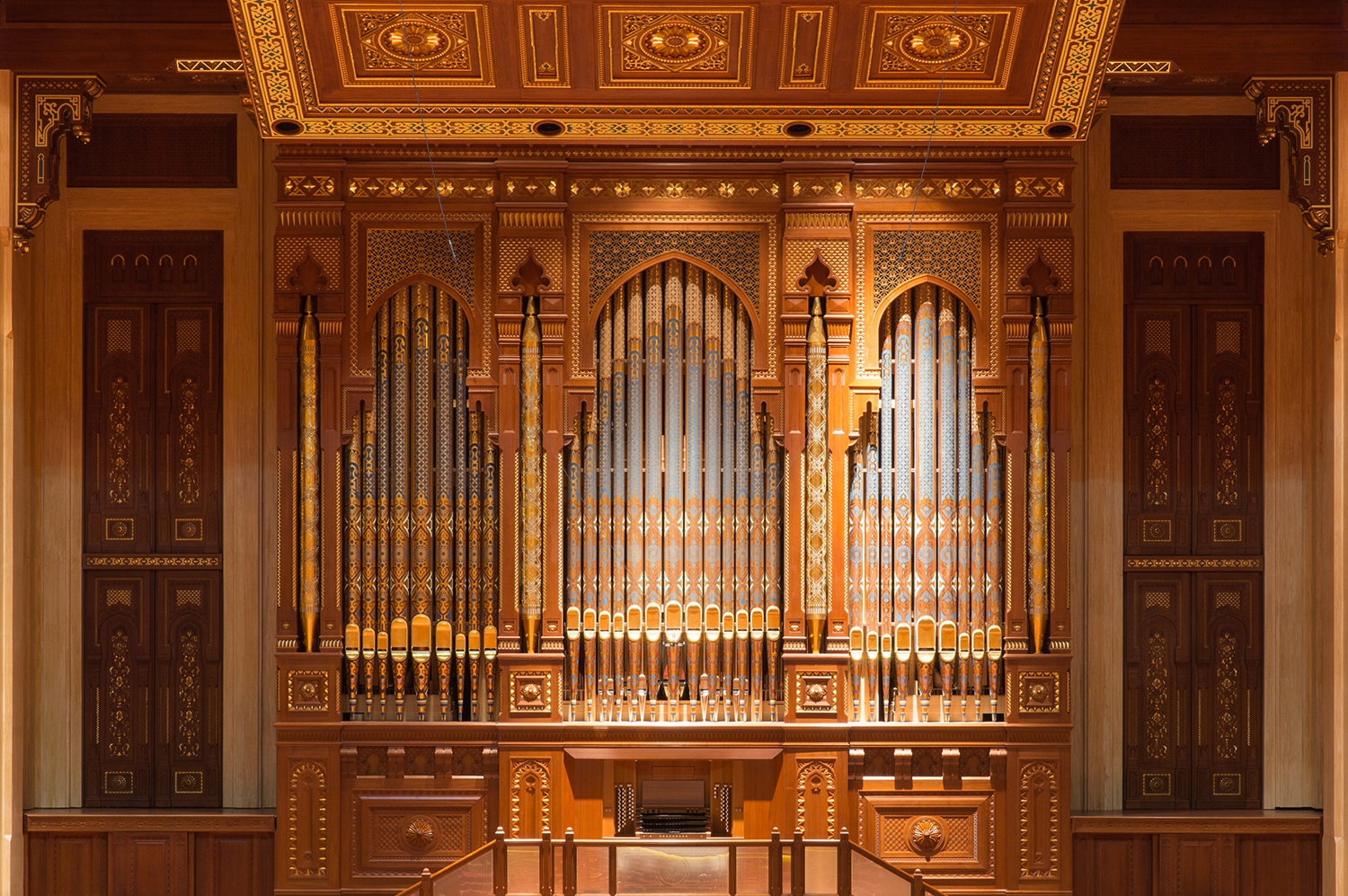
Royal Opera House Muscat
A sultan who played the lute ordered an opera house built. That single fact explains more about modern Oman than any economic statistic. Sultan Qaboos bin Said, who had transformed one of the world's most isolated countries into a functioning modern state, turned his attention to culture in 2001 and commissioned what would become the Royal Opera House Muscat. Ten years later, on October 12, 2011, Placido Domingo conducted the opening production of Turandot. The 1,100-seat venue in Muscat's Shati Al-Qurm district had arrived.
From House of Musical Arts to ROHM
The project began with the working title House of Musical Arts before the grander name Royal Opera House Muscat was chosen. Carillion Alawi handled construction of a complex that extends well beyond the performance hall: the grounds include a concert theatre, an auditorium, formal landscaped gardens, a cultural market with retail shops, luxury restaurants, and an art center. The architecture draws on contemporary Omani design traditions -- arches, stonework, and geometric patterns -- without imitating the historical buildings of Old Muscat. The opera house became the first in the world equipped with Radio Marconi's Mode23 multimedia interactive display seatback system, a technological flourish that signaled the venue's ambitions.
A First Season to Remember
The inaugural season set the standard. Placido Domingo conducted the opening Turandot, then returned to perform. Andrea Bocelli sang. Soprano Renee Fleming appeared. Yo-Yo Ma brought his cello. The London Philharmonic Orchestra performed. The American Ballet Theatre staged Don Quixote. The Mariinsky Ballet danced Swan Lake. Wynton Marsalis and the Jazz at Lincoln Center Orchestra brought New York jazz to the Arabian Peninsula. The programming was a deliberate statement: this was not a vanity venue that would host local events and the occasional imported show. It was intended to function at the highest international level from its first night.
Where Worlds Meet on Stage
The opera house does not limit itself to Western classical traditions. Arab artists including Majida El Roumi have performed on its stage, and a tribute concert honored the legendary Egyptian singer Um Kalthoum. In March 2013, Indian violin virtuoso L. Subramaniam performed and noted that the Royal Oman Symphony Orchestra was the only orchestra in the Middle East composed entirely of musicians from the region. The programming reflects Qaboos's vision of Oman as a crossroads -- a place where Western, Arab, Indian, and African cultural traditions could share the same stage, just as they have shared Oman's harbors and souqs for centuries.
Culture as National Project
Building an opera house in a country that had barely ten kilometers of paved road when its sultan took power in 1970 requires explanation. Qaboos saw cultural institutions not as luxuries that follow development but as engines of it -- markers of national sophistication that help define a country's identity on the world stage. The ROHM sits on Sultan Qaboos Street in the Shati Al-Qurm district, surrounded by the gardens and commercial spaces that make it a destination beyond performance nights. Oman's oil reserves are smaller than its Gulf neighbors', and the pressure to diversify the economy makes cultural tourism a strategic interest rather than merely an aesthetic one. The opera house, like the National Museum in Old Muscat, is part of a deliberate effort to give visitors reasons to come to Oman that have nothing to do with hydrocarbons.
From the Air
The Royal Opera House Muscat is at approximately 23.61N, 58.47E in the Shati Al-Qurm district of Muscat, along Sultan Qaboos Street. The building and its landscaped grounds are visible from low altitude. Muscat International Airport (OOMS) is the nearest major airport, located to the west. Old Muscat and its historical sites lie approximately 12 km to the east along the coast.