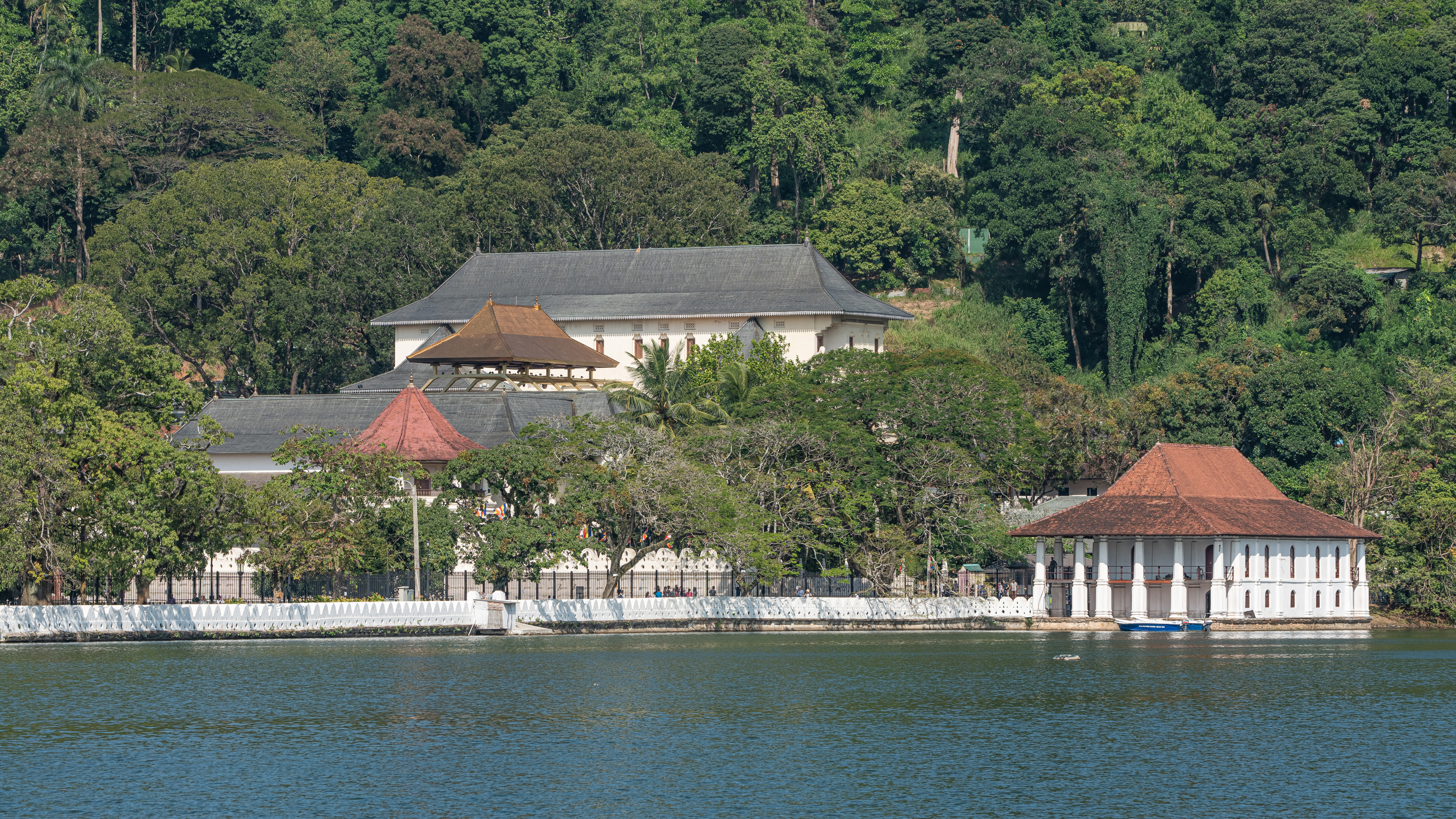
Royal Palace Complex of Kandy
On 2 March 1815, inside a carved wooden hall called the Magul Maduwa, Sinhalese chiefs signed away the last independent kingdom on the island of Sri Lanka. The building where they did it still stands. So does the palace around it, and the temple beside it, and the lake the last king built in front of it. The Royal Palace Complex of Kandy is not one building but a constellation of structures spanning five centuries -- throne rooms and bathing pavilions, queens' chambers and armories -- each layer recording who held power and what they did with it.
Built, Burned, Built Again
The earliest structures date to the 14th century, when Vickramabahu III ordered the initial buildings constructed. In the late 16th century, Vimaladharmasuriya I took up residence and expanded the complex, incorporating architectural influences from the Portuguese -- the same people his forces were fighting. The irony is instructive: Kandyan culture borrowed freely even from its enemies. The Portuguese destroyed the palace in the early 17th century during the reign of Senarat, but Rajasinha II rebuilt it meticulously in 1634. This cycle of destruction and reconstruction became the palace's defining pattern. Invaders would burn it. Kings would rebuild it, each leaving their own architectural signature. When the British finally took possession in 1815, the complex contained eighteen buildings. They destroyed twelve of them.
Windows That Watched Everything
The King's Palace, known as the Maha Wasala, sits at the complex's northern edge. Its most revealing feature is a set of observation windows called the Siv Maduru Kawulu -- four openings that gave the king a panoramic view of the Queen's Palace, the Temple of the Tooth, the city below, and the Udawatta Kele forest sanctuary above. From one seat, a king could survey his entire world. The Magul Maduwa, or Royal Audience Hall, began construction under Sri Vikrama Rajasinha in 1783. Its rows of carved wooden pillars -- sixty-four in total, after the British extended the building in 1872 to welcome the Prince of Wales -- are among the finest surviving examples of Kandyan woodwork. The British expansion used pillars scavenged from another palace building, the Palle Vahale, replacing its originals with brick. They preserved the craft while rearranging the context.
The Queens' Realm
The Meda Wasala, or Queens' Chambers, is a small building that tells an outsized story. It has a single room, a compact courtyard with a lotus pond, frescoed corridors, and a door designed to lock only from the inside. Historical accounts say King Sri Vikrama Rajasinha confined Queen Rangammal here, allowing only her most trusted attendants to see her. Archaeologists found four copper sheets concealed within the bed's pillar pits -- protective mantras, hidden spells against indiscretion. Beneath the wall plaster, they discovered floral patterns etched on a red background, secret decoration for a secret room. Nearby, the Queen's Bathing Pavilion -- the Ulpange -- rises from what appears to be Kandy Lake, though the pavilion actually predates the lake by six years. Built in 1806 on marshy paddy land over a natural spring, it fed its octagonal pool from water rising beneath the foundation. The British later added a storey and converted it into the United Service Library.
What the Terrace Remembers
The Maha Maluwa, the Great Terrace in front of the Temple of the Tooth, was once a threshing ground for paddy fields -- the same fields that would later become Kandy Lake. According to local tradition, astrologers advised King Wimala Dharmasuriya to build his capital where a white mongoose frequented the threshing floor. Today the terrace holds a stone pillar memorial containing the skull of Keppetipola Disawe, the Sinhalese hero who led the Uva Rebellion of 1818 in an attempt to reclaim independence from the British. He was executed for it. His skull rests here as both monument and reproach. Nearby stand statues of Princess Hemamali and Prince Danthakumara, who legend says brought the tooth of the Buddha to Sri Lanka. The terrace is where mythology and rebellion share the same ground, where the sacred relic and the hero's skull occupy the same square. The palace complex holds everything Kandy was: sovereign, sacred, defiant, and ultimately forced to accommodate powers it never chose.
From the Air
The Royal Palace Complex of Kandy (7.295N, 80.641E) sits at approximately 465m elevation on the north shore of Kandy Lake. The complex is a UNESCO World Heritage Site visible as a cluster of traditional-roofed buildings adjacent to the lake. The Queen's Bathing Pavilion (Ulpange) extends into the lake on its south side. The Maha Maluwa (Great Terrace) is the open area between the Temple of the Tooth and the lake. Nearest airport is Bandaranaike International (VCBI/CMB), 115km southwest. The Udawatta Kele forest sanctuary rises immediately behind the complex to the north.