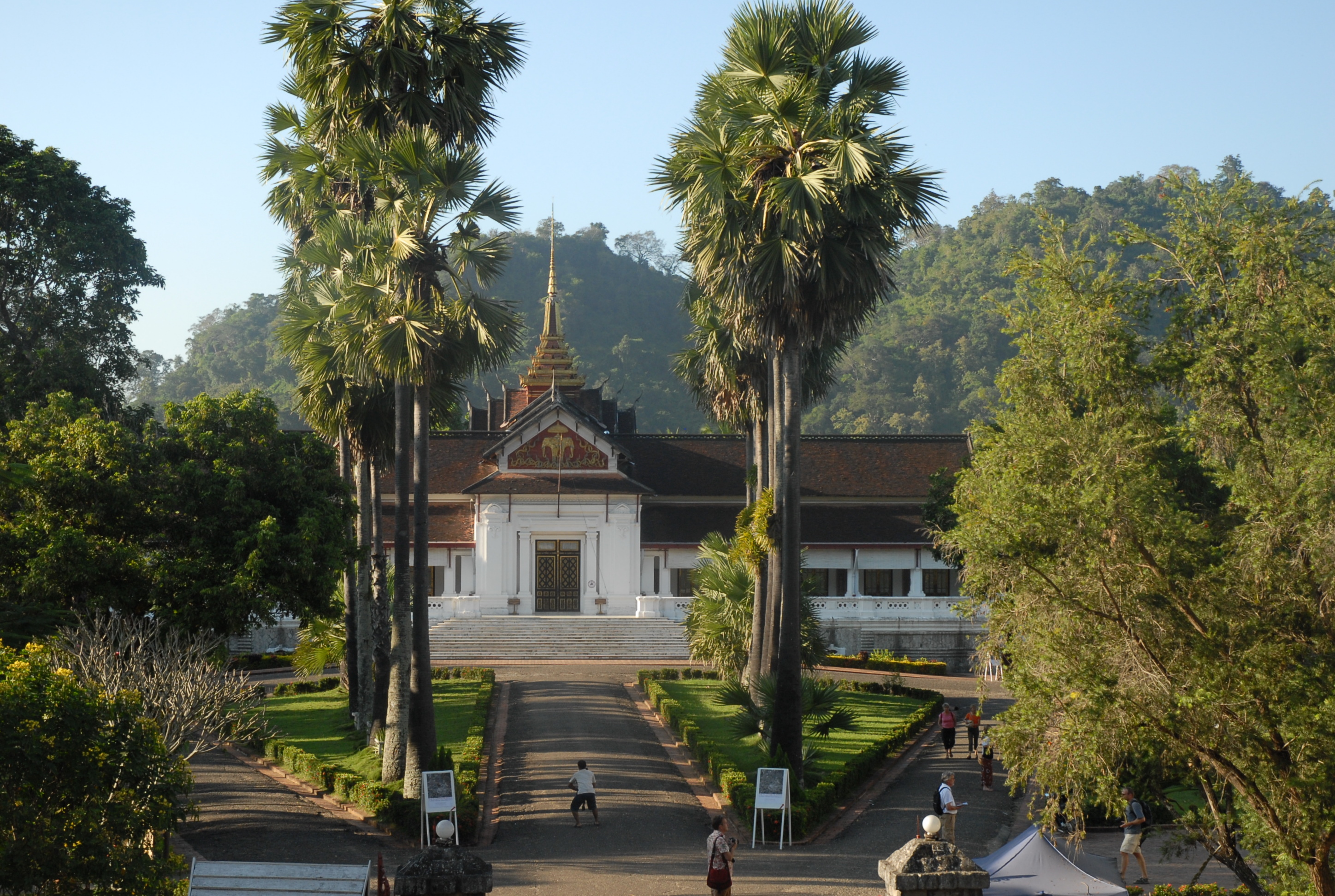
Royal Palace, Luang Prabang
The murals inside the king's reception room were designed to be viewed at specific hours. French artist Alix de Fauntereau painted them in 1930 so that morning light would illuminate the dawn scenes, afternoon sun would warm the midday panels, and the golden hour would complete the cycle on the western wall. It is a small, almost obsessive detail -- and it captures everything about the Haw Kham, the golden hall that served as Laos's royal palace. Built in 1904 where the Nam Khan River meets the Mekong, the palace was sited so that foreign dignitaries could step directly from their boats onto the steps below and be received by the king. Today, visitors still approach from the river side, climbing the same Italian marble staircase. But the king who should greet them is gone.
Where Two Rivers Meet
The French built the Haw Kham during their colonial administration of Laos, creating something that belonged fully to neither culture. Its double-cruciform floor plan follows Beaux-Arts symmetry, but above the entrance stands a three-headed elephant sheltered by the sacred white parasol -- the symbol of the Lao monarchy stretching back centuries. The result is a building that reads as French from a distance and Lao up close. King Sisavang Vong, for whom the palace was constructed, would occupy it for decades while navigating the tightrope between colonial subjugation and royal tradition. His statue still stands on the grounds near the conference hall, flanked by a lotus pond and two cannons at the entrance, surveying a kingdom that no longer exists.
A Buddha's Long Journey Home
The palace's most treasured object is the Phra Bang, a standing Buddha cast from a gold, silver, and bronze alloy that stands 83 centimeters tall and weighs roughly 50 kilograms. According to tradition, it was crafted around the first century in Sri Lanka, eventually making its way to the Khmer Empire, where the king gifted it to his son-in-law, King Fa Ngum, in 1359. The statue gave Luang Prabang its name. But keeping it proved difficult. The Siamese carried the Phra Bang to Thailand twice, in 1779 and 1827, before King Mongkut returned it in 1867. Nearby sit three embroidered silk screens crafted by the queen herself, and another Buddha flanked by large elephant tusks. In the secretary's reception room across the hall, diplomatic gifts from around the world are arranged with blunt honesty: objects from Myanmar, Cambodia, China, and Vietnam on one side, gifts from the United States, Canada, and Australia on the other, divided into "socialist" and "capitalist" countries. Among the American offerings sits a piece of Moon rock from an Apollo mission.
Portraits on the Wall, Ghosts in the Room
In the queen's former reception room hang three large portraits: King Savang Vatthana, Queen Khamphoui, and Crown Prince Vong Savang, painted in 1967 by Russian artist Ilya Glazunov. The faces are composed, regal, confident. Eight years after those portraits were completed, the Pathet Lao overthrew the monarchy. The royal family was removed from the palace and sent to re-education camps in the northeastern mountains. None of them returned. Walk deeper into the palace and you reach the royal bedrooms and living quarters, preserved exactly as they were the day the king was forced out in 1975. The personal objects, the furniture, the arrangement of the rooms -- all frozen in the moment when a six-century-old dynasty ended. A dining hall sits nearby, and a room displays royal seals and medals. The throne room still holds the crown jewels of Laos, now belonging to no one and everyone.
The Museum That Was a Monarchy
The conversion from palace to national museum happened swiftly after the communist takeover. What had been a living seat of power became an exhibit almost overnight. The gilded and lacquered Ramayana screens in the reception room, crafted by local artisan Thit Tanh, still shimmer under the light that enters through the windows Fauntereau studied so carefully. The religious objects in the entrance hall still occupy their positions. On the palace grounds, the royal barge shelter, the kitchen and storage buildings, the conference hall, and the Haw Phra Bang temple that houses the sacred Buddha image continue to define the compound. Luang Prabang itself became a UNESCO World Heritage Site in 1995, and the palace sits at the heart of that designation. Visitors from around the world now climb those marble steps, pass beneath the three-headed elephant, and step into rooms where the light still changes through the day, illuminating murals that were painted for a king who would never see them grow old.
From the Air
Located at 19.89°N, 102.14°E on the peninsula where the Nam Khan River meets the Mekong in Luang Prabang, Laos. The palace compound is visible along the riverbank at low altitude. Nearest airport is Luang Prabang International Airport (VLLB), approximately 4 km northeast. The UNESCO-protected old town surrounding the palace is identifiable from the air by its distinctive peninsula shape between the two rivers. Best viewed at 2,000-3,000 ft AGL for context of the river confluence.