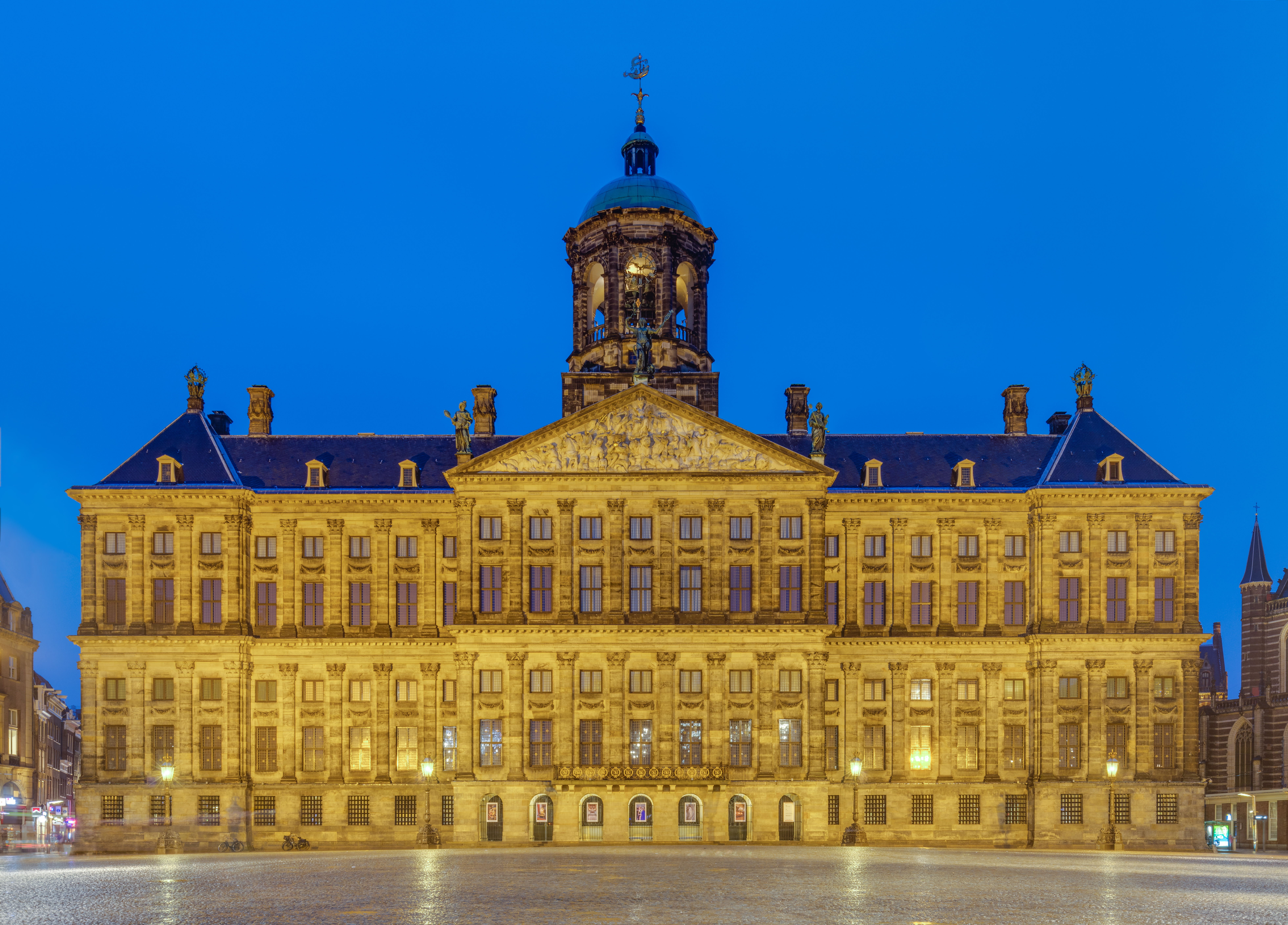
Royal Palace of Amsterdam
The building on the western side of Dam Square was not meant to be a palace. It was meant to be a town hall - the seat of the burgomasters of a republic at the moment that republic became the richest commercial power in Europe. When Jacob van Campen began the design in 1648, the year the Treaty of Westphalia ended the Eighty Years' War and recognised Dutch independence, he was being asked to build a civic monument suitable for a city that had just outgrown every other in Europe. He did. The building still feels like an oversized statement, because that is exactly what it was. The fact that it later became a royal palace is one of those accidents of history that the Dutch never quite got over.
The Town Hall of the Republic
Burgemeester Nicolaes Tulp - the same Nicolaes Tulp Rembrandt painted in The Anatomy Lesson of Dr. Tulp - commissioned a new stadhuis even before the old one burned. When the old town hall did burn, on 7 July 1652, Amsterdammers crowded around the flames "saving" coins from the city treasury into their own pockets. The fire was almost convenient: comparison of city maps before and after shows that whole blocks were cleared during the rebuilding to create a fire buffer. The new town hall opened on 29 July 1655. Jacob van Campen designed it in a strict classical idiom that nodded toward Rome but did not borrow Rome's specific gestures. The whole vast structure rests on 13,659 wooden piles driven into Amsterdam's soft ground - a number Dutch schoolchildren still memorise. The Citizens' Hall inside, the Burgerzaal, was paved with marble inlay maps of the eastern and western hemispheres so that anyone walking the floor stood, symbolically, on the world the city traded with.
The Eighth Wonder
Foreign visitors called it the eighth wonder of the world. The 17th-century Dutch traveller and writer Constantijn Huygens helped set its programme, and the sculptural decoration - by Artus Quellinus and his workshop - depicts the virtues of good civic government with the seriousness of a tribunal. In the Vierschaar, the room where capital sentences were pronounced, the iconography of justice is so dense that the room reads like a sermon. On the rear elevation, six metres tall, stands a copper statue of Atlas with the celestial globe on his shoulders. He has held it up since the 17th century. From Dam Square below, the figure is small. Closer, on a roof level walk, he is enormous. The point of the figure is that Amsterdam's commerce had reached every star on the globe Atlas was carrying.
Louis Bonaparte Moves In
In 1806 Napoleon Bonaparte, having absorbed the Netherlands into his system of allied states, decided to give the Dutch a king. The king he chose was his younger brother Louis, titled King Louis I of Holland. Louis was twenty-seven years old and had no Dutch. He learned the language, surprisingly well, and grew to love the country he had been parachuted into. After two years of holding his court in The Hague and Utrecht, Louis moved to Amsterdam in 1808 and asked the city for a residence. The city offered him its town hall. Louis converted the public ground-floor rooms into the first national museum of the Netherlands, under the curator Cornelis Apostool, and took the rest of the building for himself. The Burgerzaal became his throne room. The cell complex behind the Vierschaar became servants' quarters. The Empire furniture that Louis installed - much of it still inside - became one of the largest intact collections of Napoleonic-era interior design in Europe. Then in 1810 Napoleon, dissatisfied with his brother's growing sympathy for the Dutch, simply annexed the country and forced Louis out.
A Palace, More or Less
Napoleon fell. The House of Orange returned in 1813. The new King William I inherited his brother-in-law's palace by default - the building had stopped being a town hall and there was no easy way to undo Louis's conversion. So the Royal Palace of Amsterdam stayed a royal palace, one of three at the disposal of the Dutch monarch by Act of Parliament. The current King Willem-Alexander uses it for state receptions and the swearing-in of new prime ministers; the abdication of Queen Beatrix in 2013 took place inside, in the Mozeszaal, with the new king and Beatrix appearing together on the central balcony facing Dam Square afterward. Between events, the public ground floor still functions as a museum, exactly as Louis intended in 1808. The building was restored between 2005 and 2009, when asbestos was removed and the Atlas figure was conserved. He still holds the globe. The town hall that became a palace is now back, a few days a year, to being a kind of town hall again - the room where the Dutch republic, which is officially a kingdom, performs its constitutional rituals.
From the Air
Coordinates 52.373 N, 4.891 E. The Royal Palace dominates the west side of Dam Square at the centre of Amsterdam. From the air it reads as a long classical block with a low dome and a curved pediment facing the square, with the Nieuwe Kerk immediately to its north and the white obelisk of the National Monument facing it across the open Dam. Recommended viewing altitude 1000-2500 feet AGL for orientation against the radial canals. Nearest airport: Amsterdam Schiphol (EHAM), 12 km southwest. Low cloud over the city centre is routine; clear afternoon light is best for the pale sandstone facade.