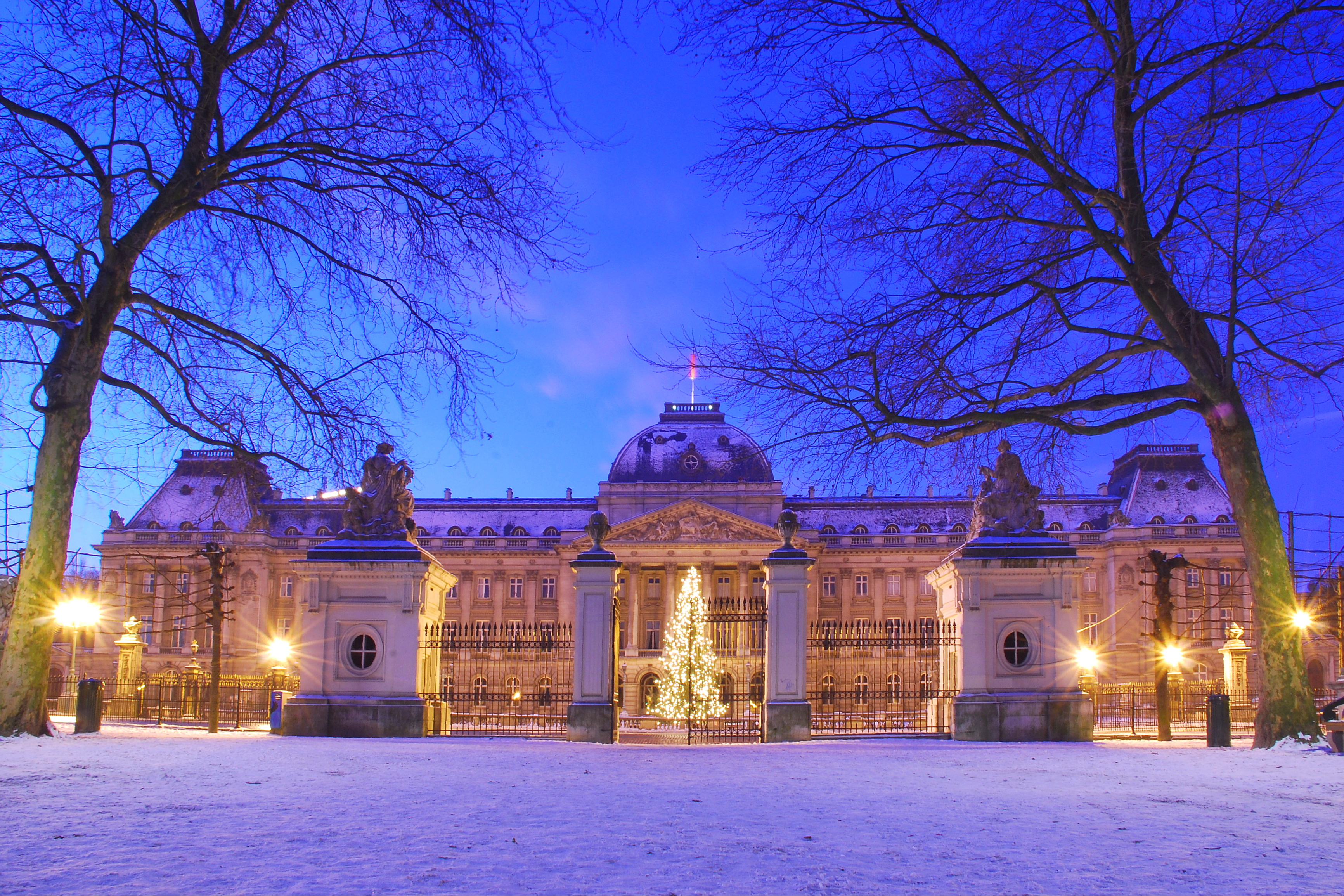
Royal Palace of Brussels
Look up in the Hall of Mirrors of the Royal Palace of Brussels and the ceiling glows the colour of a beetle. That is because it is. In 2002, the Flemish artist Jan Fabre attached more than a million wing-cases of jewel beetles to the ceiling of one of the palace's most-used reception rooms, the place where ambassadors present their credentials to the king. The work is called Heaven of Delight, and walking under it is like walking under a pond of liquid metal that has been frozen mid-shimmer. The palace's relationship to its own building is full of these mild absurdities. The king does not actually live here - the royal family resides at the Palace of Laeken, five kilometres north - and the Throne Room contains no throne, because the King of the Belgians does not own one (or a crown, for that matter). The Royal Palace is officially the king's working palace, the formal seat of the monarchy, the venue for state events. It is also a kind of theatre that admits visitors every summer to look at the props.
Standing on Coudenberg
To understand why the Royal Palace sits where it does, you have to know what it stands on. The grounds were once part of the Palace of Coudenberg, the medieval and Renaissance seat of the rulers of the Low Countries. After Coudenberg burned down on the night of 3 February 1731, the ruins sat untouched for more than forty years before Brussels' urban planners finally cleared them in the 1770s, laying out Brussels Park and the Place Royale on top. On the southern edge of the new park, two new mansions went up, joined by a street between them. One served as the residence for the abbot of the nearby Coudenberg Abbey; the other housed senior government officials. These two buildings, joined later by a gallery and given a neoclassical facade, would become the palace. The middle axis of Brussels Park still runs from the front door of the Royal Palace, straight across the park, to the front door of the Belgian Federal Parliament on the other side - a deliberate alignment meant to symbolise the country's constitutional balance between monarch and legislature.
The Dutch King and the First Belgian
After the Congress of Vienna in 1814-15, the Low Countries were reorganised into the United Kingdom of the Netherlands, with Brussels and The Hague as joint capitals. King William I of the Netherlands needed a palace in Brussels. The street between the two existing mansions was covered, the buildings were joined with a gallery, and the architect Tilman-Francois Suys gave the new composite structure a neoclassical facade with a peristyle and a wrought-iron balcony. William I also built a second palace next door for his crown prince (the future William II of the Netherlands), which is why the square in front is called the Place des Palais - Palaces' Square - in the plural. That second palace is now the Academy Palace, home to five Belgian academies including the Royal Academies for Science and the Arts. Then the Belgian Revolution of 1830-31 happened. William I lost his southern provinces, the new Kingdom of Belgium needed a king, and in 1831 the Royal Palace was offered to Prince Leopold of Saxe-Coburg-Gotha when he ascended the throne as Leopold I, the first King of the Belgians.
Leopold II Builds Bigger
Leopold I used the palace for state receptions but lived at Laeken, just as the Belgian royal family does today. His son and successor, Leopold II, found the building too modest. Across his reign (1865-1909), the palace nearly doubled in surface area. Houses between the existing wings were demolished, and two symmetrical curving galleries were added to widen the building dramatically. The king's architect Alphonse Balat - the same architect responsible for the Palace of Fine Arts that houses the Oldmasters Museum nearby - designed the Grand Staircase, the Throne Room, and the Grand Gallery. Balat planned a new facade as well but died before it could be built. After 1904 the architect Henri Maquet executed a different facade, the one visible today, with a pedimental sculpture by Thomas Vincotte showing an allegorical figure of Belgium flanked by Industry and Agriculture. The pediment carries Leopold II's monogram in the floors. Leopold II is also the king whose private property the Congo Free State was, and the same wealth that built much of grand Brussels was generated by extraction and forced labour in central Africa. The palace's grandeur is inseparable from that history.
Rooms with Stories
The Throne Room, despite its name, has no throne. It does have an extraordinary parquet floor in oak, maple, mahogany, and ebony, with Leopold II's monogram inscribed in the wood; red velvet and silk hangings installed by Queen Elisabeth in the early twentieth century; allegorical bas-reliefs of the Meuse and Scheldt rivers by Thomas Vincotte; and a frieze of female figures attributed to Auguste Rodin representing the Belgian provinces and their main industries. The Province of Brabant is missing from the frieze because the palace already sits on Brabant soil. The Empire Room - originally a ballroom decorated under William I - was the room in which Napoleon and his wife Josephine received the authorities of the City of Brussels in 1803. The Goya Room has held three tapestries woven at Spain's Royal Tapestry Factory of Santa Barbara from designs by Francisco de Goya since 1905; they were a gift from Queen Isabella II of Spain to Leopold I. The Coburg Room is a family album in oil paint, with portraits of Leopold I's mother, sister, brother-in-law (Queen Victoria's father), and his German Saxe-Coburg-Saalfeld relations.
Beetles, Open Doors, and the Working Palace
Heaven of Delight, Jan Fabre's beetle-wing ceiling, was installed in 2002 in what is now used as the Hall of Mirrors, where the king receives letters of credence from new ambassadors. The wing-cases - elytra - come from buprestid beetles, gathered from the food industry in Thailand where the beetles are eaten and their iridescent shells discarded. Each was individually attached to the ceiling by Fabre and his team. The work has remained in place despite Fabre's 2022 conviction in Belgium for sexual offences against members of his theatre troupe; the palace concluded the artwork's institutional standing was separable from its maker. Since 1965, the Royal Palace has opened to the public every summer from 21 July - Belgian National Day - until early September, Tuesday to Sunday, 10:30 a.m. to 5:00 p.m. The palace is, even in a constitutional monarchy, a place of work: king's office, household services, council meetings, formal receptions of ambassadors and foreign heads of state, and the lying-in-state of a king after his death. Its facade is about 50 per cent longer than Buckingham Palace's; its floor area is less than half. The flag goes up when the king is in the country. The guard of honour stands at the front when he is inside the building. From the Place des Palais you can read the king's day off the palace itself.
From the Air
Located at 50.8417°N, 4.3622°E in the Royal Quarter of central Brussels, on the southern edge of Brussels Park. The Royal Palace is a long horizontal three-part neoclassical building with a central pedimented projection, facing the Place des Palais across formal gardens. From the air, the alignment is striking: the palace and the Belgian Federal Parliament (Palace of the Nation) face each other across the long green rectangle of Brussels Park, with the park's central axis running between them. Nearest airport: Brussels Airport (EBBR), about 12 km northeast. The Royal Palace of Laeken - where the king actually lives - lies about 6 km north in another large park.