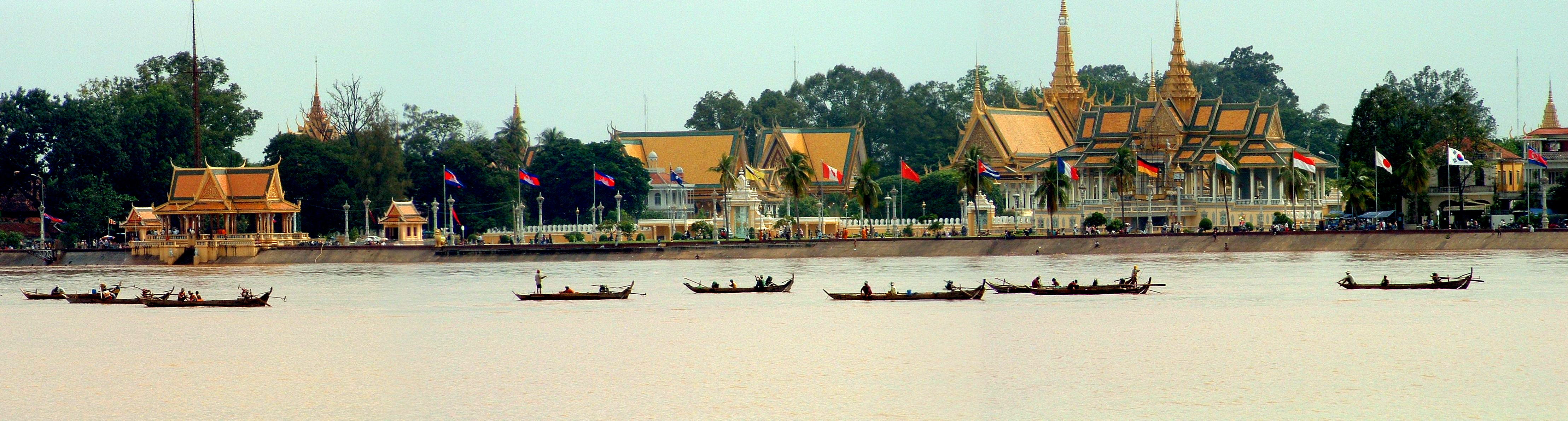
Royal Palace of Cambodia
Four faces of Brahma gaze outward from the top of a 59-metre spire, watching over Phnom Penh from the same riverbank where Khmer kings have held court for more than 150 years. The Royal Palace of Cambodia sits where the Tonle Sap and Mekong rivers converge at a junction the Khmer call Chaktomuk, named for that same four-faced god. It is a place where Buddhist ceremony, French colonial engineering, and ancient Khmer artistry overlap in ways that few royal residences anywhere can match. A prefabricated iron villa shipped from Paris stands within the same walls as a nine-tiered coronation throne that symbolizes hell, earth, and heaven.
A Wandering Throne
The seat of Khmer power has never stayed in one place for long. From 802 AD until the early 15th century, it rested in or near Angkor, north of the great Tonle Sap Lake. When environmental pressures forced the court to abandon Angkor, it drifted south -- first to Phnom Penh around 1434, then onward to Basan, Longvek, and finally Oudong. The capital did not return to Phnom Penh until 1866, when King Norodom chose this site at the confluence of the rivers. He first lived in a temporary wooden structure near Wat Ounalom while workers built the permanent compound. Norodom's original palace -- a sprawling collection of throne halls, private villas, open-sided pavilions, and a western courtyard reserved exclusively for the king's household -- was almost entirely demolished by his half-brother King Sisowath between 1912 and 1919. Of Norodom's buildings, only the eastern wall section and the Napoleon Pavilion survive today.
The Sacred Seat of Judgement
The Throne Hall, known in Khmer as Preah Tineang Tevea Vinnichay, translates to "the Sacred Seat of Judgement." The cross-shaped building was inaugurated by King Sisowath in 1919 to replace Norodom's original, which had been demolished four years earlier. Its central spire rises 59 metres, crowned by the white four-faced head of Brahma. Inside stand three royal thrones and golden busts of Cambodian kings and queens stretching back to King Ang Doung. The traditional coronation throne, the Preah Tineang Bossabok, is a nine-level structure covered in intricate floral carvings, with small Garuda statues lifting its upper tiers. Three of those nine levels represent hell, middle earth, and the heavens. Four golden nine-tiered umbrellas called Aphirom surround it, and a white royal umbrella tops the whole assembly, signifying universal sovereignty. The building is still used today for coronations, royal weddings, and the reception of foreign ambassadors.
An Iron House and a Moonlit Stage
Among the palace's more unexpected structures is the Napoleon Pavilion, a prefabricated cast-iron villa manufactured in Paris by the firm Docros in 1875. During the 19th century, Cambodians called it the maison de fer -- the Iron House. The legend that Napoleon III commissioned it as a gift did not appear until 1925, in a history by a former colonial administrator. King Norodom gave it a far more poetic name: Tusitala, after the Buddhist heaven where the final Buddha awaits incarnation. Nearby stands the Moonlight Pavilion, or Chan Chhaya, an open-air stage built along the palace wall where Khmer classical dancers have performed for more than a century. Rebuilt in 1913-14 under King Sisowath, its balcony overlooks Sothearos Boulevard and has served as a tribune for kings addressing crowds below. As recently as 2004, it hosted the coronation banquet for King Norodom Sihamoni.
Silver Floors and Diamond Buddhas
South of the main compound lies the Silver Pagoda, officially called Preah Vihear Preah Keo Morakot but better known as Wat Preah Keo. During King Sihanouk's pre-Khmer Rouge reign, workers inlaid its floor with 5,329 silver tiles and clad portions of the facade in Italian marble. Inside sits a small crystal Buddha -- Cambodia's "Emerald Buddha" -- whose origins remain debated: it may be 19th-century Baccarat crystal or a 17th-century artifact of unknown provenance. Beside it stands a life-sized gold Maitreya Buddha encrusted with 9,584 diamonds, commissioned by King Sisowath. The surrounding wall bears murals depicting the Reamker, the Khmer retelling of the Ramayana, though neglect has faded the lower portions over the years. Outside, a statue of King Norodom astride a white horse faces east toward the rising sun.
Still a Living Palace
Nearly all of the original Norodom-era buildings have been demolished and replaced, and the Khmer Rouge years emptied the palace entirely. But the monarchy returned, and so did the rituals. Half the palace grounds remain closed to the public -- the Khemarin Palace, Villa Kantha Bopha, royal gardens, and various pavilions still serve the reigning king. Visitors can walk the Silver Pagoda compound and the central courtyard around the Throne Hall, where the Moonlight Pavilion still catches the evening light along the boulevard. The complex covers nearly 175,000 square metres, its defensive walls topped by decorative seima leaf shapes identical to those on Buddhist monasteries, marking everything within as sacred. In a city that has endured French colonialism, Japanese occupation, civil war, and genocide, the palace endures as both a functioning seat of power and a reminder of how many times the Khmer court has rebuilt itself.
From the Air
Located at 11.564N, 104.931E on the western bank of the Tonle Sap-Mekong confluence in central Phnom Penh. The golden spires of the palace complex and the Silver Pagoda are visible from moderate altitude. Phnom Penh International Airport (VDPP) lies approximately 10 km to the west. Approach from the east over the river confluence for the best view of the palace grounds against the waterfront. Typical visibility is good in dry season (November-April), reduced during monsoon season.