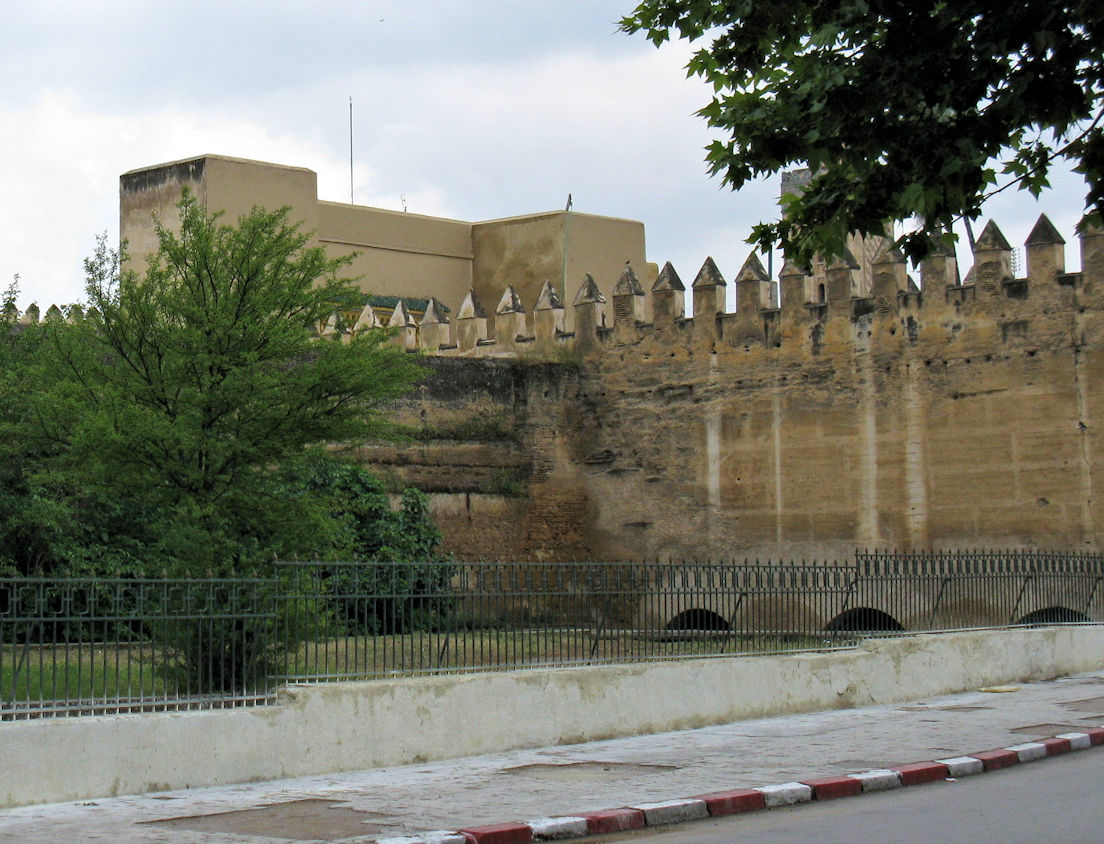
Royal Palace of Fez
There is a gate in Fez that changed its purpose without moving. Bab al-Qantara, the "Gate of the Bridge," was originally the northern entrance to an entire city. Then the palace grounds expanded around it, and the public gate became a private threshold -- the entrance to the Dar al-Makhzen, the Royal Palace. That story of absorption captures the palace's nature perfectly. Over seven and a half centuries, the Dar al-Makhzen has consumed everything around it -- walls, gates, neighborhoods, gardens -- growing into an 80-hectare complex that takes up much of Fes el-Jdid, the fortified royal district that the Marinid sultans founded in 1276.
The Marinid Foundation
When the Marinid sultans established Fes el-Jdid as their administrative capital in 1276, they built the palace as its centerpiece. The original layout cannot be fully reconstructed because centuries of expansion and modification have buried it beneath later work. What is known is that the earliest palace was concentrated further southwest within the current grounds and was connected to the Grand Mosque of Fes el-Jdid by a passage that allowed the sultan to move between prayer and governance without entering public space. The mosque is still adjoined to the north side of one of the palace's ceremonial courtyards, just outside the royal grounds proper. This arrangement -- the palace physically linked to the mosque, governance tethered to faith -- set the template for Moroccan royal architecture.
Seven Centuries of Growth
Every dynasty that followed the Marinids left its mark. The Alawi sultans, who have ruled Morocco from the 17th century to the present, are responsible for much of the palace's current appearance. The complex's layout is irregular and labyrinthine, the product of repeated modifications rather than any single plan. Rooms were added, demolished, rebuilt. One section included a marble-paved courtyard and rooms with ceilings gilded with gold leaf, but even this was eventually abandoned and partly looted. The Lalla Mina Gardens occupy the western edge of the central structures. Across the vast grounds, ceremonial courtyards called mechouars provide open space for royal audiences and public events. The Fez River passes beneath one of these mechouars through culverts visible in the outer walls.
A City Within a City
At 80 hectares, the Dar al-Makhzen is not merely a palace but a self-contained district. It dwarfs European royal residences: the Palace of Versailles covers 63 hectares including its gardens; the Dar al-Makhzen exceeds this within its walls alone. The complex includes mosques, gardens, courtyards, administrative buildings, residential quarters, and the infrastructure to support them all. It is not open to the public, which adds to its mystique -- Moroccans and visitors alike know the palace primarily by its famous brass doors and the high walls that surround it. From the outside, those walls define the boundary between public Fez and royal Fez, a division that has held since the 13th century.
The Palace from Above
Seen from altitude, the Dar al-Makhzen reads as a green-and-grey expanse interrupting the dense urban fabric of Fez. Its gardens and courtyards stand out against the packed rooftops of the medina to the east and the more regular grid of the Ville Nouvelle to the west. The high walls trace a perimeter that has expanded over centuries, absorbing land and structures the way the palace absorbed Bab al-Qantara -- quietly, permanently, without negotiation. The palace remains an active royal residence, one of several maintained by the Moroccan monarchy across the country. Its gates still open for the king; the passage to the Grand Mosque still connects prayer to power. What began as a Marinid fortress has become something closer to a geological formation -- layered, massive, and shaped by forces that acted on it for far longer than any single reign.
From the Air
Coordinates: 34.053N, 4.994W. The palace occupies most of Fes el-Jdid, the fortified royal district west of Fes el Bali. Its 80-hectare footprint is clearly visible from 3,000-5,000 ft AGL as a large green-and-walled area contrasting with the dense medina to the east. Nearest airport: Fes-Saiss (GMFF), approximately 15 km south. The palace walls, gardens, and mechouar courtyards are identifiable landmarks.