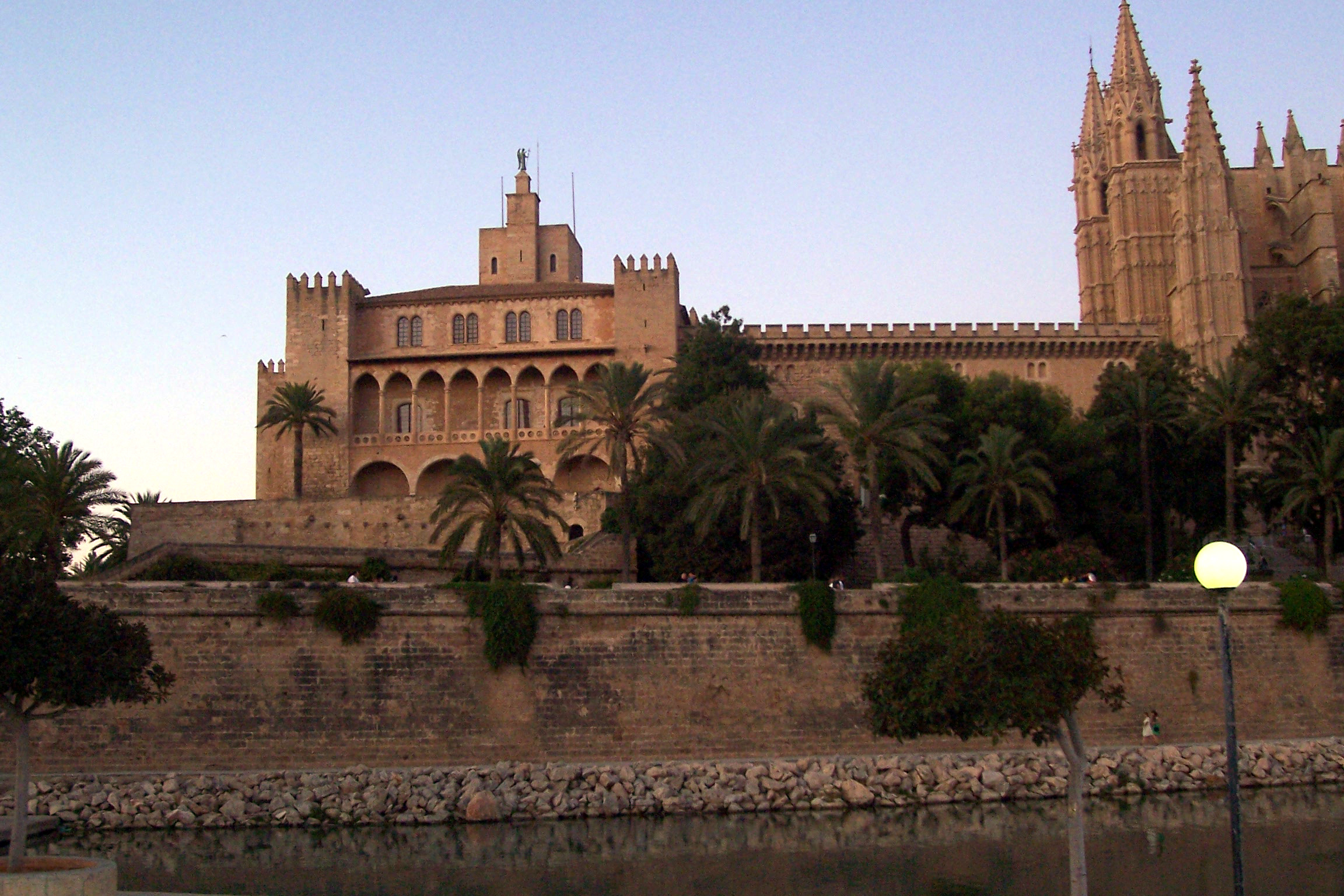
Royal Palace of La Almudaina
The Arabic word "almudaina" means citadel, and the name has outlasted every regime that occupied this fortress on the Palma waterfront. Built as a Muslim alcazar, rebuilt as a Gothic royal palace, later converted to house a court of law and a military headquarters, La Almudaina still serves its original purpose: it is where power resides. Today it stands opposite Palma Cathedral as one of the official residences of the Spanish royal family, its stones carrying the imprint of seven centuries of continuous political authority.
From Alcazar to Palace
At the time of the Christian conquest, the fortress was known as the Zuda. When King James II of Majorca established his kingdom, he launched an ambitious program in 1298 to reshape the city of Palma -- and the centerpiece was transforming this imposing Muslim stronghold into a proper royal palace. Construction began in 1305, though plans had been drawn before 1300. Between 1309 and 1314, builders erected the Great Hall, founded St. Anne's Chapel, and created a sculpture of the Archangel St. Gabriel. The architect Pere Salva, who simultaneously worked on nearby Bellver Castle, oversaw portions of the construction. The resulting palace served the monarchs of the Kingdom of Majorca until 1349, when Peter IV of Aragon absorbed the island into the Crown of Aragon. From that point forward, Aragonese and later Spanish monarchs held court here in succession.
Layers of Power
The palace's current structure corresponds largely to what was built in the 14th century, though each century added its own layer. The ground floor preserves a medieval atmosphere, decorated with artworks spanning from the 15th to the 20th century. The upper floor, which Charles V had built during the first half of the 16th century, is furnished with objects from other royal sites dating to the 17th, 18th, and 19th centuries. It is this upper floor that is used for official ceremonies of the royal family. Philip II of Spain converted the Great Hall -- known as the Tinell -- into a Real Audiencia, the royal court of appeals, and installed the General Captaincy of the Islands in the remaining spaces. The palace thus became both a symbol of royal authority and its practical instrument.
The Spaces Within
Walking through La Almudaina is an exercise in reading architectural palimpsest. The separate palaces of the King and Queen occupy distinct wings, their rooms arranged around patios that echo the courtyard plans of the Muslim alcazar that preceded them. St. Anne's Chapel retains its Gothic character, a small sacred space within the fortress walls. The baths speak to the building's Islamic origins, when ablution was both religious obligation and daily comfort. What strikes most visitors, though, is how the building's Roman foundations -- for the site was occupied long before the Muslims arrived -- still shape its footprint. Each civilization built atop the last, and in La Almudaina's walls you can read that accumulation like rings in a tree.
Summer Residence on Ancient Stones
La Almudaina remains an official summer residence of the Spanish king, functioning alongside the Royal Palace of Madrid and the Palace of Marivent, which also sits on Majorca. When the royal family visits each summer, the same rooms that hosted the kings of Majorca seven hundred years ago host their modern successors. The palace stands directly opposite Palma Cathedral, the two buildings forming a pair that has defined the city's waterfront since the 14th century. From the harbor, their profiles merge into a single wall of honey-colored stone, the cathedral's soaring Gothic pinnacles rising behind the palace's more restrained battlements. It is a skyline that has greeted arriving ships for centuries -- and that greets arriving aircraft today, the palace and cathedral among the first landmarks visible as the descent into Palma begins.
From the Air
Located at 39.57N, 2.65E on the Palma waterfront, immediately adjacent to Palma Cathedral. The palace and cathedral together form the most prominent landmark cluster on the waterfront. Best viewed at 1,500-3,000 feet approaching from the bay. Palma de Mallorca Airport (LEPA) is approximately 8 km to the east. The old city walls and harbor are clear visual references.