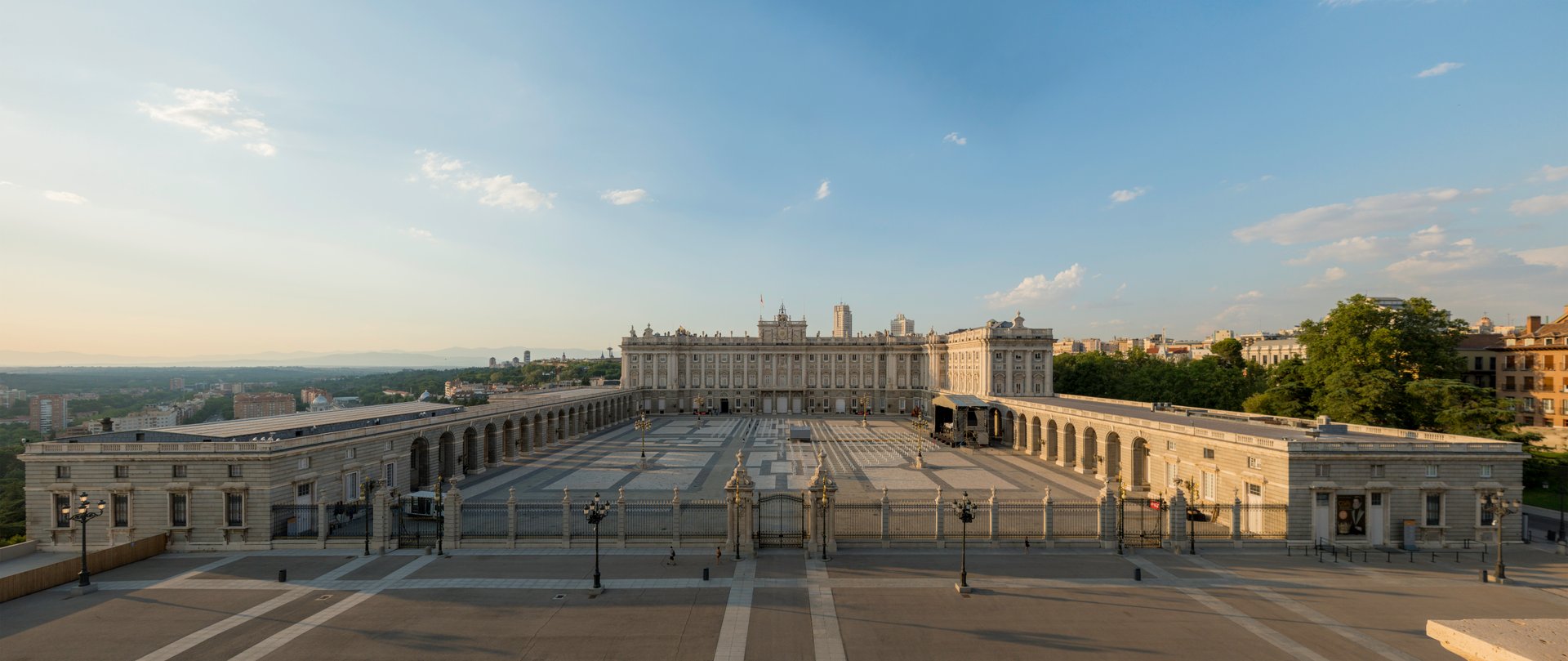
Royal Palace of Madrid
No one lives here. That is the first thing to understand about the Royal Palace of Madrid -- its 3,418 rooms, its Stradivarius violins behind glass, its Tiepolo ceilings depicting the glory of the Spanish monarchy, all of it maintained for ceremonies and state dinners rather than for any royal family's breakfast table. Felipe VI and his family chose the more modest Palace of Zarzuela in El Pardo. The result is a building frozen somewhere between museum and residence, a place where the furniture is real but the domesticity is not, where the thrones are dusted but never sat upon except when diplomats require impressing.
From Fortress to Inferno
The ground beneath the palace has served power for over a thousand years. In the 9th century, Emir Muhammad I of Cordoba built a fortress here above the Manzanares River, commanding the approaches to what was then a modest settlement on the central plateau. The Christians took it during the Reconquista, and the Trastamara monarchs expanded it into the Alcazar of Madrid, a sprawling royal stronghold that stored the crown's treasure and housed its kings. For centuries the alcazar grew, gaining wings and courtyards through the 16th century. Then, on Christmas Eve 1734, it burned. The fire consumed not only the building but hundreds of paintings, including works by Velazquez, Rubens, and Titian. What rose from the ashes was something deliberately different -- not a medieval fortress rebuilt, but a statement in Italian Baroque stone.
A Palace Built on Italian Ambitions
Philip V, the first Bourbon king of Spain, wanted no more wooden beams or timber-framed walls. He commissioned Filippo Juvarra to design a new palace entirely of stone, immune to fire. Juvarra died before construction began, and his student Giovanni Battista Sacchetti carried the project forward, working alongside Ventura Rodriguez and Francesco Sabatini. Construction lasted from 1738 to 1755, and the building that emerged was a monumental rectangle of limestone and granite in the style of Bernini, its facade lined with Ionic and Doric pilasters. Charles III, who moved in first, brought Giambattista Tiepolo from Venice to paint the throne room ceiling -- a swirling apotheosis of the Spanish monarchy that remains one of the finest frescoes in Europe. The interiors accumulated treasures across generations: Flemish tapestries, porcelain rooms in the Rococo style, a royal armory with tournament armor from the 16th century, and the Stradivarius Palatinos, a collection of string instruments by the master luthier still considered among the finest in existence.
Ceremonies and Ghosts
The palace's role shifted with Spain's political fortunes. During the Second Republic it was renamed the Palacio Nacional and opened to public view. The Civil War brought it perilously close to the front lines -- the Siege of Madrid raged through the university district just to the north. Franco restored the monarchical trappings without the monarch, using the palace for state functions while governing from El Pardo. When Juan Carlos I took the throne after Franco's death in 1975, the palace resumed its ceremonial role: credential presentations for ambassadors, state banquets, and the annual Pascua Militar. The grand staircase, designed by Sabatini with ceilings by Corrado Giaquinto, still serves as the processional route for visiting heads of state, its marble steps polished by centuries of diplomatic footfall.
The View from the Western Bluff
The palace sits on the western edge of central Madrid, perched above the Manzanares River valley with views toward the Sierra de Guadarrama. The Campo del Moro gardens descend the slope to the west in formal terraces -- laid out in the English style in the 19th century but named for the Moorish armies that once camped there during the Reconquista. To the east, the Plaza de Oriente separates the palace from the Teatro Real opera house, its semicircular colonnades framing statues of Spanish monarchs that were originally meant for the palace roof but proved too heavy. Below the plaza, the remains of Muslim-era walls discovered during metro construction serve as a reminder that this hill has been contested ground since before Spain existed as a concept. The palace occupies roughly 135,000 square meters, making it larger than Buckingham Palace or Versailles in floor area -- a fact that surprises visitors who associate Spanish grandeur with the south.
From the Air
Located at 40.418N, 3.714W on the western bluff of central Madrid, overlooking the Manzanares River. The palace is a massive rectangular white-stone structure easily identified from the air, with the Campo del Moro gardens descending the western slope. The Plaza de Oriente lies to the east, and the Almudena Cathedral is adjacent to the south. Recommended viewing altitude 3,000-5,000 ft AGL. Nearest airport: Madrid-Barajas (LEMD), approximately 15 km northeast.