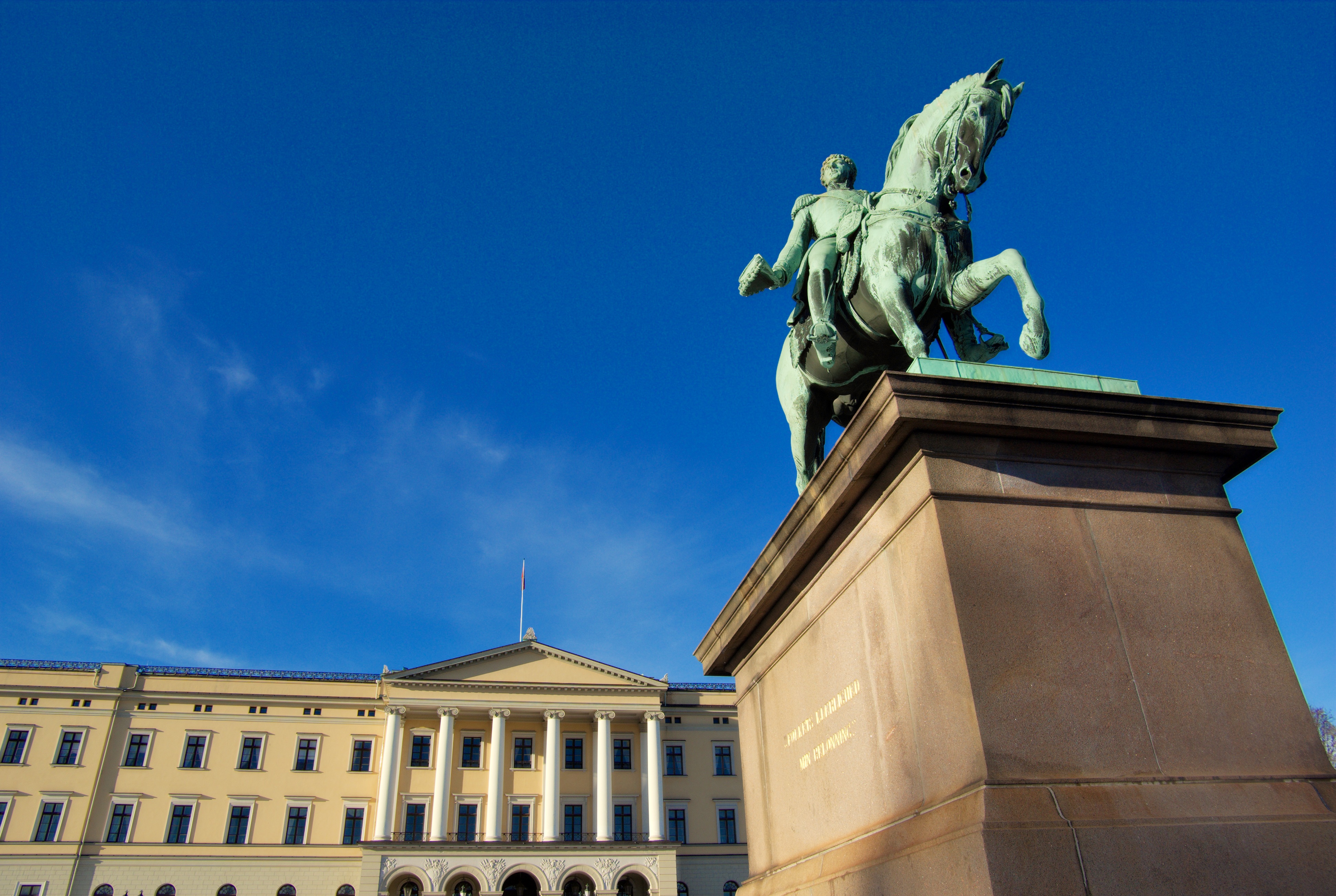
Royal Palace, Oslo
Charles XIV John, born Jean Bernadotte in the French city of Pau, rose from common soldier to marshal of Napoleon's armies before being elected crown prince of Sweden in 1810 and eventually ruling both Sweden and Norway. He chose the hilltop site for his Norwegian palace in 1821, commissioned a Danish-born officer named Hans Linstow who had almost no architectural experience to design it, and watched the project run over budget, stall for six years, and shrink from its original plan. He died in 1844 without ever sleeping a night under its roof. The palace that defeated its founder has since become the most visible symbol of Norwegian independence.
A Palace Built on Stubbornness
Linstow's original design called for a two-story building with projecting wings flanking the main facade. Construction began in 1824, and Charles John laid the foundation stone beneath the altar of the future palace chapel on October 1, 1825. Then the money ran out. The costly foundation work exhausted the budget by 1827, and the Norwegian Parliament, the Storting, refused further funding as a political protest against the king's push for a tighter union between Norway and Sweden. Building halted for six years. When work resumed in 1833, Linstow submitted a cheaper design, eliminating the wings but adding a third story as compensation. The Storting, its relations with the king improved, released the funds. The roof went on in 1836 and the interiors were completed in the late 1840s, but not before the original colonnade was reintroduced and the steep provisional roof was replaced with a more elegant flat one.
Kings Who Preferred to Be Elsewhere
Oscar I and his queen Josephine were the palace's first residents, moving in for the official inauguration in 1849. They quickly found it too small and extended the garden-facing wings. The Bernadotte kings who followed, Charles IV and Oscar II, maintained the palace but preferred Stockholm. Queen Sophia of Nassau spent her Norwegian summers not at the palace but at Skinnarbol, a country manor near the Swedish border chosen for her health. When the union between Norway and Sweden dissolved in 1905, Oscar II never appeared at the palace during the crisis. His son, Crown Prince Gustaf, made two brief visits in a futile attempt to preserve the union. The building that was meant to bind the two kingdoms had witnessed their separation.
Haakon's House
With the Bernadottes gone, Norway elected Prince Carl of Denmark as its new king. He took the name Haakon VII and became the first monarch to make the palace a permanent residence, though two years of refurbishment were needed before he, Queen Maud, and Crown Prince Olav could move in. Haakon established traditions that persist today: he was the first king to wave from the palace balcony during the children's parade on Constitution Day, May 17, and he introduced the weekly Council of State meetings held in the palace's Council Chamber, where the monarch still sits on the throne to receive government ministers. His son Olav V, king from 1957 to 1991, largely lived elsewhere because the poorly built palace desperately needed renovation he could not afford. When Olav gave the Skaugum estate to Crown Prince Harald as a wedding gift in 1968, he relocated to the palace by necessity.
Opening the Doors
Harald V, upon becoming king in 1991, launched the comprehensive renovation that the palace had needed for over a century. The work, managed by the state building authority Statsbygg, included new fire alarm systems, bathrooms, kitchens, and offices, plus structural repairs addressing deficits that dated to Linstow's original construction. The expense drew public criticism, though much of the cost simply corrected 150 years of deferred maintenance. Harald and Queen Sonja moved from Skaugum to the renovated palace in 2001, handing the estate to Crown Prince Haakon and his family. The following year, public tours opened for the first time, allowing Norwegians to see what their tax money had accomplished. The daily changing of the Royal Guards became a tourist attraction, and the 22-hectare Palace Park surrounding the building remains one of Oslo's largest green spaces. In 2017, the former royal stables were converted into the Dronning Sonja KunstStall, an art gallery and concert venue open to the public.
From the Air
Located at 59.92N, 10.73E at the western terminus of Karl Johans gate in central Oslo. The palace and its 22-hectare park are clearly visible from the air, forming a large green rectangle in the urban grid. The equestrian statue of Charles John is visible on the Palace Square. Nearest major airport is Oslo Gardermoen (ENGM), approximately 40 km northeast. The Storting (Parliament) building is visible along the same axis about 1 km to the southeast. Best viewed at 2,000-4,000 ft AGL.