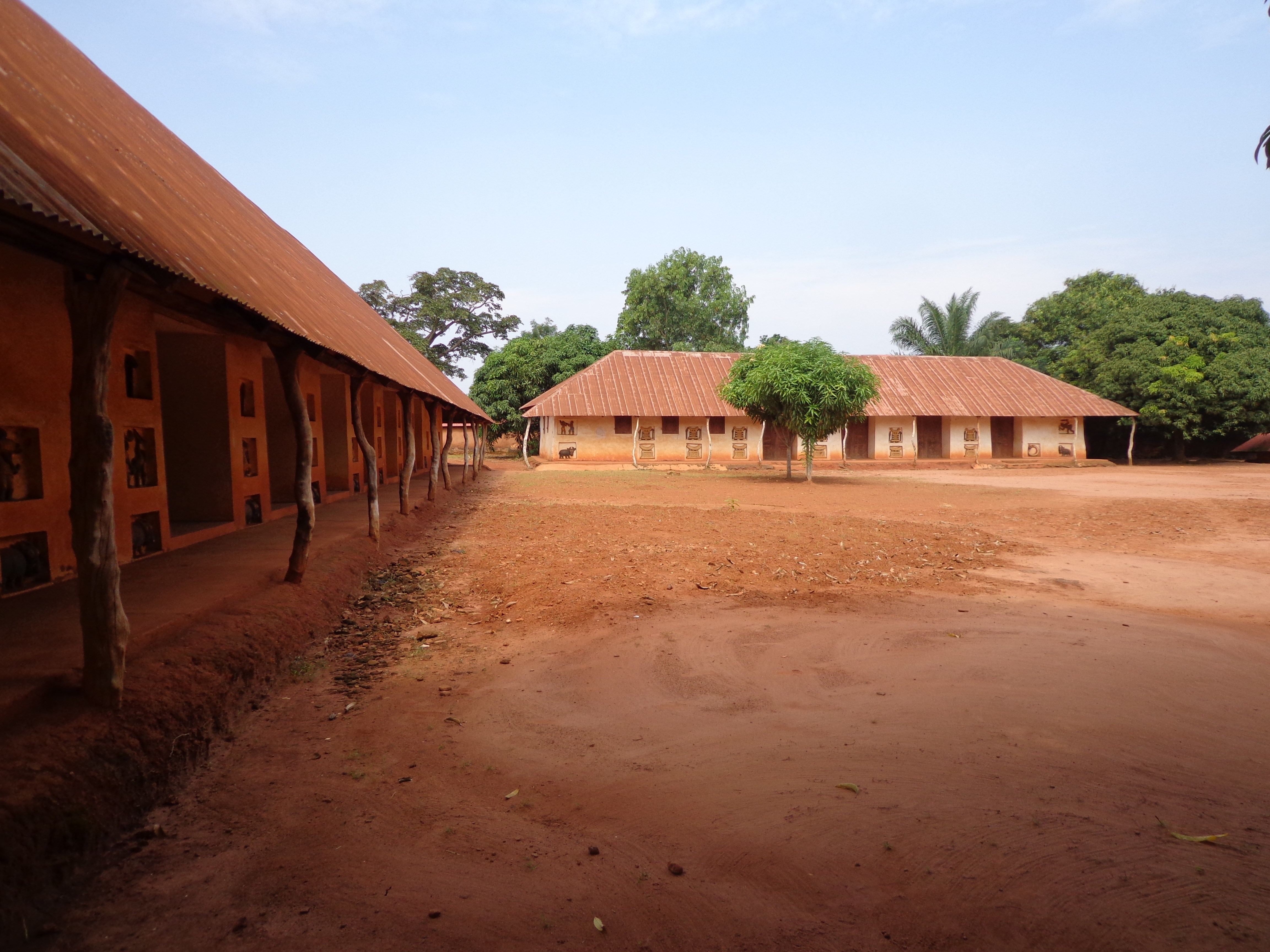
Royal Palaces of Abomey
According to the founding myth of Dahomey, the royal bloodline descends from Princess Aligbonon of Tado and a panther. Whether or not you take the legend literally, something feline runs through the kingdom's history: patience, ferocity, and an instinct for survival. For nearly three centuries, from 1625 to 1900, twelve kings ruled the Fon people from a walled compound in the city of Abomey, each one adding his own palace to a complex that eventually sprawled across 40 hectares. At its peak, the compound could house 8,000 people. Today these palaces, inscribed as a UNESCO World Heritage Site, stand at the center of a story about power, artistry, destruction, and one of the most significant cultural restitution efforts of the twenty-first century.
Walls That Speak
The palaces of Abomey were never merely residential. They were political statements, rendered in earth and pigment. Each king built according to his own vision, and the compound grew into a labyrinth of courtyards, ceremonial halls, and sacred spaces. The most striking features are the bas-reliefs: images sculpted into walls and pillars from earth collected from anthills, mixed with palm oil, and dyed with vegetable and mineral pigments. These reliefs depicted military victories, religious rituals, and the symbolic animals associated with each ruler. They were not decoration. They were history, recorded on the walls for a largely non-literate society to read and remember. The originals have been carefully conserved and moved into the museum; replicas now stand in their place on the palace walls.
Trade, War, and the Slave Coast
The Kingdom of Dahomey built its power on military conquest and commerce, and for much of its history those two activities converged on a single commodity: human beings. The Fon captured prisoners in wars with neighboring peoples and sold them to European slave traders operating along what became known as the Slave Coast. This trade fueled the kingdom's economy and funded the very palaces that still stand in Abomey. By the nineteenth century, however, the antislavery movement in Britain was reshaping Atlantic commerce. King Guezo, who ruled from 1818 to 1858, responded by diversifying the economy toward agriculture, expanding exports of corn and palm oil. It was a pragmatic pivot that brought further prosperity, though the wealth already accumulated through the slave trade remained embedded in every wall and courtyard of the royal compound.
Fire, Tornado, and Survival
In 1892, French colonial troops under Colonel Alfred Dodds sacked the palaces and looted 26 royal statues and artifacts, shipping them to Paris. Two years later, King Behanzin, the last independent ruler of Dahomey, set fire to the palaces of Guezo and Glele rather than let them fall intact to the French. The buildings survived, damaged but standing. Nearly a century later, on March 15, 1984, a tornado struck Abomey, wrecking the King Guezo Portico, the Assins Room, the royal tomb, and the Jewel Room. UNESCO placed the site on the World Heritage in Danger list. International restoration efforts repaired the damage, and in July 2007 the palaces were removed from the danger list. Then, on January 21, 2009, a bushfire fanned by Harmattan winds destroyed more buildings, including the tombs of Kings Agonglo and Guezo. Each time, the palaces have been rebuilt.
The Treasures Come Home
The 26 artifacts looted by Colonel Dodds in 1892 spent more than a century in France, eventually housed in the Musee du quai Branly in Paris. Following a landmark 2018 report on the restitution of African cultural heritage, France passed a new law enabling their return. The statues were repatriated to Benin and went on display in early 2022 at the Palais de la Marina in Cotonou. They are scheduled to travel the country before settling permanently in the Museum of the Epics of Amazons and Kings of Danhome in Abomey, a new facility funded partly by a 20-million-euro loan from the French Development Agency. The restitution was a watershed moment in the global movement to return cultural property to its countries of origin, and for the people of Abomey, it represented something more specific: ancestors coming home.
A Living Heritage
The palaces of Guezo and Glele now house the Historical Museum of Abomey, established in 1943 by the French colonial administration and holding over 1,050 artifacts. Appliqued royal quilts, ceremonial drums, and paintings of the war between France and Dahomey fill the galleries. But the palaces are more than a museum. Sacred spaces within the compound are still respected by the royal families and the wider community, and ritual ceremonies continue to be performed as a living form of heritage preservation. In 2006, the City of Abomey established urban planning regulations to protect the site. A year later, Benin adopted national legislation for the protection of cultural and natural heritage. Fifty-six bas-reliefs in one palace alone have been conserved with hands-on involvement from Benin's Cultural Heritage staff. The compound that twelve kings built over three centuries is being tended now by a republic that understands what it nearly lost.
From the Air
The Royal Palaces of Abomey are located at 7.186°N, 1.994°E, in central Benin approximately 130 km north of the coast. The 40-hectare palace compound is visible from lower altitudes as a distinct walled area within the city of Abomey. The nearest major airport is Cadjehoun Airport (DBBB) in Cotonou, about 140 km to the south. The terrain is relatively flat Abomey plateau country. Weather is tropical with a dry season from November to March and a rainy season from April to October. Harmattan haze can reduce visibility from December through February.