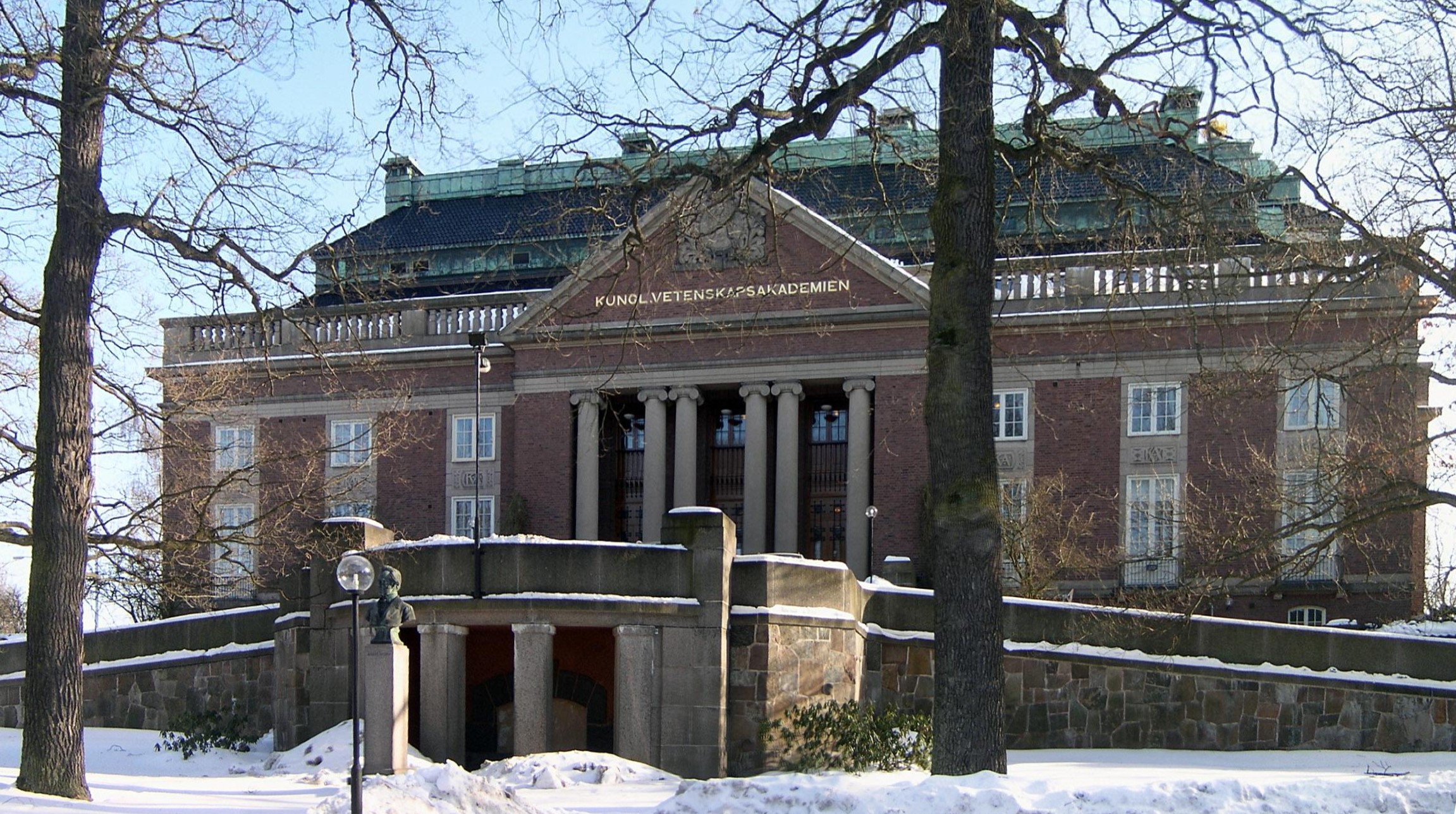
Royal Swedish Academy of Sciences
Every October, the world holds its breath as Stockholm announces who will receive science's highest honors. The Nobel Prizes in Physics and Chemistry, along with the Economics Prize, flow from the deliberations of an institution founded nearly three centuries ago when Carl Linnaeus, the father of modern taxonomy, gathered five colleagues in Stockholm with a revolutionary idea: scientific knowledge should be published in Swedish, not Latin, so that ordinary people could understand it. That democratic impulse still animates the Royal Swedish Academy of Sciences, which has grown from six founders to nearly 650 members and transformed from a local society into the global arbiter of scientific achievement.
Linnaeus and the Language of Discovery
On June 2, 1739, naturalist Carl Linnaeus joined forces with mercantilist Jonas Alströmer, mechanical engineer Mårten Triewald, civil servants Sten Carl Bielke and Carl Wilhelm Cederhielm, and statesman Anders Johan von Höpken to establish an academy fundamentally different from its peers. Sweden already had the Royal Society of Sciences in Uppsala, founded in 1719, but that institution published in Latin for an academic audience. The new Stockholm academy deliberately positioned itself near commerce rather than academia, in a capital that lacked a university, where practical knowledge could flow directly to merchants, manufacturers, and citizens. The founders modeled their society on the Royal Society of London and France's Académie Royale des Sciences, institutions some had visited, but they insisted on the vernacular tongue.
The Weight of the Nobel
Alfred Nobel's will designated the Academy as selector of Physics and Chemistry laureates, a responsibility it has carried since 1901. The Economics Prize, formally the Sveriges Riksbank Prize in Economic Sciences in Memory of Alfred Nobel, joined the portfolio in 1968. The selection process involves thousands of nominations from qualified scientists worldwide, committee reviews lasting months, and final votes by Academy members sworn to secrecy. The Academy also awards the Crafoord Prize for disciplines Nobel overlooked, including mathematics, astronomy, and geosciences, as well as the Sjöberg Prize for cancer research and the Rolf Schock Prizes spanning logic, philosophy, visual arts, and music. These prizes shape careers, direct funding, and influence which questions science pursues.
Ten Classes of Knowledge
The Academy divides its approximately 470 Swedish and 175 foreign members into ten classes representing distinct disciplines: Mathematics, Astronomy and Space Science, Physics, Chemistry, Geosciences, Biosciences, Medical Sciences, Engineering Sciences, Social Sciences, and Humanities. Since 1739, the Academy has elected roughly 1,700 Swedish and 1,200 foreign members, creating a lineage of scientific achievement spanning nearly three centuries. Members serve for life, and election represents the highest honor Swedish science can bestow on its practitioners. The Academy's permanent secretary, currently Hans Ellegren since January 2022, guides the institution's daily operations and serves as the face of Nobel announcements, a position held previously by luminaries including Jöns Jacob Berzelius, who served from 1818 to 1848.
Publishing the Progress of Knowledge
The Academy began publishing its transactions, Vetenskapsakademiens handlingar, in 1739, creating one of the world's oldest continuous scientific journals. By 1826, specialized annual reports in physics, chemistry, technology, botany, and zoology had emerged. Today, the Academy publishes Ambio for environmental research, Acta Mathematica, Arkiv för Matematik, Acta Zoologica, and Zoologica Scripta in partnership with Norway's Academy of Science and Letters. This publishing empire disseminates knowledge far beyond Sweden's borders, fulfilling the founders' vision of science as a shared human endeavor. The Academy also produces biographies of deceased members and portrait collections of current ones, documenting the human faces behind scientific progress.
A Park, a Mission, and the Future
The Academy of Sciences occupies a position within Stockholm's Royal National City Park, a green refuge in the Swedish capital that stretches across land and water. From this setting, the Academy pursues goals that would be familiar to Linnaeus: fostering dialogue across disciplines, supporting young researchers, rewarding outstanding achievement, and stimulating public interest in mathematics and science. The institution maintains relationships with academies worldwide, promotes international scientific cooperation, and seeks to influence research policy. Each October, when the Academy announces who has contributed most to physics, chemistry, or economics, it exercises a power that shapes scientific priorities globally, a remarkable legacy for six Swedish gentlemen who believed knowledge belonged to everyone.
From the Air
Located at 59.37°N, 18.05°E within Stockholm's Royal National City Park. The Academy buildings are nestled in parkland north of the city center. Nearest major airport: Stockholm Arlanda (ESSA), approximately 35km north. Stockholm Bromma (ESSB) provides closer access. The Royal National City Park is visible as a distinctive green corridor through the urban landscape when approaching Stockholm from any direction.