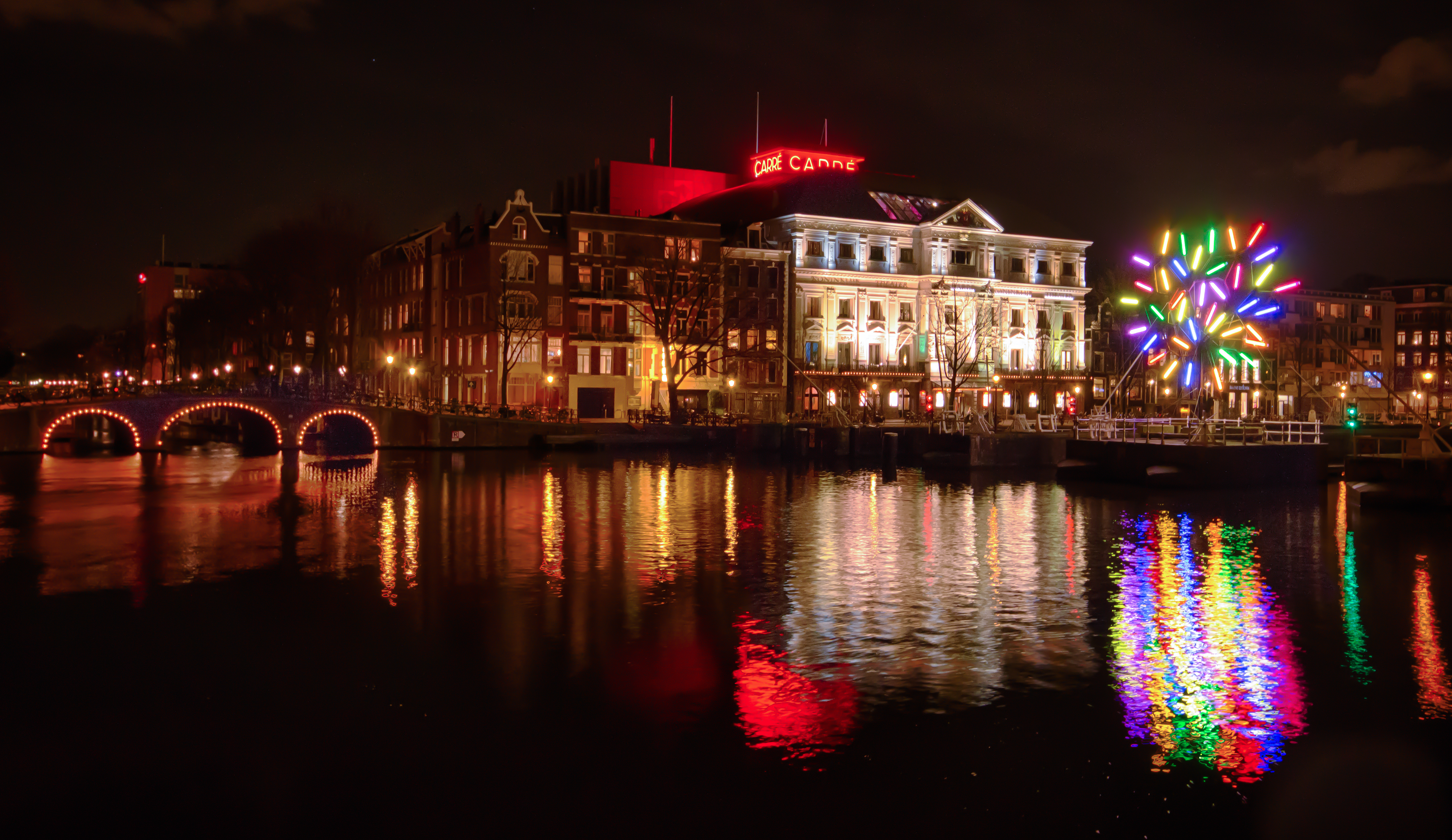
Royal Theater Carré
It started as a circus. The Royal Theater Carre on Amsterdam's Amstel river opened on 3 December 1887 as a permanent winter home for a German horseback troupe, the family Carre. The building was wooden behind a stone facade. There was sawdust on the floor. The horses came in through a ground-level entrance and performed in a ring. Today the same building seats around 1,700 people for musicals and Kate Bush concerts, and the family name still hangs on the door. Almost no other circus building in Europe has held its identity through this many transformations - and it survived a 1968 plan to demolish it for a hotel only because Dutch artists threw themselves in front of the bulldozers.
The Family Carré
The Carre family began performing in the late 18th century, travelling across the German-speaking world. In 1863 they arrived in the Netherlands for the first time. Oscar Carre, born in Germany and trained as an equestrian, was the showman who wanted permanence. In 1866 he secured permission to put up his first stone theatre on the Amstel, on a site occupied until then by the Rooseboom windmill near the city locks. Two decades of agitating later, the building opened on 3 December 1887. It was an immediate hit. Oscar's winter circus performed in it from late autumn to early spring; the troupe travelled the rest of the year, leaving the theatre empty. In 1893 the Dutch producer Frits van Haarlem took over the summer season with vaudeville shows, and from then on Carre was open year-round. The horses gradually gave way to variete - the Dutch version of the music hall - and from there to almost everything.
The Bad Years
Oscar Carre died in 1911. The theatre struggled. Max Gabriel rebuilt it and lasted a year. A man named Boekholt programmed new amusements and lasted not much longer. A company that tried to bring back the circus went bankrupt. The name was simplified in 1920 to Theater Carre. Not until 1924 did two managers, Benjamin and Content, finally turn a profit. They were succeeded by Alex Wunnink, who brought in shows that worked. Through the 1920s and 1930s, Carre booked Italian operas, Dutch revues, vaudeville bills, and an extraordinary cross-section of international talent - the African-American singer and dancer Josephine Baker performed here, as did the Swiss clown Grock, one of the highest-paid entertainers in interwar Europe. Carre had become the room in the Netherlands where you played if you were big and had crossed an ocean to get there.
War and After
During the Second World War, Carre filled its seats - people came for distraction from occupation, and the theatre stayed open. Then in 1944 the German razzias began, the street raids that swept Amsterdam for forced labour and Jewish people in hiding, and audiences stopped coming out at night. The doors closed from 1944 until 1945. After liberation, revues and winter circuses returned. In 1956 Carre staged Porgy and Bess and introduced American musical theatre to the Netherlands - the first time the form had appeared on a Dutch stage in earnest. In 1963 the Dutch comedian Toon Hermans performed his first solo cabaret show here, inventing the Dutch one-man show as a popular genre. Cabaret and stand-up are still Carre staples, and statues of Hermans, Jos Brink, Youp van 't Hek, Tineke Schouten, and Andre van Duin now line the lobby like a small pantheon of Dutch comic memory.
The Demolition That Didn't Happen
Under Alex Wunnink's son Karel, in the 1960s, Carre slumped again. In 1968 the building was bought with the intention of tearing it down to put up a hotel. Amsterdam in 1968 was not in a mood for that kind of trade. Artists organised. The municipality refused permission to demolish. Two years later the city gave Carre formal monument status to make demolition impossible, and in 1977 the municipality bought the building outright. At the centenary in 1987, Queen Beatrix granted the theatre the koninklijk predicate - the royal qualifier - and the name became Koninklijk Theater Carre. A full renovation in 2004 preserved the historic facade and interior. The room that Oscar Carre had built for horses became, by formal title, a royal theatre.
The House Today
Walk into Carre tonight and you might catch Cats or West Side Story, a Crowded House concert or a stand-up set, a poetry evening or the Dutch National Ballet. Van Morrison has played here. So have Loreena McKennitt, Harry Belafonte, Sammy Davis Jr., the Jacksons. The top-floor restaurant is called Oscar's, after the founder who finally got his stone theatre built. And when famous Dutch performers die, their bodies are sometimes laid in repose inside the theatre so that the public can pay respects in the room those performers worked. The singer Ramses Shaffy and the cabaretier Jos Brink were honoured this way. The building that started as a winter shelter for travelling equestrians has become one of the rooms the city of Amsterdam uses to say goodbye to people it loved.
From the Air
Coordinates 52.362 N, 4.904 E. The Royal Theater Carre sits directly on the western bank of the Amstel river, just south of the Magere Brug (Skinny Bridge) and east of Waterlooplein. The distinctive long facade faces the river, with the Neo-Renaissance frontage running parallel to the Amstel. From altitude the theatre is recognisable as a substantial rectangular block on the riverbank in the otherwise tight grid of central Amsterdam. Recommended viewing altitude 1000-2000 feet AGL. Nearest airport: Amsterdam Schiphol (EHAM), 12 km southwest. The Amstel is a useful line-feature for low-altitude approach in clear weather.