Royston: Where Warships Go to Die and Rhododendrons Bloom
On a ship heading up from Nanaimo in 1890, a Scottish immigrant named William Roy struck up a conversation with James Dunsmuir, the coal baron who owned vast tracts of Vancouver Island. Dunsmuir invited Roy to look around and pick some land. Roy chose beach property straddling both sides of what would become Royston Road, and the community that grew from that chance encounter has never entirely shed its accidental quality. Royston - named perhaps for 'Roy's Town,' perhaps for Frederick Warren's hometown in Hertfordshire, perhaps for both - sits on the east coast of Vancouver Island in the Comox Valley, a place of roughly 1,500 people where the logging industry, the coal trade, and the navy's discarded warships have all left their marks.
A Port Built on Logs and Coal
Throughout the 20th century, Royston served as the major port for the Comox Valley's logging industry. Logs arrived by rail from the interior, were boomed in the harbour, and towed across the Strait of Georgia to mainland mills for processing into lumber. The rail connection to Cumberland, running from 1914 to 1930, turned Royston into more than a port - Cumberland residents built summer homes along Royston and Gartley Beach on the south side of the Trent River, commuting daily on the train. When the mine workers' strike of 1912-1914 brought hardship to the coal communities, squatters moved into the area between Gartley Beach and Millard Creek. By 1912, the settlement had grown from William Roy's original homestead to 30 settlers, and Frederick Warren was laying out village lots for sale.
The Pavilion That Burned as the Music Started
The Royston Imperial Pavilion, built in 1918 and given a permanent roof in 1925, was the social heart of the community. One single and four double tennis courts lined the waterfront, hosting tournaments and community gatherings. Then came the evening of 1940 when an orchestra was warming up for a summer dance. An electrical fire broke out, and the pavilion burned to the ground in minutes. It was never replaced. The Royston Community Club later purchased a machine shop at the corner of the Island Highway and Royston Road in 1952 to serve as a community hall - a building that was already 27 years old, having been constructed in 1925. The pragmatism of repurposing an industrial building for community use says something about Royston's character: make do with what you have.
The Graveyard of Ships
Royston's most visually striking feature lies just offshore. Beginning in the late 1940s, decommissioned warships and other vessels were deliberately sunk in the shallow bay to form a breakwater protecting the log booming grounds. HMCS Eastview, a River-class frigate that escorted convoys in the Battle of the Atlantic; USS Tattnall, a Wickes-class destroyer that fought from the Mediterranean to Okinawa; and HMS Express, an E-class destroyer that rescued survivors from the sinking of Force Z - all ended their days here. At low tide, their rusted hulls emerge from the water, creating an eerie landscape that draws photographers and history enthusiasts. The breakwater works as intended, shielding the harbour from the swells of the Strait of Georgia, but it also functions as an unintentional memorial to the naval history of two world wars.
Oil, Wharf Timber, and a Quiet Shore
Shell and Imperial Oil took over Royston's government wharf in 1940, and for decades the community handled heavy tonnages of fuel. Barrels were initially rolled ashore along a wharf approach that was just 1.1 metres wide but stretched 400 metres out to a 12-by-30-metre wharf head. Later, fuel was pumped from barges to tanks at the corner of Royston Road and Marine Drive, where oil storage operated from 1916 until 1997. The wharf itself was removed in 2003, but its timbers and decking were recycled into the viewing stand at the end of Royston Road. Today the waterfront is quieter - the logs no longer boom in the harbour, the oil tanks are gone, and the warships offshore settle a little deeper into the mud each year. Mary Greig's legacy of rhododendron cultivation still blooms in local gardens, a softer inheritance from a place shaped by industry and war.
From the Air
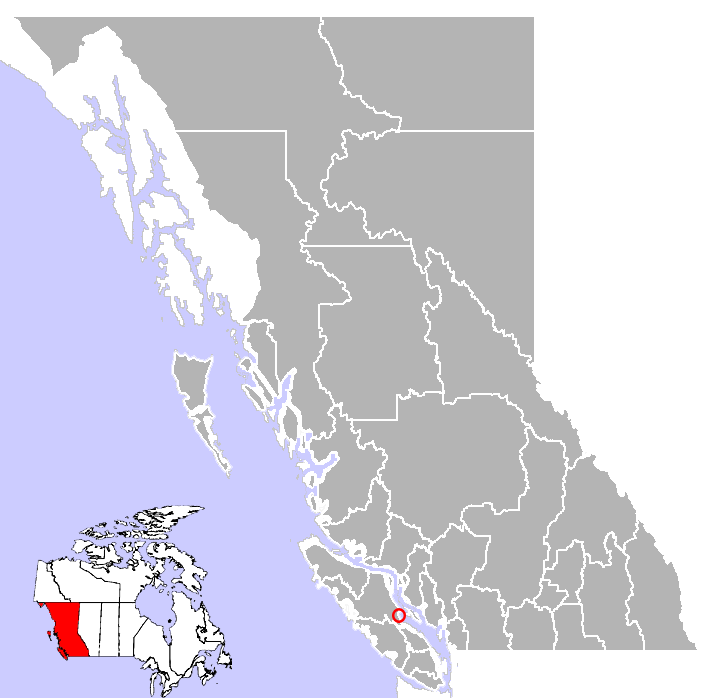
Located at 49.65N, 124.95W on the east coast of Vancouver Island in the Comox Valley, across the harbour from Comox and adjacent to the southeast boundary of Courtenay. The Royston breakwater - a line of sunken warships visible at low tide - is the most distinctive feature from the air, running parallel to the shore south of where the Trent River enters the strait. Nearest airport: CFB Comox (CYQQ) approximately 8 km north. Best viewed at 1,000-2,000 feet approaching from the Strait of Georgia, when the individual ship hulls in the breakwater and the harbour layout are most visible. The Island Highway (19A) runs through the community.