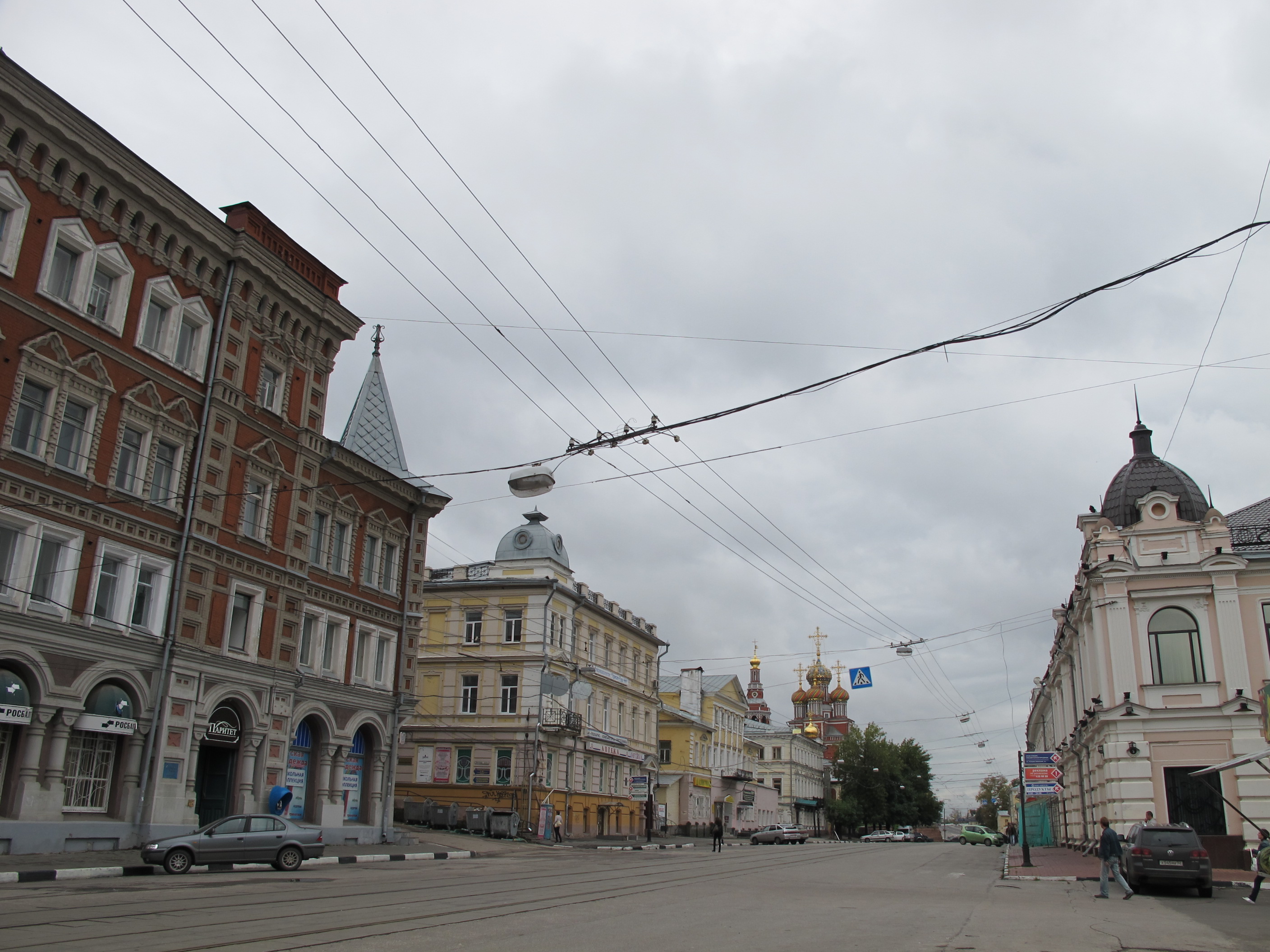
Rozhdestvenskaya Street
Maxim Gorky set his play The Lower Depths in a flophouse at Number 2 Rozhdestvenskaya Street. The building still stands, a reminder that this street has always been a place where wealth and hardship existed side by side. Running through the Lower Posad below the Kremlin, Rozhdestvenskaya is Nizhny Novgorod's most concentrated stretch of pre-revolutionary stone architecture -- 35 officially listed monuments, not a single wooden house among them, the oldest dating to the mid-18th century. It has been renamed four times, seen its churches demolished and its facades crumble, and still managed to survive as one of the most intact historical streetscapes in central Russia.
Names Written in Stone and Fire
Settlement on this ground dates to the founding of Nizhny Novgorod itself. By the 14th century, the area lay within the Lesser Ostrog, the wooden fortifications that ringed the lower town. In the 17th century, during a period of economic growth, the street took its first recorded name -- Kosmodemyanskaya, after the Church of Cosmas and Damian that stood at the center of the Lower Posad. When a stone Nativity church was built in 1653, the street became Rozhdestvenskaya. Then, in 1719, the merchant Grigory Stroganov constructed another stone church beside the first. This one survived the centuries. It carries two names: Stroganov, for the family that paid for it, and Nativity, for the street where it stands. The Stroganov Church became the street's defining landmark, its ornate facade a specimen of what art historians would later call Stroganov Baroque.
Funiculars and the First Tramway
The All-Russia Exhibition of 1896 transformed Rozhdestvenskaya Street. Funiculars were built near Unity Square and the Pokhvalinsky descent, linking the lower town to the heights above. A power station appeared opposite the Oksky Pontoon Bridge, giving the city its first electricity. On June 21, 1896, Nizhny Novgorod opened its tramway -- a 3.5-verst line (about 3.7 kilometers) running from Skoba at Unity Square to the bridge, connecting both funiculars along the way. The Blinov brothers, local merchants, built the Blinovsky Passage along the street, and a stock exchange went up nearby. In the space of a single exhibition year, a street of churches and merchant houses acquired the infrastructure of a modern city.
Renamed, Demolished, Preserved
After the October Revolution, the Bolsheviks renamed the street Kooperativnaya in 1924 and then, in 1940, Mayakovsky Street -- "Mayakovka" in local slang. The campaign against religion claimed the churches of Cosmas and Damian, St. Nicholas, and the Life-Giving Trinity. The Church of St. John the Baptist survived the early demolitions but lost its domes and bell tower to successive rebuildings. The Stroganov Church was slated for destruction, but its rector, Father Sergiy Veysov, mounted an extraordinary defense. He gathered photographs, historical documents, and delivered lectures at the Soviet Ministry of Culture on the artistic significance of Stroganov Baroque. His campaign worked. The church stood, though during World War II a pharmacy warehouse occupied its nave. The iconostasis was saved. Later, a Museum of Religion and Atheism operated in the building until 1993.
Crumbling Facades and Growing Trees
After the Soviet Union dissolved, the street reclaimed its original name. But the 1990s crisis left it neglected. Advertising banners covered the facades of historic buildings. Plaster and stucco crumbled from aging walls. On the roofs of some buildings, trees took root and grew where gutters had failed and rain collected in the masonry. The street that had once hosted Russia's first tramway looked, in places, like it was being reclaimed by nature. The turnaround came in 2012, when a comprehensive reconstruction began. Workers paved the pedestrian zone with cobblestones, replaced storm sewers, installed period-appropriate lampposts, and restored the building facades. One of the two tram tracks was removed, and trams began running on a single reversible line to Annunciation Square.
A Street That Tells a City's Story
Walking Rozhdestvenskaya today, you pass through layers of the city's entire history. The Bugrov Homeless Shelter at Number 2 -- Gorky's inspiration -- sits at one end. The Bugrov Revenue House, which once held the Volzhsko-Kamsky Bank, anchors the commercial stretch at Number 27. The Stroganov Church's white stone carvings catch the light midway along the street. Of the six temples that once lined this road, only two survived: the Church of St. John the Baptist and the Stroganov Church. The others exist as absences -- empty lots, a modern business center called Myravey where St. Nicholas once stood. The street runs from the Kremlin walls down to the river, a single line connecting fortress to waterfront, medieval fortification to 19th-century commerce. Every stone house that remains is a monument that outlasted fire, revolution, neglect, and the particular indignity of trees growing from its roof.
From the Air
Located at 56.33N, 43.99E in the Lower Posad of Nizhny Novgorod, running roughly parallel to and below the Kremlin bluff toward the Oka River. The Stroganov Church's ornate facade and bell tower are the most identifiable landmark from the air. Recommended viewing altitude: 1,500-3,000 feet. Nearest airport: Nizhny Novgorod Strigino (UWGG), approximately 14 km southwest. The street runs between the Kremlin hill and the river, providing clear geographic orientation.