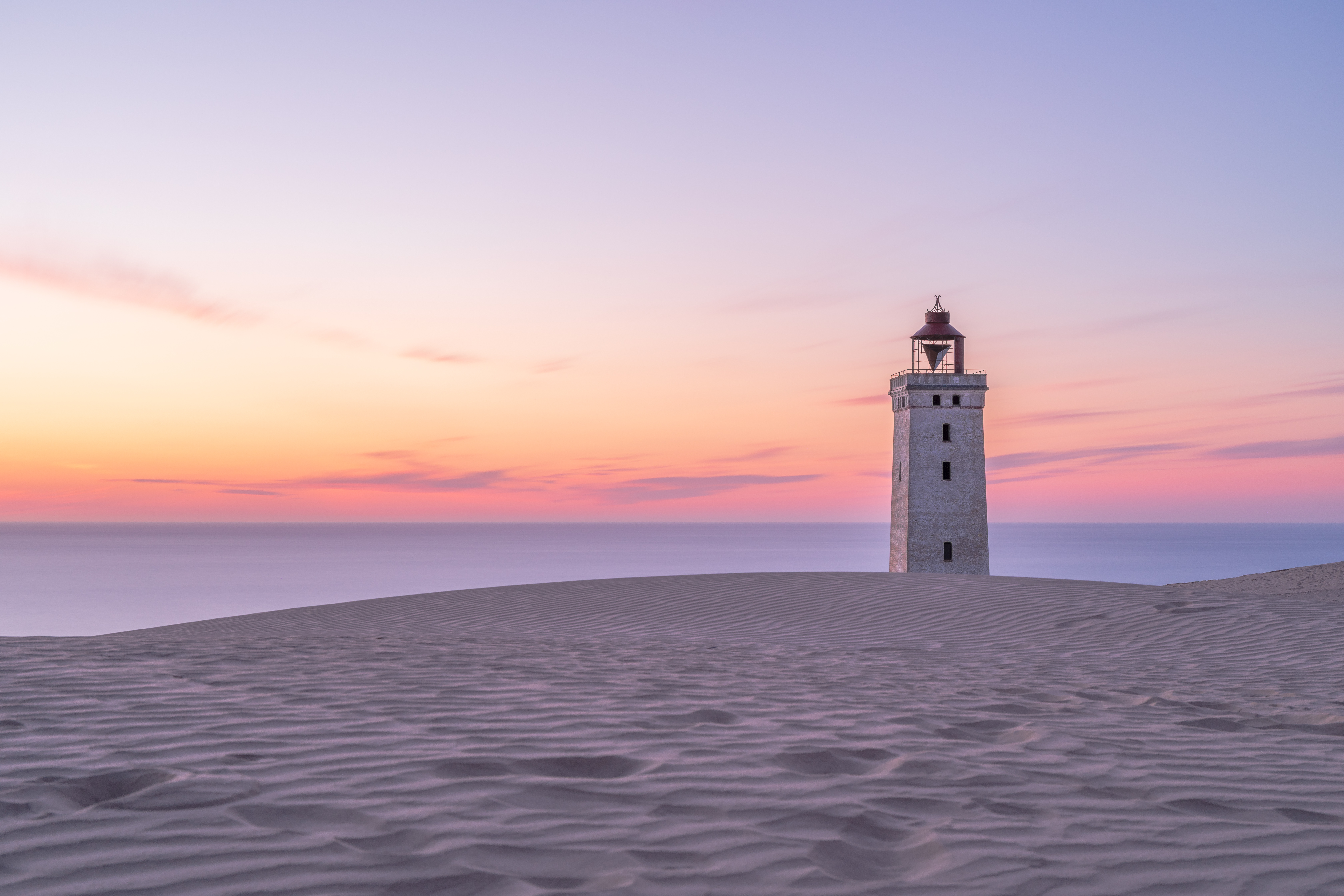
Rubjerg Knude Lighthouse
On 22 October 2019, a 23-meter lighthouse weighing 720 tonnes began to slide. Not into the sea, which had been creeping toward it for over a century, but away from it, inching along specially built rails toward safer ground. The move took the Rubjerg Knude Lighthouse 70 meters inland, buying it perhaps four more decades of existence on a coastline that erodes an average of 1.5 meters every year. It was an extraordinary act of defiance against geography, performed on a structure that geography had been trying to erase since the day it was built.
Light on a Crumbling Edge
Construction began in 1899 on the top of Lonstrup Klint, a cliff rising 60 meters above the North Sea on the northern coast of Jutland. The lighthouse was first lit on 27 December 1900, its beam reaching out across waters that had wrecked ships along this coast for centuries. Until 1908, the light ran on gas produced by a small gasworks on the site. The location was dramatic but precarious from the start. The coastline here is not stable rock but soft clay and sand, constantly reshaped by North Sea storms. The same winds that made a lighthouse necessary here were also the forces that would eventually make it impossible to maintain one.
When the Dunes Came
Shifting sands proved as relentless as the sea. Over the decades, massive dunes migrated across the landscape, burying roads, fences, and eventually the lighthouse's outbuildings. The light ceased operating on 1 August 1968, its beam rendered useless not by technology but by sand piling against the tower. For a time afterward, the buildings found second lives as a museum and coffee shop, but the sand kept coming. By 2002, the dunes had made even these uses impossible, and the site was abandoned. Photographs from different decades tell the story with eerie clarity: the lighthouse standing proud in 1912, half-buried in drifts by the 1990s, its outbuildings reduced to rooflines poking from the sand by the early 2000s. The nearby Marup Church, facing the same coastal erosion, was dismantled in 2008 to prevent it from falling into the sea entirely.
The Move
Engineers had estimated the tower would topple into the North Sea by 2023 if nothing was done. Hjorring Council, with government funding, committed 5 million Danish kroner to a solution that was equal parts engineering and stubbornness. On 14 August 2019, workers began preparing rails beneath the lighthouse's foundation. On 22 October, the 720-tonne structure was lifted onto the rails and moved 70 meters inland. The entire operation was broadcast live on Danish television. Five million kroner translates to roughly 600,000 British pounds, a modest price for saving one of Denmark's most photographed landmarks. The move is expected to secure the lighthouse until approximately 2060, at which point the sea will have caught up again and a new generation will face the same question.
Standing Against the Inevitable
Rubjerg Knude is not a functioning lighthouse. It guides no ships. Its light has been dark for over half a century. What it has become is something arguably more powerful: a monument to impermanence, standing on a cliff that is visibly, measurably disappearing beneath it. Visitors who climb to the site walk through a landscape of bare sand and wind-sculpted dunes, with the North Sea visible below and the lighthouse standing alone against the sky. There is no town nearby, no boardwalk, no commercial district. There is just the tower, the cliff, and the sea that is coming for both of them. CNN once named it one of the world's most mysterious buildings. The mystery is not architectural. It is existential: how long do you fight to preserve something that the earth itself is determined to reclaim?
From the Air
Located at 57.45N, 9.78E on the northern coast of Jutland, Denmark. The lighthouse is prominently visible from the air as a white tower standing on pale sand cliffs above the North Sea. The surrounding landscape of migrating dunes is distinctive and unmistakable. Nearest airport is Aalborg Airport (EKYT), approximately 60 km to the southeast. The fishing village of Lonstrup lies nearby to the south. Best viewed at 2,000-4,000 feet to see the dramatic interplay of lighthouse, dunes, cliff, and sea. The coastline's erosion is visible as a raw, receding edge.