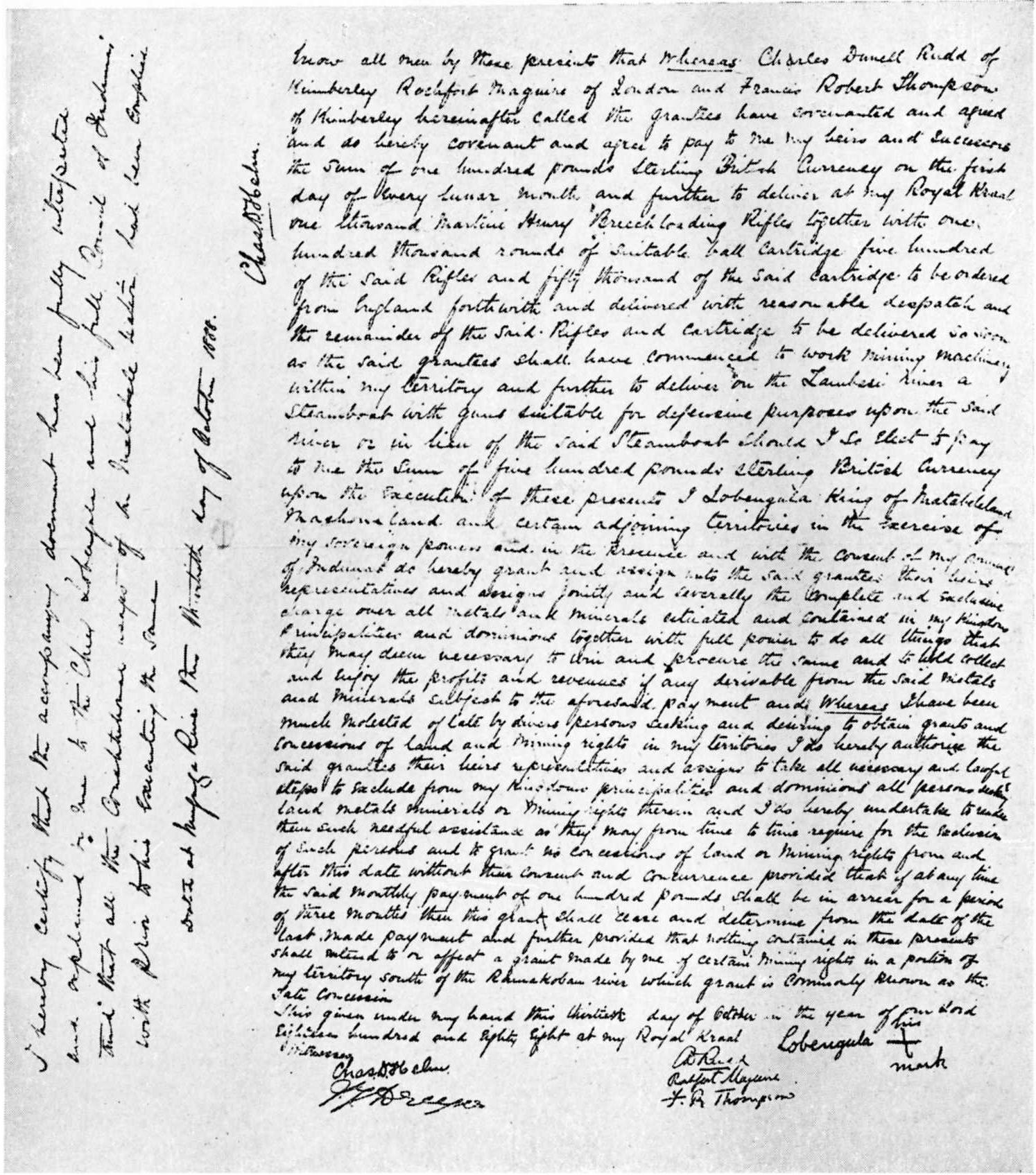
Rudd Concession
The document was brief -- barely a page -- and what it actually said depended entirely on who was reading it. On 30 October 1888, King Lobengula of the Ndebele people affixed his mark to a concession granting exclusive mining rights over Matabeleland, Mashonaland, and adjoining territories to three men acting on behalf of Cecil Rhodes. Charles Rudd, James Rochfort Maguire, and Francis Thompson had spent weeks at Lobengula's royal kraal in Bulawayo, negotiating through translators and competing with rival concession-seekers. What the king believed he had granted and what Rhodes intended to claim were two very different things. The gap between those understandings would cost Lobengula his kingdom and reshape the map of southern Africa.
The Race to Bulawayo
Rhodes was not the only man pursuing Lobengula's mineral rights. Two London financiers, George Cawston and Lord Gifford, had dispatched their own agent, Edward Arthur Maund, to the Ndebele capital. Cawston and Gifford had better connections in Whitehall; Rhodes had the advantage of proximity, operating from the Cape. The competition forced Rhodes to move fast. In February 1888, he arranged a treaty of friendship between Britain and the Ndebele through John Smith Moffat, son of the missionary Robert Moffat, whose relationship with Lobengula's father Mzilikazi gave him rare access to the Ndebele court. The Moffat Treaty committed Lobengula not to enter into any correspondence or treaty with any foreign state without British approval -- a seemingly diplomatic document that was, in practice, a trap. It cleared the field for Rhodes's agents to negotiate without rival European powers intervening.
What the King Signed
The concession that Rudd presented to Lobengula offered specific terms: 1,000 Martini-Henry rifles, 100,000 rounds of ammunition, a steamboat on the Zambezi River, and a monthly payment of 100 pounds. In return, the king would grant the complete and exclusive charge over all metals and minerals in his territories. Charles Helm, a missionary stationed in Bulawayo who served as interpreter, assured Lobengula that the concession was limited to mining and that no more than ten white men would dig at any one time. But the written English text contained no such limitation. It granted the grantees "full power to do all things that they may deem necessary to win and procure" the minerals -- language broad enough to justify almost anything. Lobengula, who could neither read nor write English, relied entirely on what Helm told him the document said.
Buyer's Remorse
Within weeks, Lobengula began to suspect he had been deceived. South African newspaper reports of the concession arrived in Bulawayo in January 1889, and a local white resident named William Tainton translated them for the king -- adding embellishments of his own. He told Lobengula that he had sold his country, that miners could dig anywhere including inside kraals, and that an army could be brought in to depose him. Alarmed, Lobengula summoned Helm to read back the copy of the concession that had remained in Bulawayo. Helm confirmed the translation was accurate but continued to insist the concession was limited in scope. The king was not reassured. He sent two of his most trusted indunas -- Babayane and Mshete -- to London to carry a personal message to Queen Victoria, repudiating the concession and asking for British protection against those who would claim it.
Rhodes Outmaneuvers Everyone
The Ndebele envoys reached London in February 1889, but Rhodes had already been at work neutralizing any threat to his concession. He approached Cawston and Gifford with an offer to merge their interests, proposing an amalgamated company that would unite all competing claims. The London syndicate agreed, and Rhodes gained their political connections in exchange for equity. When Babayane and Mshete met with Lord Knutsford at the Colonial Office, they were advised that Lobengula should work with the concessionaires rather than against them -- advice that effectively endorsed Rhodes's position. On 29 October 1889, almost exactly a year after Lobengula had signed the Rudd Concession, Queen Victoria granted a royal charter to the newly formed British South Africa Company, giving it authority to govern and develop the territory. The concession had achieved its purpose.
The Document's Long Shadow
The Rudd Concession did not create Rhodesia by itself, but it was the legal keystone. Without it, Rhodes could not have obtained the royal charter; without the charter, there would have been no Pioneer Column marching into Mashonaland in 1890. Lobengula continued to protest, sending letters to Queen Victoria and declaring the concession void, but his repudiations carried no weight in London. The promised rifles were delivered; the steamboat never was. By 1893, Company forces had invaded Matabeleland, defeated Lobengula's army, and the king died fleeing north in early 1894. The territory was named Rhodesia in 1895. A single page of English prose, signed by a king who could not read it, had provided the legal architecture for the colonization of a country now called Zimbabwe.
From the Air
The Rudd Concession was signed at Lobengula's royal kraal near present-day Bulawayo, Zimbabwe, roughly 440 km southwest of Harare. The story is geolocated to Harare (17.86°S, 31.03°E) as the eventual capital of the territory the concession opened to colonization. From 5,000-8,000 feet AGL, central Harare's colonial-era grid is visible. Harare International Airport (FVHA) serves the area. Bulawayo (FVBU), closer to the historical events, lies to the southwest across open savanna and farmland.