Rudkhan Castle: Fortress of the Assassins
The Assassins did not choose their castles carelessly. When the Nizari Ismailis rebuilt Rudkhan Castle in 1096, they selected a site that the Sasanian Empire had already proved defensible: twin mountain peaks wrapped in dense forest, 25 kilometers southwest of Fuman in Gilan province. The fortress stretches 1,550 meters along ridgelines at elevations of 670 and 715 meters, its walls threading through trees and over rock outcrops that the forest has been trying to reclaim for centuries. To reach it, you climb through canopy so thick the sunlight arrives filtered and green. The castle emerges from the trees the way its builders intended -- suddenly, and with the unsettling realization that you have been within its sight lines for some time.
Two Castles on Two Peaks
Rudkhan Castle divides into two distinct sections straddling the mountain ridge. The western section, called the Arg, rises two stories high in brick construction -- the commander's stronghold, designed for last-stand defense. The eastern section, the Qorkhaneh, also stands two stories tall but features multiple skylights and openings, built for storage and garrison life. Between them, a natural spring provides fresh water -- the critical resource that made prolonged siege survival possible. The eastern complex contains twelve entrances, a prison, an emergency escape door, a bath, and a water catchment system. The western Arg matches it with twelve entrances of its own, plus a pond, reservoir, cold storage, bath, a royal water basin, and residential quarters. Towers and fortifications ring the entire compound. The builders thought of everything, from drinking water to escape routes.
From Sasanian Stronghold to Assassin Refuge
The original fortress dates to the Sasanian era, roughly between the 3rd and 7th centuries AD. When Arab armies conquered Persia and the Sasanian Empire collapsed, this corner of Gilan became part of the resistance. The region of Tabarestan -- the mountainous strip along the Caspian Sea -- held out against Arab rule longer than most of Iran, and fortresses like Rudkhan were the reason. Centuries later, in 1096, the Nizari Ismailis recognized the same strategic value. They rebuilt and expanded the castle as part of their network of mountain strongholds. The Nizari state, known to the Crusaders and later Western historians as the Order of Assassins, specialized in inaccessible fortresses from which they could project power without holding conventional territory. Rudkhan Castle, buried in forest and perched on twin peaks, fit their doctrine perfectly.
Iron in the Mountain
The geology beneath Rudkhan Castle tells its own story. The site sits within what geologists call the Gasht complex, a zone shaped by two distinct phases of metamorphic transformation. The older phase dates to the Precambrian and Paleozoic eras, marked by intense metamorphism that hardened the underlying rock. The younger phase, from the Mesozoic era, left lighter traces. Geological surveys have identified a high probability of iron reserves in the area. The presence of iron may help explain why the site attracted builders across multiple centuries -- iron meant weapons, tools, and the raw material of fortification. The rock itself provided natural abutments for the castle walls, and the dense forest supplied timber. Rudkhan Castle was not imposed on its landscape. It grew from it.
The Climb Through the Forest
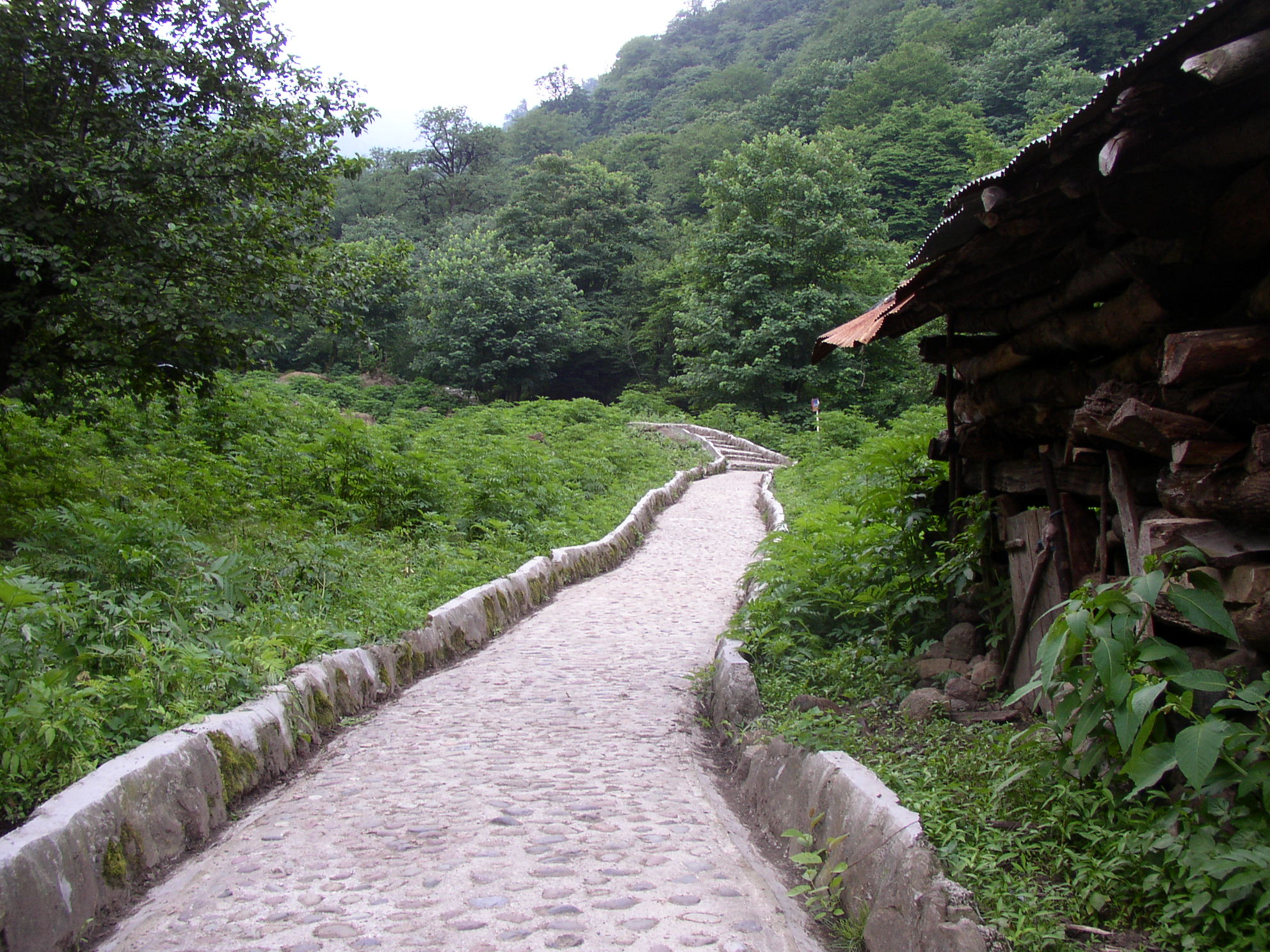
Reaching Rudkhan Castle today requires a hike through one of northern Iran's lushest forest corridors. The Rudkhan Castle River flows from south to north through the surrounding heights, cutting through vegetation so dense it feels subtropical. The trail follows the river upstream, crossing water and climbing steadily. Gilan province receives more rainfall than almost anywhere else in Iran, and the forest reflects it -- towering trees, thick undergrowth, the air heavy with moisture. The castle appears in stages: first a tower through the canopy, then a wall section, then the full scope of the fortification spreading across the ridge. The 2.6-hectare compound rewards the climb with views back down through the forest and across the valleys of Gilan. It is one of the few places in Iran where medieval military architecture and lush Caspian forest exist in the same frame.
From the Air
Located at 37.06°N, 49.24°E in the forested mountains of Gilan province, northern Iran. The castle sits at 670-715 meters elevation on twin peaks, 25 km southwest of Fuman. From altitude, the site is difficult to spot beneath dense forest canopy -- look for the ridgeline running through unbroken green. The nearest major airport is Rasht Sardar-e-Jangal International Airport (OIGG), approximately 40 km to the northeast. The Caspian Sea coastline is visible to the north. The contrast between the lush green of Gilan's forests and the drier terrain to the south is dramatic from the air.